










Aurobindo Pharma Limited Q2 profit rises 32.5% on record revenue
Key highlights
- Aurobindo Pharma reported record Q2 FY27 revenue from operations of ₹10,263 crore, up 23.9% year on year.
- Consolidated Q2 FY27 net profit rose 32.5% year on year to ₹1,124 crore.
- Q2 FY27 EBITDA increased 28.5% to ₹2,156 crore and margin improved to 21.0%.
- Aurobindo Pharma declared an interim dividend of ₹7 per equity share, equal to 700% of face value.
powered by IRIS
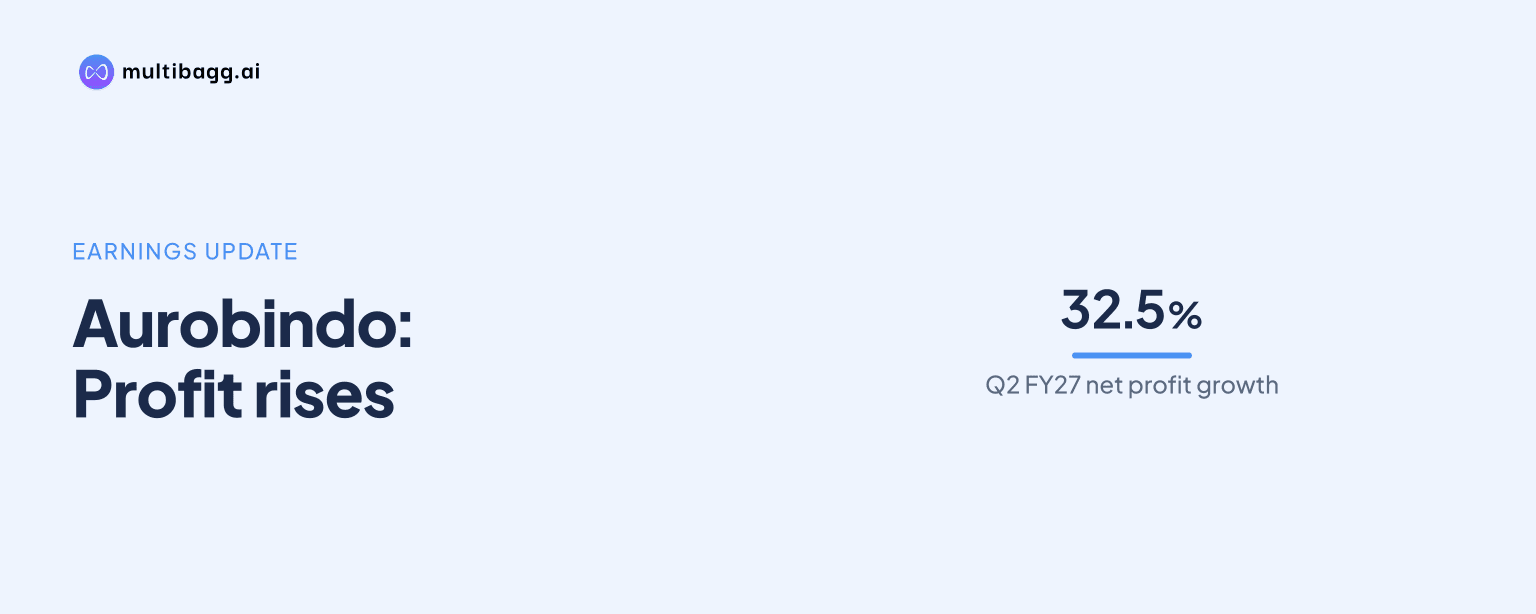
Aurobindo Pharma Limited reported a 32.5% year-on-year increase in consolidated net profit to ₹1,124 crore in Q2 FY27, supported by record revenue from operations of ₹10,263 crore, up 23.9% from a year earlier. The September-quarter result exceeded CNBC-TV18 poll estimates for revenue, profit and operating earnings.
Know Aurobindo Pharma inside out
Results, valuation, peers and who's buying, in one view.
What did Aurobindo Pharma report for Q2 FY27?
Aurobindo Pharma reported its highest-ever quarterly revenue from operations of ₹10,263 crore for the quarter ended September 30, 2026. Revenue rose from ₹8,286 crore in Q2 FY26, reflecting 23.9% year-on-year growth across the company’s businesses.
Consolidated profit after tax rose to ₹1,124 crore from ₹848 crore a year earlier. Reported figures from different disclosures place the profit at ₹1,123.84 crore before rounding. The company’s expenses increased to ₹8,740.9 crore from ₹7,132.03 crore in the corresponding prior-year quarter.
The September-quarter performance also lifted first-half profit. For the half year ended September, Aurobindo Pharma reported net profit of ₹2,155.88 crore, compared with ₹1,672.33 crore in the year-earlier period, a rise of 28.9%.
Which businesses supported Aurobindo Pharma’s quarterly growth?
Aurobindo Pharma’s US formulations business and European operations were major contributors to the quarter’s growth. US formulation sales increased 25% year on year to ₹4,555 crore, while European sales rose 27% to ₹3,161 crore.
Growth Markets revenue increased 16% to ₹1,026 crore, equivalent to $107 million. Formulations revenue, which accounted for most of the company’s sales, rose 24% year on year to ₹9,102 crore. API revenue increased 21% to ₹1,162 crore and represented 11% of total revenue.
The quarter included contributions from Lannett Company LLC, whose acquisition was completed on June 29, 2026. The purchase consideration for Lannett and its subsidiaries was ₹2,321.83 crore, or $245.7 million. The transaction was accounted for under Ind AS 103 and resulted in goodwill of ₹460.27 crore.
Aurobindo Pharma also reported antiretroviral product revenue of ₹359 crore, or $38 million, during the quarter. The available disclosures do not provide a comparable year-on-year figure for this business line.
How did Aurobindo Pharma’s operating margins change?
Aurobindo Pharma’s EBITDA rose faster than revenue, increasing 28.5% year on year to ₹2,156 crore in Q2 FY27. EBITDA was ₹1,678 crore in the year-ago quarter, while the EBITDA margin improved by 75 basis points to 21.0%.
The margin was higher than the CNBC-TV18 poll estimate of 20.6%, and EBITDA was above the ₹2,006 crore poll estimate. The reported operating improvement came alongside a 26.9% increase in gross profit to ₹6,280 crore. Gross margin improved by 149 basis points year on year to 61.2%.
Consolidated earnings per share stood at ₹19.57 on both a basic and diluted basis. The company’s reported net profit and operating earnings were also ahead of the relevant CNBC-TV18 poll estimates, indicating that the quarterly performance exceeded the expectations cited before the results.
Got a follow-up? Ask IRIS
What do the cash flow, R&D and dividend details show?
Aurobindo Pharma generated free cash flow of $146 million during the quarter after accounting for strategic capital expenditure investments. Its net cash position, including investments, stood at $189 million as of September 30, 2026.
Research and development expenditure was ₹376 crore, compared with ₹344 crore in the previous quarter. The sequential increase indicates continued spending on product development, although the disclosures do not provide a year-on-year R&D comparison for Q2 FY27.
The board approved an interim dividend of ₹7 per equity share with a face value of ₹1 each. This equals 700% of face value. The announcement followed the approval of unaudited consolidated and standalone financial results for the quarter and half year ended September 30, 2026.
Why does the Q2 FY27 performance matter for investors?
Aurobindo Pharma’s Q2 FY27 result matters because revenue, EBITDA and profit all grew at rates above 20%, while the EBITDA margin improved to 21.0%. The company also recorded its highest quarterly revenue, with growth reported across the US, Europe, Growth Markets, formulations and API operations.
The Lannett acquisition is relevant to reading the quarter because its contribution was included in Q2 FY27 numbers. Investors assessing underlying trends will therefore need to distinguish organic operating growth from revenue and earnings associated with the acquired business as more comparable periods become available.
The company’s cash generation and reported net cash position provide additional financial context after the acquisition and strategic capital expenditure. The interim dividend gives shareholders a direct distribution of ₹7 per share, while R&D expenditure remains a material allocation for future product development.
Conclusion
Aurobindo Pharma delivered record Q2 FY27 revenue of ₹10,263 crore and a 32.5% increase in consolidated net profit to ₹1,124 crore. Higher sales in US formulations and Europe, growth in formulations and API revenue, and a 75-basis-point improvement in EBITDA margin supported a quarterly result that surpassed the cited CNBC-TV18 estimates.
Investors will watch the company’s subsequent disclosures for the ongoing contribution from Lannett Company LLC, movement in operating margins, R&D spending and free cash flow after strategic capital expenditure. The company has disclosed its September 30, 2026 net cash position of $189 million, but has not provided earnings-call guidance in the supplied material.