










AZAD FY26 working-capital outflow drove operating cash negative
Key highlights
- AZAD used Rs 123.26 crore of net operating cash in FY26 after a Rs 300.30 crore working-capital outflow.
- AZAD’s total inventory days increased from 117 in FY24 to 159 in FY26.
- AZAD’s total receivable days increased from 155 in FY24 to 169 in FY26.
- AZAD reported FY26 standalone revenue of Rs 590.38 crore and profit after tax of Rs 132.16 crore.
powered by IRIS
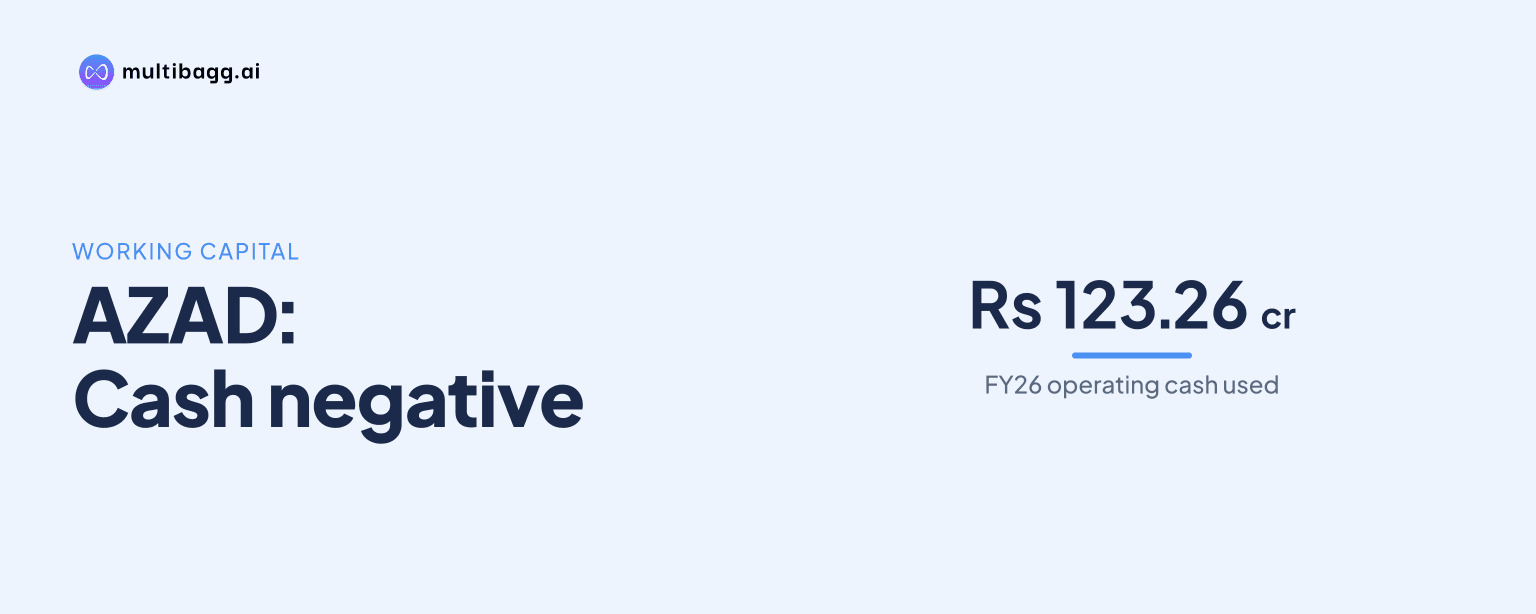
In FY26, AZAD reported Rs 123.26 crore of net cash used in operating activities after working-capital changes absorbed Rs 300.30 crore, exceeding Rs 225.70 crore of operating profit before working-capital changes, even as standalone revenue rose to Rs 590.38 crore and profit after tax reached Rs 132.16 crore.
Know Azad Engineering inside out
Results, valuation, peers and who's buying, in one view.
Why did AZAD’s operating cash flow turn negative in FY26?
AZAD’s FY26 operating cash flow turned negative because its Rs 300.30 crore working-capital outflow exceeded Rs 225.70 crore of operating profit before working-capital changes. Cash generated from operations was consequently negative Rs 74.59 crore, and direct taxes paid of Rs 48.67 crore took net cash used in operating activities to Rs 123.26 crore.
The FY26 result reversed FY25, when AZAD generated Rs 62.89 crore of net operating cash flow. In FY25, operating profit before working-capital changes was Rs 168.35 crore and the working-capital outflow was Rs 87.95 crore. The cash-flow statement also reported negative net operating cash flow of Rs 6.95 crore in FY24 and Rs 10.21 crore in FY23.
How did AZAD’s working-capital days change?
AZAD’s total inventory days rose to 159 in FY26 from 117 in FY24, while total receivable days increased to 169 from 155. The FY26 figures were also above FY25, when inventory days were 130 and receivable days were 158, matching the larger FY26 working-capital cash outflow.
The pattern varied between Aerospace & Def and Energy & others. Aerospace & Def inventory days declined from 246 in FY24 to 154 in FY26, and receivable days fell from 229 to 212. In Energy & others, inventory days increased from 98 to 160 and receivable days rose from 145 to 154 over the same FY24-to-FY26 period.
How did AZAD’s profit growth compare with cash conversion?
AZAD’s earnings rose between FY24 and FY26, while operating cash flow remained negative in both of those years. Standalone revenue increased from Rs 340.77 crore in FY24 to Rs 590.38 crore in FY26, and profit after tax increased from Rs 58.58 crore to Rs 132.16 crore. Net cash from operating activities, however, moved from negative Rs 6.95 crore in FY24 to negative Rs 123.26 crore in FY26.
Adjusted earnings before interest, tax, depreciation and amortisation, or adjusted EBITDA, increased to Rs 219.53 crore in FY26 from Rs 164.57 crore in FY25. Adjusted EBITDA margin increased to 37.2% from 36.3%, while profit after tax margin rose to 22.4% from 19.5%. Over the same year, the working-capital outflow increased by Rs 212.35 crore from Rs 87.95 crore.
The presentation reports Rs 217.75 crore of reported EBITDA in FY26 after Rs 1.79 crore of non-recurring expenses, including a provision for credit-impaired trade receivables. In FY25, reported EBITDA was Rs 160.99 crore. AZAD defines adjusted EBITDA through additions for specified non-recurring items, including the provision for credit-impaired trade receivables.
Got a follow-up? Ask IRIS
What balance-sheet movements accompanied AZAD’s FY26 cash outflow?
AZAD’s standalone inventory balance rose to Rs 326.63 crore at Mar-26 from Rs 188.48 crore at Mar-25, while trade receivables increased to Rs 309.24 crore from Rs 221.58 crore. Other current assets also rose to Rs 155.30 crore from Rs 80.98 crore, movements that occurred alongside the Rs 300.30 crore FY26 working-capital outflow.
Current liabilities increased as well, but their components moved differently. Current borrowings rose to Rs 173.24 crore at Mar-26 from Rs 70.44 crore at Mar-25, while dues to creditors other than micro, small and medium enterprises, or MSMEs, increased to Rs 68.33 crore from Rs 48.98 crore. Dues to MSMEs declined to Rs 18.01 crore from Rs 29.98 crore.
Financing activities provided Rs 176.58 crore in FY26, compared with Rs 872.56 crore in FY25, while investing activities used Rs 70.11 crore after using Rs 923.26 crore in FY25. Cash and cash equivalents ended Mar-26 at Rs 23.58 crore, down from Rs 40.37 crore at Mar-25, and bank balances other than cash and cash equivalents fell to Rs 160.00 crore from Rs 655.54 crore.
How did AZAD’s capital base and borrowing position change?
AZAD’s standalone property, plant and equipment increased to Rs 744.77 crore at Mar-26 from Rs 401.02 crore at Mar-25, while capital work-in-progress rose to Rs 256.68 crore from Rs 79.78 crore. Total assets reached Rs 2,195.13 crore at Mar-26, compared with Rs 1,854.53 crore a year earlier.
The expansion in assets coincided with higher borrowings. Non-current borrowings rose to Rs 278.34 crore at Mar-26 from Rs 167.90 crore at Mar-25, and current borrowings increased to Rs 173.24 crore from Rs 70.44 crore. The presentation reports net debt to equity of 0.17 times in FY26, after describing FY24 and FY25 as net cash positions.
Return on capital employed, or ROCE, was 9.2% in FY26, compared with 11.3% in FY25 and 18.8% in FY24. Adjusted ROCE was 15.3% in FY26, versus 20.7% in FY25, as property, plant and equipment and capital work-in-progress both increased at Mar-26.
Conclusion
AZAD’s standalone accounts show that profit growth did not translate consistently into operating cash generation between FY23 and FY26. Revenue increased from Rs 340.77 crore in FY24 to Rs 590.38 crore in FY26, while profit after tax rose from Rs 58.58 crore to Rs 132.16 crore; however, higher total inventory and receivable days coincided with negative operating cash flow in FY23, FY24 and FY26.
The next developments to watch are management’s disclosed plans to expand wallet share with existing clients, serve new clients, add higher-value products and use automation, lean manufacturing and capacity utilisation measures. AZAD has also disclosed a memorandum of understanding for Saudi Arabia expansion and plans involving large components and Advanced Turbo Gas Generator manufacture, assembly and integration; future working-capital days and cash-flow statements will show how those plans affect cash conversion.