










Baheti Recycling Industries Reported FY26 PAT of Rs 27.06 Crore
Key highlights
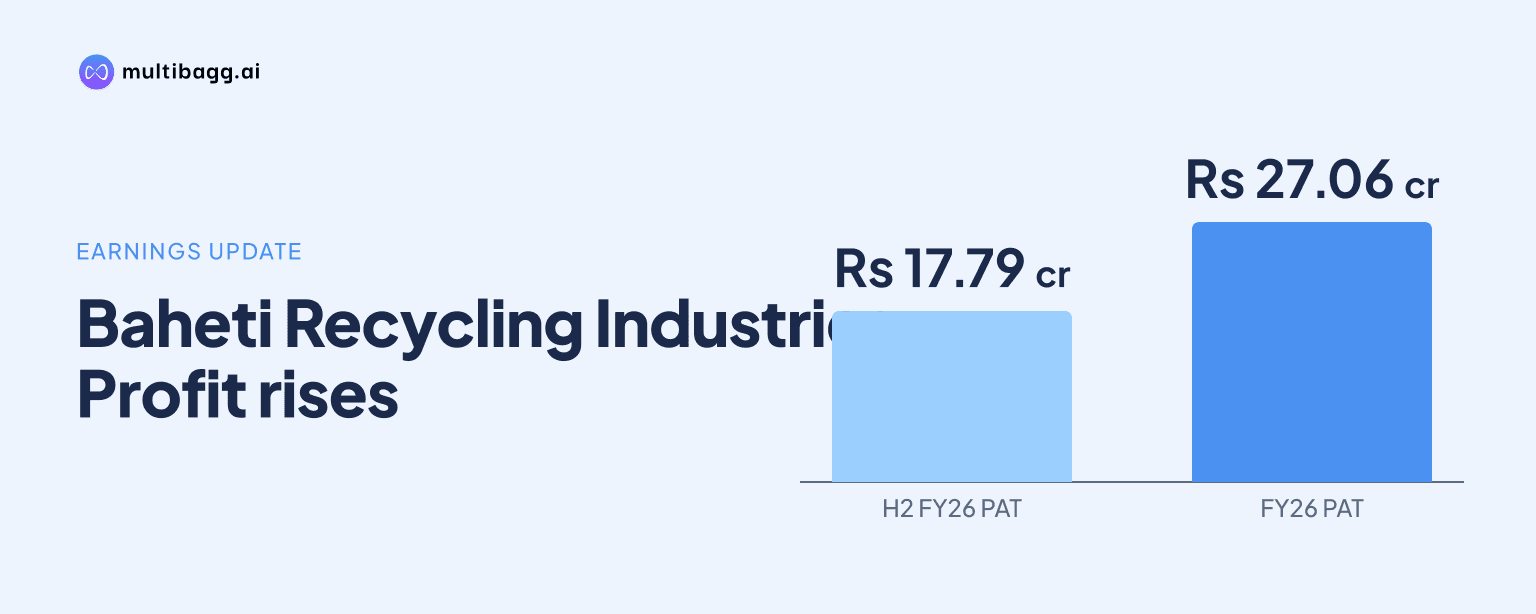
- Baheti Recycling Industries reported FY26 PAT of Rs 27.06 crore, up 50.25% year on year.
- The company reported H2 FY26 revenue of Rs 409.72 crore and PAT of Rs 17.79 crore.
- Baheti Recycling Industries disclosed a Q1 FY27 order book of more than Rs 175 crore.
- The company plans to increase total smelting capacity to 38,000 MT through electric-furnace upgrades.
powered by IRIS
Baheti Recycling Industries Limited reported FY26 profit after tax of Rs 27.06 crore, while its investor-presentation summary showed a Q1 FY27 order book of more than Rs 175 crore. The aluminium recycler also outlined furnace upgrades and a wire-rod expansion plan, although two different FY26 revenue figures appeared in the supplied presentation summary.
Know Baheti Recycling Industries inside out
Results, valuation, peers and who's buying, in one view.
What did Baheti Recycling Industries report for FY26?
Baheti Recycling Industries Limited reported FY26 PAT of Rs 27.06 crore, up 50.25% year on year according to the investor-presentation summary. EBITDA was reported at Rs 60.97 crore. The summary also stated that the company surpassed its revenue guidance by 12% and PAT guidance by more than 15%, without disclosing the underlying guidance figures.
The supplied information contains two FY26 revenue figures. One part of the summary lists revenue of Rs 714.86 crore, while another profit-and-loss summary lists revenue of Rs 724.85 crore, with year-on-year growth of 38.25%. The company reported H2 FY26 revenue of Rs 409.72 crore, up 53.38% year on year, and H2 FY26 PAT of Rs 17.79 crore, up 61.87% year on year. Investors should note this revenue inconsistency when comparing the presentation data with future audited financial disclosures.
What was disclosed in the latest investor presentation?
The company informed the exchange about an investor presentation on November 2. The available company filings show that investor presentations have been a recurring disclosure, including presentations dated April 29, May 1, and earlier FY25 updates. Such disclosures provide investors with management-reported financial, capacity and business-planning information, but are not a substitute for statutory financial statements.
The investor-presentation material describes the company as an aluminium recycling business incorporated in 1994. It processes aluminium-based metal scrap and manufactures aluminium alloys in ingot form, along with aluminium de-oxidation alloys in cubes, ingots, shots and notch bars. The company is listed on the NSE under the symbol BAHETI.
The presentation also included a disclaimer that its contents were prepared for information purposes and did not constitute an offer, recommendation or invitation to buy or subscribe to securities. No earnings-call transcript was reported for the earlier quarter referenced in the supplied data, meaning the disclosed operating figures were drawn from the investor presentation rather than management commentary during a call.
How is Baheti Recycling Industries expanding capacity?
Baheti Recycling Industries plans to replace pit furnaces with electric furnaces, a move that the presentation said would raise total smelting capacity to 38,000 MT. It also stated that five more furnaces were planned during FY27. The reported capacity utilisation rate for FY26 was 60.46%, which provides context for the stated expansion programme.
The company also outlined a wire-rod division plan. Phase 1 is expected to involve investment of Rs 20 crore to Rs 25 crore in FY27 for 12,500 MT of capacity, with a targeted annual revenue range of Rs 200 crore to Rs 250 crore. A proposed Phase 2 with 25,000 MT capacity could target annual revenue of Rs 500 crore, according to the presentation. These are company targets rather than reported revenue.
Earlier information showed installed capacity rising to 29,160 MTPA in FY24 from 16,800 MTPA in FY23 and 12,000 MTPA previously. The FY24 balance sheet also reported work-in-progress assets of Rs 7.65 crore, indicating capital expenditure was under way. The later 38,000 MT smelting-capacity reference therefore represents a further planned enhancement rather than a historical operating figure.
Got a follow-up? Ask IRIS
What do the figures show about the company’s earlier margins?
Earlier disclosed H2 FY24 figures showed revenue of Rs 222.61 crore, compared with Rs 199.70 crore in H2 FY23. Despite the revenue increase, EBITDA declined to Rs 12.63 crore from Rs 22.28 crore. The EBITDA margin fell to 5.67% from 11.16%, a decline of 548.4 basis points.
Operating profitability showed a similar movement. The reported EBIT margin for H2 FY24 was 5.42%, down from 11.03% in H2 FY23, a reduction of 560.4 basis points. These figures show that revenue growth and margin performance did not move together during that period, an important consideration when assessing later profit growth and capacity plans.
For investors, the FY26 PAT growth and the stated order book provide evidence of higher reported business activity. However, the supplied material does not disclose a share-price reaction, customer concentration, order-book execution schedule, or the funding mix for the full expansion programme. It does state that Rs 7.48 crore was raised to maintain working capital, highlighting the relevance of liquidity as operations and capacity expand.
Why do the FY26 disclosures matter to investors?
The FY26 presentation combines reported profit data with forward-looking operational targets. The Rs 27.06 crore PAT, H2 FY26 revenue and the order book above Rs 175 crore are reported presentation metrics. By contrast, the wire-rod revenue ranges and Phase 2 potential are targets that depend on execution of planned capital expenditure, capacity commissioning and demand conditions.
The difference between the two cited FY26 revenue figures requires attention. Investors comparing annual growth, margins or valuation measures should wait for a reconciled figure in the company’s statutory results, annual report or a subsequent exchange filing. The absence of a reported market-price movement in the supplied material means no conclusion can be drawn here about the immediate stock-market response to the presentation.
The company’s business is linked to aluminium scrap processing and alloy manufacturing, where plant utilisation, raw-material availability, working capital and operating margins can influence reported performance. The planned shift toward electric furnaces and the proposed wire-rod division indicate that the company is seeking to increase its manufacturing capability, but the supplied disclosures do not give commissioning dates beyond FY27 planning references.
Conclusion
Baheti Recycling Industries reported FY26 PAT of Rs 27.06 crore and H2 FY26 PAT of Rs 17.79 crore, alongside an order book of more than Rs 175 crore for Q1 FY27. The figures point to reported profit growth and continuing investment plans, while the conflicting FY26 revenue numbers mean the annual revenue base should be checked against future formal financial disclosures.
The next disclosures to watch are details of the FY27 furnace additions, spending on the 12,500 MT wire-rod Phase 1 project, utilisation trends and any reconciliation of FY26 revenue. Investors can also monitor whether subsequent filings provide clarity on order-book conversion, working-capital requirements and the progress of the planned capacity increase to 38,000 MT.