










VMS TMT Commissions Billet Plant and 12 MW Solar Capacity
Key highlights
- VMS TMT operationalised 12 MW of its planned 15 MW captive solar plant in Q1 FY27.
- VMS TMT commissioned its billet manufacturing facility in Q1 FY27.
- TMT capacity utilisation reached 90% of peak installed capacity in Q1 FY27.
- VMS TMT has annual capacities of 2,00,000 tonnes for TMT bars and 2,16,000 tonnes for billets.
powered by IRIS
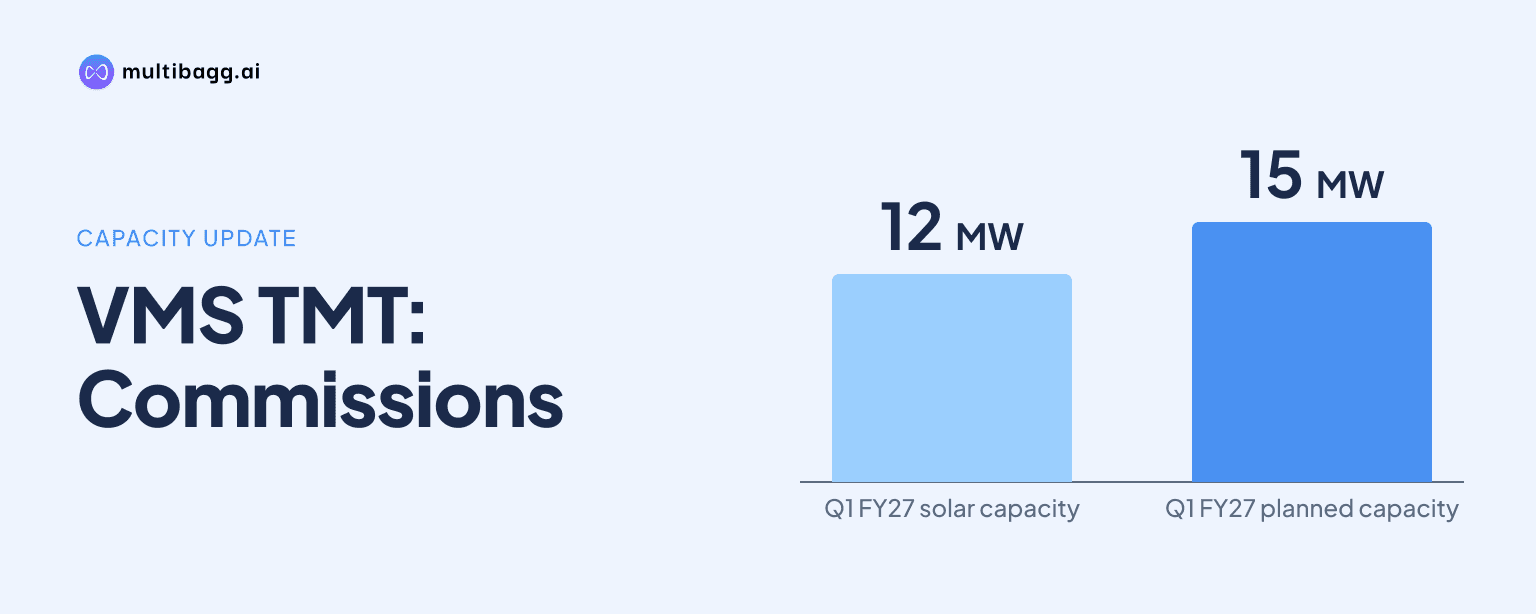
VMS TMT Limited commissioned its billet manufacturing facility and operationalised 12 MW of its planned 15 MW captive solar plant in Q1 FY27, strengthening the Ahmedabad-based steelmaker's integrated production setup and captive energy infrastructure.
Know VMS TMT inside out
Results, valuation, peers and who's buying, in one view.
What did VMS TMT announce in Q1 FY27?
VMS TMT announced that it had commissioned its billet manufacturing facility and operationalised 12 MW of a planned 15 MW captive solar plant during Q1 FY27. The update was disclosed on 20 August 2026 and described as part of the company's strategic progress during the quarter.
The billet facility is important to VMS TMT's production model because billets are an intermediate steel product used to manufacture thermo mechanically treated, or TMT, reinforcement bars. The company produces TMT bars at Bhayla Village in Ahmedabad, Gujarat, and its stated product range also includes billets, binding wire, scrap and other products.
The company also announced a proposed amalgamation with Aditya Ultra Steel Limited. VMS TMT said the proposal was intended to enhance market presence and capacity. The provided update does not disclose the transaction terms, a completion date, or financial details of the proposed amalgamation.
How does the billet facility fit VMS TMT's manufacturing model?
VMS TMT operates an integrated steelmaking route that converts scrap into finished reinforcement bars at one location. Its plant uses a 30-ton induction furnace, a continuous casting machine and a rolling mill, allowing the company to melt scrap, cast billets and roll them into branded TMT bars.
The company has described two production routes. In the primary integrated route, molten steel from the induction furnace is continuously cast and hot-charged into the rolling mill. In the secondary route, billets are reheated before being rolled. This structure gives the facility flexibility in processing billets into TMT bars.
According to the company information provided, producing billets internally removes an intermediate step that had previously cost roughly ₹1,500 per tonne. The commissioning of the billet manufacturing facility therefore aligns with VMS TMT's stated aim of managing the production chain from scrap through to finished bar.
The company's TMT capacity is 2,00,000 tonnes annually, while billet capacity is 2,16,000 tonnes. These capacities indicate that billets remain a central part of its manufacturing operations rather than a separate ancillary activity.
What do the utilisation figures show about plant operations?
VMS TMT stated in its Q1 FY27 call transcript that TMT capacity utilisation was at 90% of peak installed capacity and overall facility utilisation was around 80%. This marked an improvement from the 70-75% utilisation level referenced in the Q4 FY26 call transcript dated 8 June 2026.
The improvement matters because utilisation levels show how intensively a manufacturing facility is being used relative to its installed capability. Higher utilisation can indicate that existing capacity is being employed more fully, although the company has not provided production volumes, sales volumes or quarterly financial results in the supplied material.
For VMS TMT, the figure is particularly relevant because its operations include melting, casting and rolling. The integrated route links raw-material processing with the manufacture of TMT bars, while the secondary route provides an alternative process for billets that require reheating.
The company is classified in the iron and steel products segment and has been active since its incorporation in 2013. Its location near Ahmedabad places its manufacturing base in Gujarat, where it serves the construction-linked TMT bar market from its Bhayla Village facility.
Got a follow-up? Ask IRIS
Why does captive solar capacity matter for VMS TMT?
VMS TMT operationalised 12 MW of its 15 MW captive solar plant in Q1 FY27. The disclosed development adds an internal power-generation asset alongside its induction furnace, casting equipment and rolling mill operations.
The company has not quantified the solar plant's expected electricity generation, cost savings, funding or effect on profitability in the provided material. As a result, the available information supports the conclusion that the project has been partly operationalised, but not a calculation of its financial impact.
The remaining difference between the planned and operationalised capacity is 3 MW. No commissioning schedule for that balance was included in the source material. Investors will need further company disclosures to assess the final completion status and operating contribution of the full 15 MW project.
VMS TMT's latest cited corporate update was published on 9 October 2026. The company has also announced a board meeting on 3 November 2026 to consider financial results, according to a BSE filing. That meeting is the next disclosed event that may provide additional operating or financial information.
How should investors assess the latest operational update?
The Q1 FY27 update gives investors evidence of progress in three disclosed areas: billet manufacturing, captive solar capacity and plant utilisation. The commissioning of the billet facility is consistent with VMS TMT's established integrated production strategy, while 12 MW of operational solar capacity expands the infrastructure supporting its manufacturing base.
At the same time, the supplied information does not provide revenue, profit, cash flow, debt, share-price movement or production-volume data. Those omissions limit any assessment of how the operational additions have affected financial performance. The proposed amalgamation with Aditya Ultra Steel Limited also remains subject to further disclosures on structure and timing.
For customers and construction-linked markets, VMS TMT's integrated setup is designed to manufacture billets and TMT bars from scrap at its Gujarat facility. For shareholders, the relevant disclosed indicators are the 90% TMT utilisation level, around 80% overall facility utilisation, the 12 MW solar commissioning and the upcoming results board meeting.
Conclusion
VMS TMT's Q1 FY27 update shows that the company has commissioned its billet manufacturing facility and brought 12 MW of a 15 MW captive solar project into operation. Together with TMT utilisation at 90% of peak installed capacity, the disclosures point to fuller use of the company's integrated steelmaking and rolling infrastructure.
The next item to watch is the board meeting scheduled for 3 November 2026 to consider financial results. Further disclosures may also clarify the commissioning status of the remaining 3 MW solar capacity and the terms and timeline of the proposed amalgamation with Aditya Ultra Steel Limited.