








Bajaj Auto Limited Q2 FY27 Revenue Crosses ₹20,003 Crore
Key highlights
- Bajaj Auto reported Q2 FY27 standalone revenue of ₹20,003.43 crore, up 34.1% year-on-year.
- Standalone EBITDA rose 37% to a record ₹4,172 crore in Q2 FY27.
- Standalone profit after tax increased 35% to ₹3,353.76 crore.
- Export billings grew 41% to 778,528 units, while total vehicle sales rose 20% to 1,548,884 units.
powered by IRIS
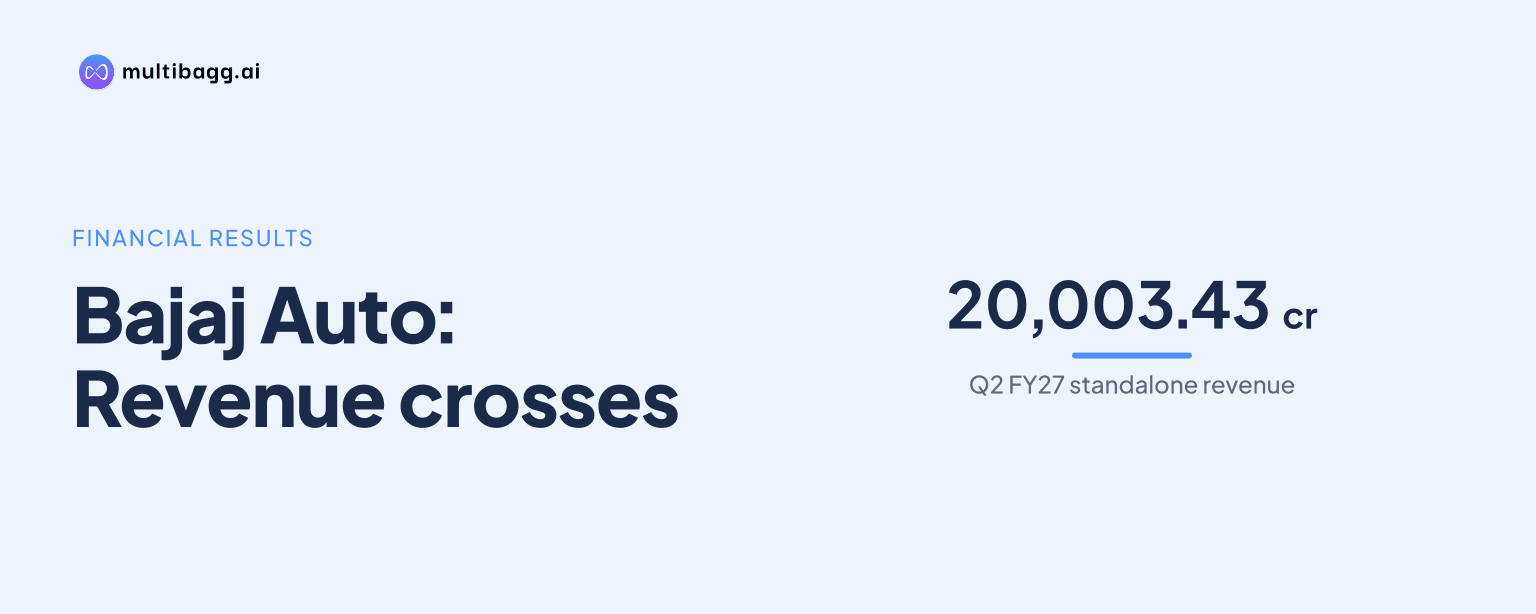
Bajaj Auto Limited reported record standalone revenue of ₹20,003.43 crore in Q2 FY27, up 34.1% year-on-year, while profit after tax rose 35% to ₹3,353.76 crore for the quarter ended September 30, 2026. The result matters because higher exports, vehicle volumes and electric-vehicle profitability supported broad-based financial growth despite input-cost and supply pressures.
Know Bajaj Auto inside out
Results, valuation, peers and who's buying, in one view.
What did Bajaj Auto report in Q2 FY27?
Bajaj Auto reported its highest-ever quarterly volumes, revenue, EBITDA, profit after tax and free cash flow in the July-September 2026 quarter. Standalone revenue from operations rose from ₹14,922.05 crore a year earlier to ₹20,003.43 crore. EBITDA increased 37% year-on-year to ₹4,172 crore, crossing the ₹4,000 crore quarterly mark for the first time.
Standalone profit before tax was ₹4,457.49 crore, while profit after tax reached ₹3,353.76 crore, compared with ₹2,484 crore in the corresponding quarter of FY26. The company announced the results on October 27, 2026. Management said the performance built on the record achieved in the preceding quarter.
The first-half figures also reflected the momentum. Standalone revenue from operations for H1 FY27 was ₹37,247.15 crore, compared with ₹27,506.50 crore in H1 FY26. H1 profit after tax rose to ₹6,336.60 crore from ₹4,575.72 crore a year earlier.
How did vehicle sales and exports drive the quarter?
Bajaj Auto sold 1,548,884 vehicles during Q2 FY27, up 20% from 1,294,120 units a year earlier. Total volumes exceeded 15 lakh units during the quarter. Two-wheeler sales grew 20% to 1,283,961 units, while commercial-vehicle volumes increased 17% to 264,923 units.
Exports were the principal volume-growth driver. Export billings rose 41% year-on-year to 778,528 units, including 676,545 two-wheelers, which grew 43.21%. Management attributed export momentum to market-share gains in Africa and Latin America, where the business recorded its highest-ever quarterly export volume of about 780,000 units.
Domestic sales rose 4% to 770,356 units. Domestic two-wheeler sales increased 2% to 607,416 units, while domestic commercial-vehicle sales grew 13% to 162,940 units. The figures show that export growth materially outpaced domestic two-wheeler expansion during the period.
Got a follow-up? Ask IRIS
Which businesses supported Bajaj Auto's growth?
Bajaj Auto said growth was spread across powertrains, markets and vehicle categories. Its electric-vehicle operations, covering Chetak electric scooters and electric three-wheelers, became margin accretive at the corporate level. Management said Chetak recorded double-digit EBITDA margins, indicating that the EV business contributed positively to profitability rather than only adding volume.
The Pro-Biking business, comprising KTM and Triumph products, also continued to grow. The company reported its highest-ever H1 sales in this segment, supported by product launches and an expanding exclusive-showroom network. No segment-level volume or revenue figures were disclosed in the provided results material.
The stronger mix of exports, commercial vehicles, premium motorcycles and electric vehicles coincided with the increase in EBITDA to ₹4,172 crore. However, Bajaj Auto also flagged persistent input-cost inflation and supply constraints, which remain relevant to the operating environment even as the company delivered record financial metrics.
What does the Q2 FY27 performance mean for investors?
The quarter demonstrates that Bajaj Auto's revenue and profit growth were supported by both volume expansion and export-led demand. Revenue growth of 34.1% exceeded total vehicle-volume growth of 20%, while EBITDA increased 37%. The reported figures indicate that the company generated higher revenue and operating profit alongside expanding sales.
For investors, exports are a significant factor to track because 778,528 export units slightly exceeded domestic sales of 770,356 units in Q2 FY27. The recovery and market-share gains cited in Africa and Latin America therefore had a material role in the quarterly outcome. Domestic two-wheeler growth, at 2%, was more modest than export growth.
The EV operation turning margin accretive is another operational development disclosed by management. At the same time, the company identified input-cost inflation and supply availability as constraints. The results do not quantify the potential financial effect of those pressures, so their impact on future margins cannot be determined from the disclosed information.
Conclusion
Bajaj Auto's Q2 FY27 results set new quarterly records across revenue, EBITDA, profit after tax, free cash flow and vehicle volumes. Standalone revenue crossed ₹20,003 crore and profit after tax crossed ₹3,353 crore, with exports, commercial vehicles, electric vehicles and the Pro-Biking portfolio contributing to the broad-based performance.
The next areas to watch are the pace of export demand in Africa and Latin America, domestic two-wheeler volumes, and the effect of input-cost inflation and supply constraints on operations. Management's comments on Chetak's double-digit EBITDA margin and the continued expansion of the exclusive Pro-Biking showroom network will also remain relevant in assessing business execution.