










Balaxi Jadcherla plant gains WHO-GMP, serves two markets
Key highlights
- Balaxi disclosed WHO-GMP certification from CDSCO for its Jadcherla formulation facility on 12 November 2026.
- Jadcherla has 34 approved products, up by 3 from the initial 31 manufacturing product permissions.
- The Jadcherla facility has successfully manufactured 22 different products so far.
- Commercial production is initially catering to Angola and the Dominican Republic.
powered by IRIS
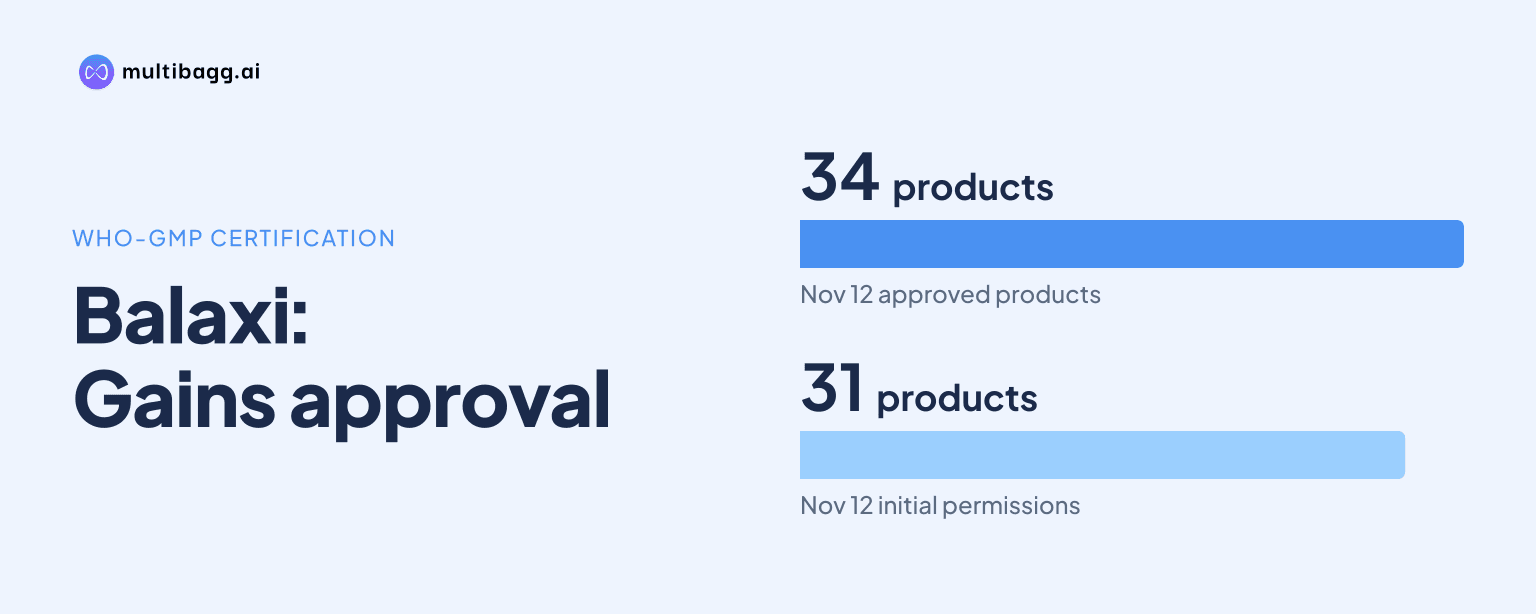
Balaxi Pharmaceuticals Limited has received WHO-GMP certification for its Jadcherla formulation facility and is progressively scaling commercial production for Angola and the Dominican Republic, with 34 products approved and 22 different products manufactured as of the board update on 12 November 2026.
Know Balaxi Pharmaceuticals inside out
Results, valuation, peers and who's buying, in one view.
Has the Jadcherla plant received WHO-GMP certification?
Yes. Balaxi received World Health Organization Good Manufacturing Practices, or WHO-GMP, certification from the Central Drugs Standard Control Organisation, or CDSCO, for its pharmaceutical formulation manufacturing facility at Jadcherla, Hyderabad. The company disclosed the certification in its board-meeting outcome dated 12 November 2026.
Balaxi said the certification establishes that the Jadcherla facility complies with WHO-GMP standards. The company described the certification as strengthening its manufacturing credentials and enhancing its capability to address domestic and international market opportunities through the formulation facility.
The 12 November 2026 update identifies a specific regulatory milestone rather than a production-volume target. Balaxi did not disclose the inspection date, certificate validity, facility capacity, dosage forms, customer names or revenue associated with the WHO-GMP certification.
Which markets is the Jadcherla plant initially serving?
Jadcherla is initially catering to Angola and the Dominican Republic as Balaxi progressively scales commercial production. The company named those two markets in its 12 November 2026 board update, but did not disclose shipment volumes, product-wise sales, customer identities or the date of the first commercial dispatch.
Balaxi separately said the WHO-GMP certification enhances its capacity to pursue domestic and international market opportunities. Its confirmed initial commercial focus, however, is limited to Angola and the Dominican Republic, while domestic and other international opportunities were described without naming additional destinations.
The facility is identified in the announcement as a pharmaceutical formulation manufacturing plant at Jadcherla, Hyderabad. Balaxi reported that it had successfully manufactured 22 different products so far, providing the disclosed production base for the initial supply activity in the two named markets.
How many products are approved and manufactured at Jadcherla?
Balaxi has 34 approved products at Jadcherla and has successfully manufactured 22 different products so far. The approved portfolio increased by three products from an initial 31 manufacturing product permissions, according to the company’s 12 November 2026 disclosure.
The change from 31 to 34 permissions is the stated regulatory expansion at the facility. Balaxi said regulatory authorities granted approvals for three additional products, but it did not identify the products by therapeutic category, formulation type, dosage strength or intended market.
The 34 approved products exceed the 22 products manufactured by 12 products. This comparison shows that the approved portfolio is larger than the reported manufactured range as of 12 November 2026, although Balaxi did not say whether the remaining products were awaiting production, demand, further clearances or commercial orders.
Got a follow-up? Ask IRIS
What does Balaxi say about Jadcherla commercial production?
Balaxi said commercial production at Jadcherla is being progressively scaled up rather than operating at a disclosed final level. The company linked the ongoing scale-up to initial catering for Angola and the Dominican Republic, with 22 different products manufactured at the facility so far.
The filing provides two separate measures of operating progress: 22 products successfully manufactured and 34 products approved for manufacturing. The manufactured-product count records executed production, while the product-permission count sets out the regulatory portfolio available for progressive expansion.
Balaxi said the portfolio is expected to expand progressively based on regulatory approvals and market demand. The company also said it would continue pursuing further manufacturing product approvals in line with business requirements and market opportunities, without providing a numerical approvals target or a timetable.
The board noted on 12 November 2026 that the facility was steadily scaling its commercial manufacturing operations. Its assessment connected WHO-GMP certification, 34 approved products and 22 manufactured products with a platform for future growth and expansion, but did not disclose capacity utilisation or output targets.
What should readers watch in the Jadcherla scale-up?
The next disclosed measure to watch is whether Balaxi obtains manufacturing product permissions beyond 34. The company’s stated plan is to pursue further approvals from regulatory authorities, but the 12 November 2026 update gives no target number, expected approval date or product pipeline.
A second measure is the number of products actually manufactured, which stood at 22 against 34 approved products. Future company disclosures could show whether more approved products enter commercial manufacture, though Balaxi has not stated a schedule for closing the 12-product gap.
A third point is whether commercial catering moves beyond Angola and the Dominican Republic. Balaxi referred to domestic and international opportunities after gaining WHO-GMP certification, but the filing confirmed initial production activity only for the two named markets.
Conclusion
Balaxi’s Jadcherla update combines a regulatory certification with early commercial manufacturing progress: the facility has WHO-GMP certification from CDSCO, 34 approved products and 22 products successfully manufactured. Production is initially catering to Angola and the Dominican Republic, distinguishing confirmed supply activity from the wider market opportunities cited by the company.
The next development to watch is Balaxi’s stated plan to pursue further manufacturing product approvals and expand its portfolio progressively according to business requirements and market demand. Subsequent updates may show whether permissions rise above 34, manufacturing extends beyond 22 products, or the initial two-market supply footprint broadens.