










Balkrishna Industries Q2 Revenue Rises 45%, Profit Gains 7%
Key highlights
- Balkrishna Industries reported Q2 FY27 revenue of ₹3,471.74 crore, up 45% year-on-year.
- Q2 FY27 consolidated net profit rose 7% year-on-year to ₹292.62 crore.
- Tyre sales volume increased 30% year-on-year to 91,397 metric tonnes in Q2 FY27.
- BKT targets annual supply of 800,000 Pirelli-branded passenger tyres by 2030.
powered by IRIS
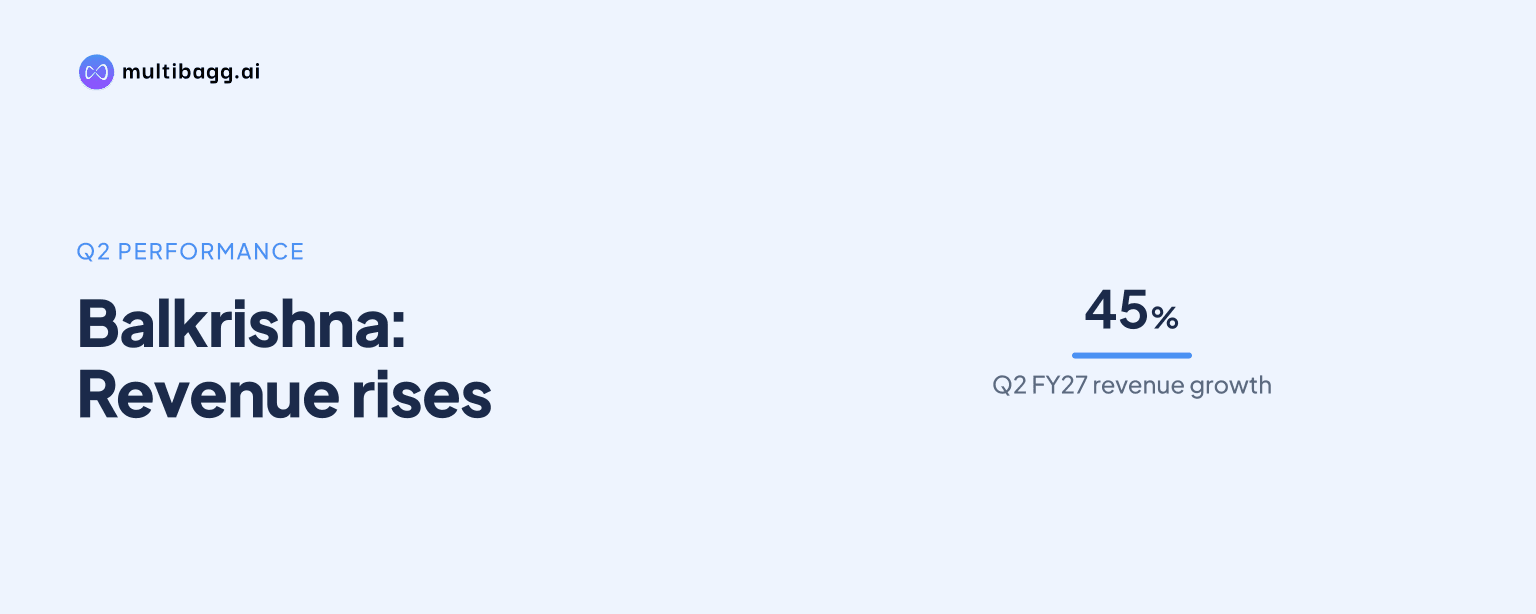
Balkrishna Industries reported Q2 FY27 revenue of ₹3,471.74 crore, up 45% year-on-year, while consolidated net profit increased 7% to ₹292.62 crore for the quarter ended September 30, 2026. The results show strong tyre volume growth, although operating-margin expansion did not keep pace with the rise in revenue.
Know Balkrishna Industries inside out
Results, valuation, peers and who's buying, in one view.
How did Balkrishna Industries perform in Q2 FY27?
Balkrishna Industries, referred to as BKT, recorded a substantial increase in revenue from operations in the September quarter. Revenue reached ₹3,471.74 crore, compared with ₹2,393.45 crore in Q2 FY26. Consolidated net profit rose from ₹273.19 crore a year earlier to ₹292.62 crore, reflecting a slower profit increase than the top-line growth.
Tyre sales volume increased 30% year-on-year to 91,397 metric tonnes. The company attributed the operating momentum to sustained demand and capacity execution in its off-highway tyre business, which remains BKT's established market. The reported volume increase provided the base for the rise in quarterly sales, but higher revenue did not produce a proportionate increase in earnings.
EBITDA grew 23.6% to ₹634 crore from ₹513 crore in the corresponding prior-year quarter. However, the EBITDA margin narrowed to 18.3% from 21.4%. This indicates that operating costs rose faster than operating profit during the period, even as the company delivered higher sales and revenue.
Why did profit growth trail Balkrishna Industries' revenue growth?
BKT's 45% increase in revenue was materially higher than its 7% rise in net profit, while EBITDA growth of 23.6% was also below the rate of sales expansion. The resulting margin decline to 18.3% from 21.4% is the clearest indicator of this difference between revenue and operating-profit growth.
The source material identifies persistent commodity-cost considerations and the importance of pricing and operating execution for margins. BKT had previously indicated that price increases implemented in the first quarter would flow through later, but the reported September-quarter margin remains below the prior-year level. No quantified breakdown of input-cost movements or other margin drivers was provided in the supplied information.
For comparison, BKT's consolidated revenue in Q1 FY27 was reported at ₹3,409 crore, up 24% year-on-year from ₹2,759 crore. The Q2 result therefore extended the company's revenue run rate into the second quarter, while the margin trend remains a key item for investors assessing the quality of that growth.
Got a follow-up? Ask IRIS
What is the Pirelli partnership and passenger tyre plan?
BKT has announced a strategic partnership with Pirelli to enter the passenger car radial tyre segment in India. Under the proposed arrangement, BKT will manufacture Pirelli-branded passenger car radial tyres at its Bhuj facility to Pirelli's specifications, while a separate service agreement is intended to provide Pirelli technical support for testing BKT-branded tyres.
The proposed structure includes a 50:50 joint venture and minimum offtake commitments. BKT has outlined a gradual ramp-up beginning in 2027, with an annual supply target of 800,000 Pirelli-branded tyres by 2030. The broader plan refers to a new passenger-car tyre plant targeted by 2027, alongside the manufacturing arrangement at Bhuj.
Management has identified India's premium passenger tyre market as the initial focus. The supplied material places annual growth for the Indian passenger tyre market at 6% to 7%, with premium tyres growing faster. Pirelli supplies are expected to address a smaller premium segment estimated at about 10% of the market, while most capacity is intended to remain for BKT-branded products.
How does the expansion fit into BKT's FY30 strategy?
The passenger-car tyre initiative is part of BKT's Vision 2030 plan, which commits ₹3,500 crore to the consumer tyre segment and targets ₹23,000 crore of revenue by FY30. Management has also indicated FY27 capital expenditure of ₹3,000 crore, linking investment plans to the proposed entry into new tyre categories.
BKT aims for new tyre categories, including the Pirelli arrangement, to contribute 20% of total revenue. The company has indicated that it seeks to maintain margins in the premium tyre segment around its blended 21% to 23% range. These are management targets rather than reported financial outcomes, and their delivery will depend on the planned capacity ramp-up and market execution.
The move broadens BKT beyond its historical concentration in off-highway tyres. For shareholders, the arrangement adds a new growth initiative but also makes capital deployment, passenger-tyre production progress and margin performance increasingly relevant measures alongside core export and off-highway demand.
What should investors monitor after the Q2 FY27 results?
BKT declared a second interim dividend of ₹4 per equity share of face value ₹2 each for FY27, described as a 200% payout. The estimated cash outflow is ₹77.32 crore. Shareholders registered on November 11, 2026, are eligible, and the company stated that payment will be dispatched within 30 days of the declaration.
The company scheduled its Q2 and H1 FY27 earnings conference call for November 5, 2026, at 10:00 AM IST. The call is expected to provide management's discussion of operating performance and the passenger tyre plan. Investors will have a formal opportunity to assess the reasons for the margin contraction, the pace of capex and the planned Pirelli-related production timeline.
Conclusion
BKT delivered strong Q2 FY27 revenue and volume growth, with revenue from operations rising 45% and tyre sales volume increasing 30%. Yet net profit rose only 7% and EBITDA margin fell 310 basis points, making profitability and cost management as important as the top-line expansion.
The next disclosed event is the November 5, 2026 earnings call, where management can provide further details on the Q2 margin movement, FY27 capital expenditure and the proposed Pirelli partnership. Investors will also watch progress towards passenger tyre production from 2027 and the stated annual 800,000-tyre supply objective for 2030.