










Bang Overseas' operating cash outflow widens to Rs 18.40 crore
Key highlights
- Bang Overseas reported a Rs 18.40 crore standalone operating cash outflow in the half year ended 30 September 2026.
- Standalone trade receivables increased by Rs 19.74 crore to Rs 47.48 crore from 31 March 2026.
- Standalone non-current borrowings rose to Rs 26.10 crore from Rs 10.47 crore in six months.
- Standalone financing cash inflow was Rs 19.05 crore, including Rs 15.63 crore from non-current borrowings.
powered by IRIS
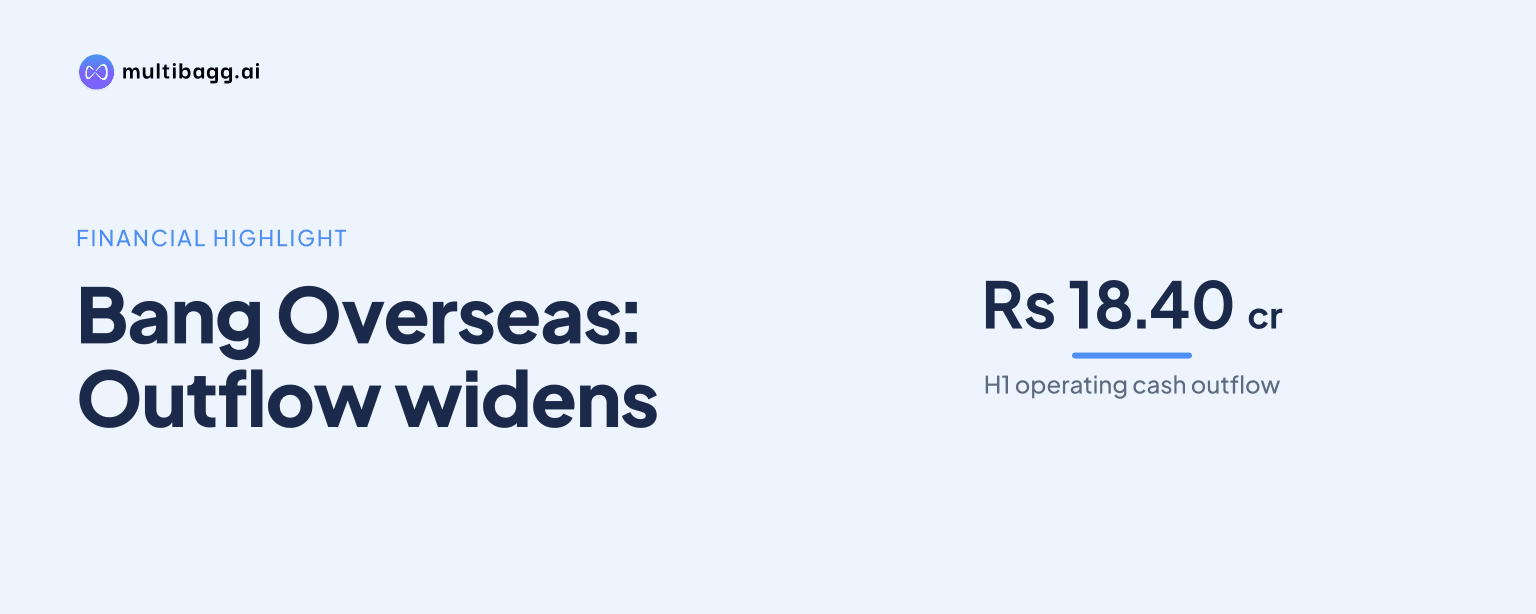
Bang Overseas Limited recorded a Rs 18.40 crore standalone net operating cash outflow for the half year ended 30 September 2026, widening from Rs 5.76 crore a year earlier, as trade receivables increased by Rs 19.74 crore. The company financed the period through Rs 19.05 crore of financing inflows, including Rs 15.63 crore from non-current borrowings.
Know Bang Overseas inside out
Results, valuation, peers and who's buying, in one view.
Why did Bang Overseas report a larger operating cash outflow?
Bang Overseas reported standalone net cash used in operating activities of Rs 18.40 crore for the half year ended 30 September 2026, compared with Rs 5.76 crore used in the half year ended 30 September 2025. Cash generated from operations was also negative Rs 18.40 crore, while direct taxes paid or refunded were nil in both half years.
Operating profit before working-capital changes was broadly unchanged at Rs 2.30 crore in the September 2026 half year, compared with Rs 2.30 crore a year earlier. The subsequent working-capital movements therefore accounted for the change in operating cash flow, with receivables, trade payables and other current liabilities together using cash.
The largest listed cash use was the Rs 19.74 crore increase in standalone trade receivables, against a Rs 2.82 crore increase in the prior-year half. Other current assets used Rs 35.26 lakh and other non-current assets used Rs 11.42 lakh, partly offset by an Rs 11.19 crore cash release from inventories.
The consolidated cash-flow statement showed the same direction. Consolidated net operating cash outflow was Rs 18.65 crore for the half year ended 30 September 2026, against Rs 4.44 crore a year earlier, while consolidated trade receivables increased by Rs 20.21 crore and inventories released Rs 11.30 crore.
How did Bang Overseas' working-capital balances change?
Bang Overseas' standalone trade receivables rose to Rs 47.48 crore at 30 September 2026 from Rs 27.74 crore at 31 March 2026, an increase of Rs 19.74 crore over six months. Standalone inventories fell to Rs 72.65 crore from Rs 83.84 crore, reducing the inventory balance by Rs 11.19 crore.
Other standalone current assets were Rs 35.12 crore at 30 September 2026, compared with Rs 34.79 crore at 31 March 2026. The Rs 32.92 lakh balance-sheet increase differs from the Rs 35.26 lakh cash-flow movement because the cash-flow statement also records changes during the half year.
Trade payables to parties other than micro, small and medium enterprises, or MSME, declined to Rs 39.70 crore from Rs 46.92 crore. The cash-flow statement records a Rs 7.17 crore use of cash from trade payables in the latest half year, compared with an Rs 8.01 crore source of cash in the comparable 2025 period.
Standalone other current liabilities declined to Rs 45.89 lakh at 30 September 2026 from Rs 5.28 crore at 31 March 2026. Their cash-flow effect was an outflow of Rs 4.82 crore, reversing an Rs 6.28 crore inflow from this line in the half year ended 30 September 2025.
Got a follow-up? Ask IRIS
How did Bang Overseas finance the cash deficit?
Bang Overseas generated Rs 19.05 crore of standalone net cash from financing activities in the half year ended 30 September 2026, compared with Rs 3.81 crore a year earlier. This financing inflow covered the Rs 18.40 crore operating cash outflow and the Rs 80.77 lakh investing outflow, although cash and cash equivalents still fell by Rs 16 lakh.
Non-current financial borrowings provided Rs 15.63 crore of cash in the latest half year, compared with Rs 1.58 lakh in the comparable prior-year period. Current financial borrowings added Rs 4.78 crore, against Rs 4.50 crore a year earlier, while interest paid rose to Rs 1.37 crore from Rs 70.33 lakh.
Standalone non-current borrowings stood at Rs 26.10 crore at 30 September 2026, more than double the Rs 10.47 crore reported at 31 March 2026. Current borrowings increased to Rs 33.98 crore from Rs 29.20 crore, taking the two borrowing categories together to Rs 60.08 crore from Rs 39.66 crore.
Consolidated financing cash inflow was Rs 19.19 crore, including Rs 15.55 crore from non-current financial borrowings and Rs 5.09 crore from current financial borrowings. Consolidated non-current borrowings were Rs 26.10 crore at 30 September 2026, while consolidated current borrowings were Rs 35.93 crore.
What happened to Bang Overseas' profit and cash balance?
Bang Overseas remained profitable, but standalone profit after tax fell to Rs 45.27 lakh for the half year ended 30 September 2026 from Rs 1.97 crore a year earlier. Revenue from operations increased to Rs 109.17 crore from Rs 105.40 crore, while finance costs rose to Rs 1.75 crore from Rs 85.06 lakh.
The cash-flow statement begins with standalone profit before tax of Rs 49.52 lakh, then includes Rs 1.37 crore of interest expense and Rs 53.44 lakh of depreciation before arriving at Rs 2.30 crore of operating profit before working-capital changes. The receivables increase and movements in payables and liabilities then reduced cash generated from operations to negative Rs 18.40 crore.
Standalone cash and cash equivalents were Rs 11.73 lakh at 30 September 2026, down from Rs 27.73 lakh at the beginning of the financial year. Bank balances other than cash and cash equivalents were Rs 3.65 crore, compared with Rs 3.64 crore at 31 March 2026, while consolidated cash and cash equivalents were Rs 17.24 lakh against Rs 34.13 lakh at the start of the year.
Investing cash flow was negative Rs 80.77 lakh in the standalone statement, compared with a positive Rs 2 crore in the prior-year half. Payments for fixed assets, including capital work-in-progress, rose to Rs 94.51 lakh from Rs 4.27 lakh, and standalone capital work-in-progress was Rs 72.84 lakh at 30 September 2026 after being nil at 31 March 2026.
Conclusion
Bang Overseas' September 2026 half-year statements show that a Rs 19.74 crore increase in standalone receivables, alongside lower payables and other current liabilities, outweighed the Rs 11.19 crore inventory release. The resulting Rs 18.40 crore operating cash outflow was accompanied by Rs 19.05 crore of financing inflow and a rise in standalone borrowings to Rs 60.08 crore.
The filing does not disclose a receivables-collection target, borrowing repayment plan or further financing plan. The unresolved reported movements to watch in later disclosures are the Rs 47.48 crore receivables balance, operating cash flow after the negative Rs 18.40 crore half-year result, and the level of non-current borrowings after they reached Rs 26.10 crore on 30 September 2026.