










Baweja Studios inventory rise turns operating cash negative
Key highlights
- Inventories increased Rs 41.296 crore in six months to Rs 129.2527 crore at 30 September 2026.
- Net cash used in operating activities was Rs 61.69 lakh, compared with Rs 3.3463 crore generated a year earlier.
- Trade receivables declined to Rs 40.7851 crore from Rs 58.4994 crore at 31 March 2026.
- Non-current borrowings rose to Rs 7.2275 crore from Rs 3.1983 crore in six months.
powered by IRIS
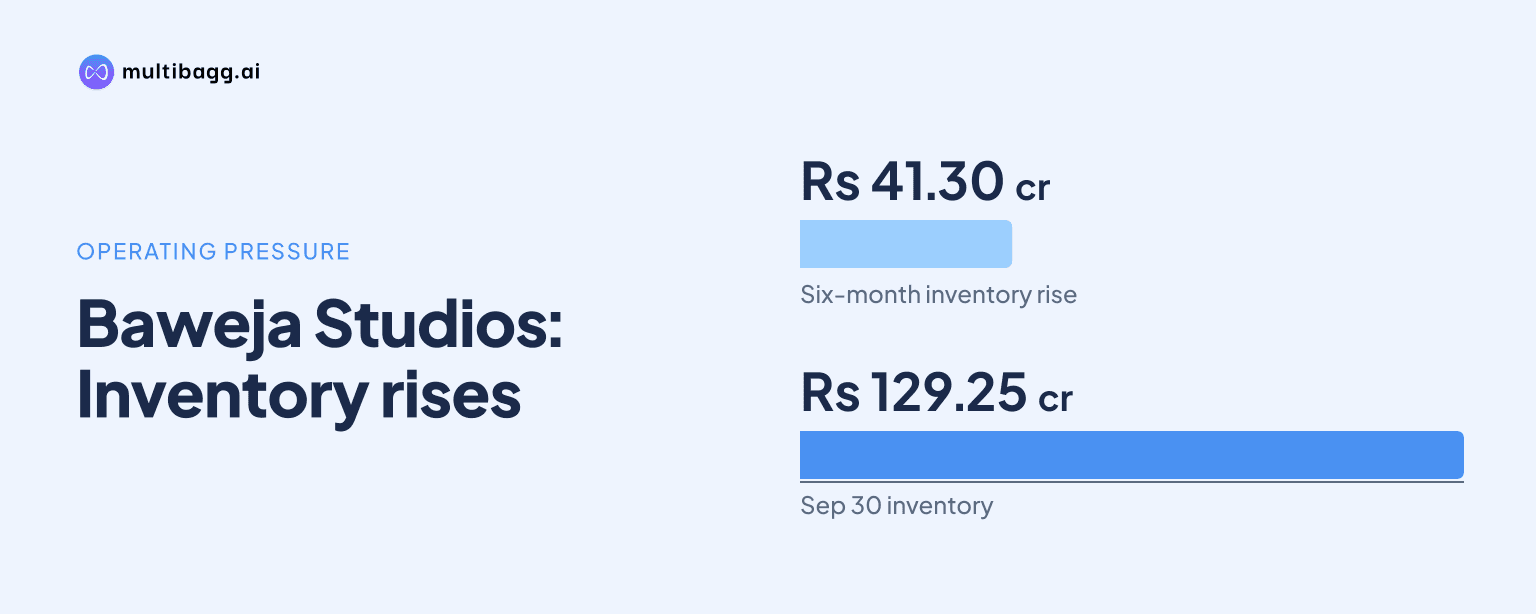
Baweja Studios Limited recorded Rs 61.69 lakh of net cash used in operating activities in the half year ended 30 September 2026, as inventories rose Rs 41.2961 crore from 31 March to Rs 129.2527 crore. The standalone cash-flow statement shows that the inventory increase outweighed operating profit before working-capital changes of Rs 6.0383 crore.
Know Baweja Studios inside out
Results, valuation, peers and who's buying, in one view.
Why did Baweja Studios’ operating cash flow turn negative?
Baweja Studios’ operating cash flow turned negative because the Rs 41.2961 crore increase in inventories absorbed cash during the half year ended 30 September 2026. The company generated Rs 6.0383 crore of operating profit before working-capital changes, but the inventory movement was substantially larger than that amount.
After working-capital movements, cash generated from operations was Rs 81.21 lakh, down from Rs 3.9511 crore in the half year ended 30 September 2025. Taxes paid were Rs 1.4291 crore, resulting in net cash used in operating activities of Rs 61.69 lakh, compared with net operating cash generated of Rs 3.3463 crore a year earlier.
The cash-flow statement identifies inventory as the largest use of operating cash in the latest half year. It does not identify individual films, content projects, distribution rights or work-in-progress categories behind the inventory build, so the filing does not establish how quickly the balance may be monetised.
How much did Baweja Studios’ inventory increase?
Baweja Studios’ inventories rose to Rs 129.2527 crore at 30 September 2026 from Rs 87.9567 crore at 31 March 2026, an increase of Rs 41.296 crore on the balance sheet. The cash-flow statement reports a closely related Rs 41.2961 crore increase in inventories for the six-month period.
The 30 September inventory balance was also Rs 47.9901 crore above the Rs 81.2626 crore reported at 30 September 2025. Inventories represented Rs 129.2527 crore of total current assets of Rs 200.314 crore at the latest reporting date, while total assets stood at Rs 209.8173 crore.
Baweja Studios reports a single operating segment under Indian Accounting Standard 108: production and distribution of film and content. The statement therefore provides no segment or project split for the Rs 129.2527 crore inventory balance, and it discloses no target or timetable for reducing inventories.
Which working-capital changes partly offset the inventory use?
Baweja Studios partly offset the inventory cash use through a Rs 17.702 crore reduction in trade receivables and a Rs 19.9084 crore increase in other liabilities in the half year ended 30 September 2026. Together, those two cash-flow movements totalled Rs 37.6104 crore, still below the inventory-related use.
Trade receivables on the balance sheet fell to Rs 40.7851 crore at 30 September 2026 from Rs 58.4994 crore at 31 March 2026. Other current liabilities increased to Rs 44.4303 crore from Rs 24.5219 crore over the same period, although the filing does not provide a component-wise explanation for that category.
Other movements also reduced cash available from operations. Current tax assets increased by Rs 1.893 crore, trade payables decreased by Rs 1.823 crore, and provisions decreased by Rs 55.45 lakh in the cash-flow statement. Other assets generated Rs 2.6839 crore of cash, compared with a Rs 1.3937 crore cash use in the corresponding prior-year half.
Got a follow-up? Ask IRIS
How did Baweja Studios’ borrowings and liabilities change?
Baweja Studios’ total borrowings increased by Rs 1.9612 crore between 31 March and 30 September 2026. Non-current borrowings rose by Rs 4.0292 crore to Rs 7.2275 crore, while current borrowings fell by Rs 2.068 crore to Rs 33.1225 crore.
The cash-flow statement reports a Rs 1.9846 crore increase in borrowings during the half year. The difference from the balance-sheet movement may reflect classification or reconciliation items, but the filing does not provide a specific reconciliation between the two presentations.
Total current liabilities rose to Rs 88.7175 crore at 30 September 2026 from Rs 72.8481 crore at the preceding year-end. Non-current liabilities increased to Rs 8.0444 crore from Rs 3.3705 crore, including Rs 62.84 lakh of non-current lease liabilities that were not reported at 31 March 2026.
Did profit and revenue rise despite the operating cash outflow?
Baweja Studios remained profitable and reported higher revenue despite the operating cash outflow. Standalone revenue from operations increased to Rs 67.1371 crore in the half year ended 30 September 2026 from Rs 35.4931 crore in the half year ended 30 September 2025, while profit after tax rose to Rs 2.9893 crore from Rs 1.5059 crore.
Compared with the immediately preceding half year ended 31 March 2026, profit after tax declined from Rs 4.5743 crore to Rs 2.9893 crore. Profit before tax was Rs 4.1094 crore in the latest half year, versus Rs 2.0127 crore a year earlier and Rs 6.2231 crore in the preceding half year.
Operational expenses increased to Rs 60.013 crore from Rs 31.374 crore a year earlier, and finance costs rose to Rs 1.6527 crore from Rs 1.3959 crore. Cash and cash equivalents nevertheless increased to Rs 1.5579 crore from Rs 1.0814 crore at the start of the half year, as investing activities generated Rs 80.17 lakh and financing activities generated Rs 29.18 lakh.
Conclusion
Baweja Studios’ latest standalone results show a divergence between accounting profit and operating cash generation. Revenue and profit after tax increased from the year-earlier half, but a Rs 41.2961 crore inventory increase, alongside other working-capital movements and tax payments, resulted in a Rs 61.69 lakh operating cash outflow.
The next financial statements should indicate whether the Rs 129.2527 crore inventory balance converts into revenue and operating cash, and whether other current liabilities remain near Rs 44.4303 crore. The company also said that recredit of Rs 45.31 lakh frozen following the 17 August 2026 cyber fraud was being expedited after a judicial order dated 26 October 2026.