










Balrampur Chini Mills Limited distillery revenue falls 19.9% in Q2FY27
Key highlights
- BCML’s Q2FY27 distillery revenue declined 19.9% year on year to Rs 324.59 crore.
- BCML’s Q2FY27 distillery PBIT fell 34.1% to Rs 39.13 crore and PBIT margin was 12.1%.
- BCML’s maize ethanol production fell 52.7% to 1.14 crore BL in Q2FY27.
- BCML’s average blended distillery realisation declined 7.8% to Rs 56.47 per BL in Q2FY27.
powered by IRIS
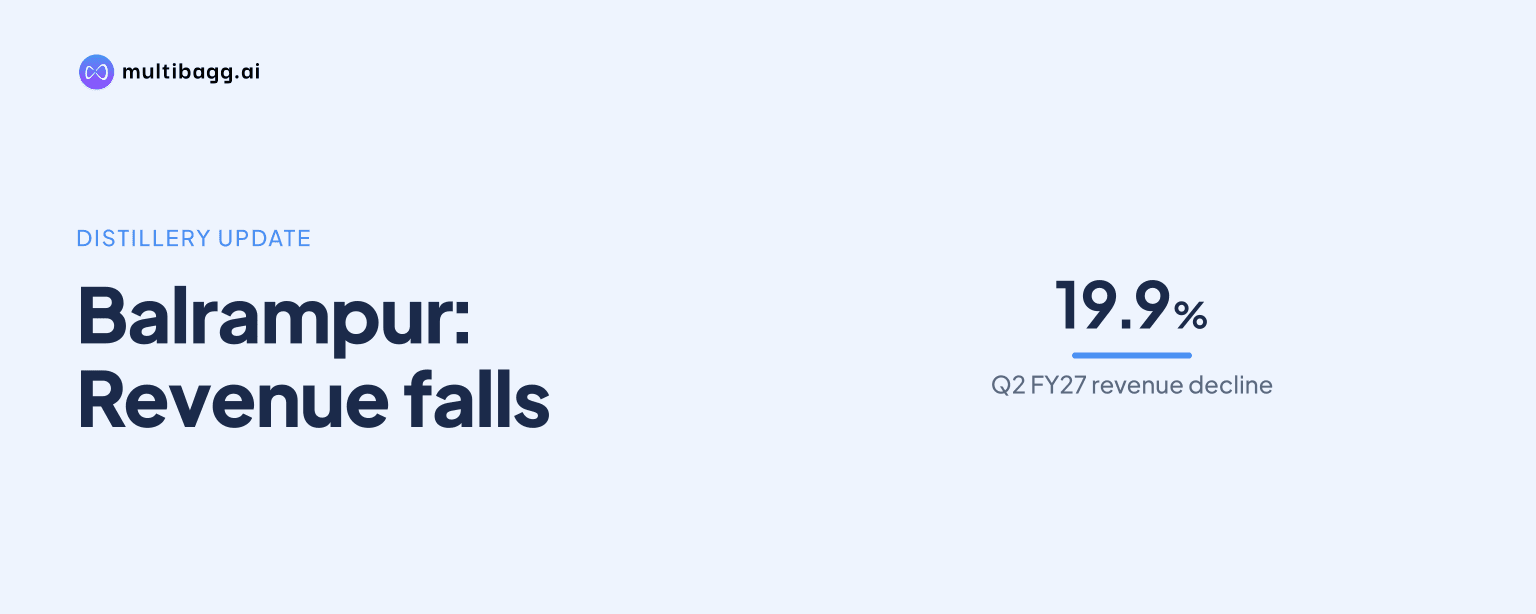
BCML’s Q2FY27 distillery revenue fell 19.9% year on year to Rs 324.59 crore, as average blended realisation declined 7.8% to Rs 56.47 per bulk litre. Profit before interest and tax, or PBIT, declined 34.1% to Rs 39.13 crore, while the reported margin reduced to 12.1% from 14.7%.
Know Balrampur Chini Mills inside out
Results, valuation, peers and who's buying, in one view.
Why did BCML’s Q2FY27 distillery revenue decline?
BCML’s Q2FY27 distillery revenue declined because both sales volume and reported average blended realisation were lower than a year earlier. Revenue was Rs 324.59 crore, compared with Rs 405.01 crore in Q2FY26, a decline of 19.9%. Sales, including extra-neutral alcohol, or ENA, and other products, fell 13.2% to 5.11 crore bulk litres, or BL, from 5.89 crore BL.
Average blended realisation, including ENA and other products but excluding freight realised on contracts, was Rs 56.47 per BL in Q2FY27. That was 7.8% below Rs 61.28 per BL in Q2FY26. In H1FY27, revenue was broadly unchanged at Rs 864.21 crore, down 0.3% from Rs 866.48 crore, as sales increased 3.6% to 13.49 crore BL despite a 3.1% reduction in realisation to Rs 57.96 per BL.
How did BCML’s distillery profitability change?
BCML’s PBIT fell faster than revenue in Q2FY27, declining 34.1% to Rs 39.13 crore from Rs 59.36 crore. PBIT margin was 12.1%, compared with 14.7% in Q2FY26. The reduction in average blended realisation to Rs 56.47 per BL occurred alongside the margin decline.
For H1FY27, PBIT was Rs 119.50 crore, 12.8% below Rs 137.03 crore in H1FY26, and margin was 13.8% rather than 15.8%. Revenue in the six-month period decreased by Rs 2.27 crore, while PBIT decreased by Rs 17.53 crore. In FY26, the distillery recorded PBIT of Rs 203.27 crore on revenue of Rs 1,720.97 crore, representing an 11.8% margin.
Which feedstock operations changed in BCML’s distillery?
BCML reduced maize-based ethanol production and sales in Q2FY27 while increasing B-heavy molasses production and reporting rice-based output. Maize ethanol production dropped 52.7% to 1.14 crore BL from 2.41 crore BL, while maize ethanol sales fell 52.3% to 1.14 crore BL from 2.39 crore BL. H1 maize production was 2.34 crore BL, down 49.9% from 4.67 crore BL.
B-heavy molasses ethanol production increased 30.4% in Q2FY27 to 1.63 crore BL, but sales from that route decreased 17.8% to 1.94 crore BL. C-heavy molasses production fell 12.1% to 0.58 crore BL. BCML reported no quarterly syrup production in either Q2FY26 or Q2FY27, although H1 syrup output increased to 0.13 crore BL from 0.04 crore BL.
Rice ethanol entered the H1FY27 operating mix, with production and sales of 0.84 crore BL each; the presentation records no rice-based production or sales in H1FY26. ENA and other-product sales rose 49.2% in Q2FY27 to 0.88 crore BL, although production fell 11.6% to 0.76 crore BL. At 30 September 2026, maize stock was 1.86 lakh quintals, compared with 0.18 lakh quintals a year earlier.
Got a follow-up? Ask IRIS
What do BCML’s inventories and transfer prices show?
BCML ended September 2026 with lower alcohol and molasses inventories than a year earlier, while maize inventory was higher. Alcohol stock was 0.56 crore BL on 30 September 2026, versus 1.77 crore BL on 30 September 2025. B-heavy molasses stock was 1.23 lakh quintals, down from 2.59 lakh quintals, and C-heavy molasses stock was 1.29 lakh quintals, down from 1.63 lakh quintals.
The disclosed transfer price for B-heavy molasses increased to Rs 1,360 per quintal in H1FY27 from Rs 1,150 per quintal in H1FY26. The C-heavy molasses transfer price increased to Rs 800 per quintal from Rs 600 per quintal. These changes coincided with H1FY27 B-heavy production of 6.29 crore BL, up 7.0%, and C-heavy production of 0.95 crore BL, down 15.2%.
How do ethanol policy and pricing affect BCML’s next cycle?
BCML’s next distillery cycle will operate under an ethanol policy that reduces sugar diversion to zero for ethanol year, or ESY, 2026-27. The presentation says government directions reduced sugar diversion for ethanol to zero in ESY 2026-27, which runs from November 2026 to October 2027. Oil marketing companies, or OMCs, issued a cycle-one tender for 1,100 crore BL for that year.
The ethanol price under the Ethanol Blended Petrol, or EBP, programme for maize is Rs 68.86 per BL in ESY 2026-27, down from Rs 71.86 per BL in ESY 2025-26. The disclosed prices for C-route, B-route and syrup are unchanged at Rs 57.97, Rs 60.73 and Rs 65.61 per BL, respectively. The government also allowed 72 lakh tonnes of surplus Food Corporation of India, or FCI, rice to ethanol distilleries for ESY 2026-27.
For ESY 2025-26, the presentation records total ethanol supply of about 987 crore BL through 30 September 2026 and blending of about 19.99%. Total allocation for that year was 1,196.6 crore BL, including 908.0 crore BL for grains, 165.9 crore BL for syrup, 110.5 crore BL for B-heavy and 12.2 crore BL for C-heavy. The allocation mix and zero-diversion direction provide the disclosed policy context for BCML’s feedstock choices.
Conclusion
BCML’s Q2FY27 distillery result combined a 19.9% revenue decline with a 34.1% PBIT decline, as sales volume fell 13.2% and average blended realisation fell 7.8%. The operating mix also changed: maize ethanol output halved, B-heavy production increased, rice entered H1 production, and ENA and other-product sales rose.
The next disclosed point to watch is ESY 2026-27, when sugar diversion is directed to be zero and the OMC cycle-one tender covers 1,100 crore BL. Relevant measures will include BCML’s use of maize and permitted FCI rice, the Rs 68.86-per-BL maize price, and whether distillery sales volumes and blended realisation change from Q2FY27 levels.