










Beta Drugs retains outlook as H1FY27 revenue reaches Rs 263 crore
Key highlights
- Beta Drugs reported H1FY27 consolidated revenue of Rs 263.04 crore, up 29.20% from Rs 203.6 crore in H1FY26.
- Branded Oncology grew 17% despite a plant shutdown and platinum API supply constraints, with some orders shifted to H2FY27.
- CMO business grew 21% in H1FY27, which Beta Drugs attributed to new customers and products it developed.
- Gross margin increased 486 basis points to 56.21% in H1FY27, while EBITDA rose about 30% to Rs 61 crore.
powered by IRIS
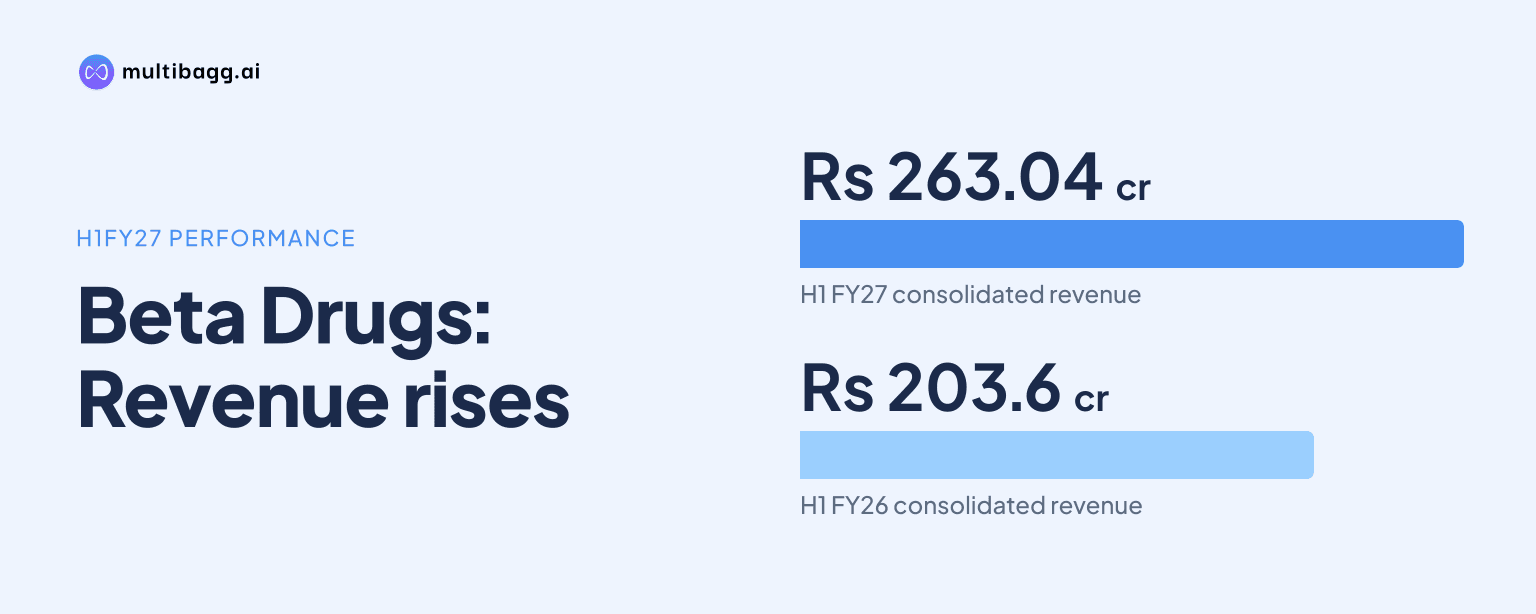
Beta Drugs Limited retained its Branded Oncology and CMO outlook after H1FY27 consolidated revenue rose 29.20% to Rs 263.04 crore, despite a production shutdown at the Adley Formulation Plant and platinum active pharmaceutical ingredient supply constraints that shifted some oncology orders into H2FY27. Management still expects Branded Oncology revenue of Rs 150 crore for FY27.
Know Beta Drugs inside out
Results, valuation, peers and who's buying, in one view.
Why did Beta Drugs retain its outlook despite disruptions?
Beta Drugs retained its outlook because management reported growth across key businesses in H1FY27 and treated the manufacturing and supply issues as temporary constraints. Consolidated revenue from operations increased to Rs 263.04 crore in H1FY27 from Rs 203.6 crore in H1FY26, a 29.20% increase. The company said it maintained its guidance for Branded Oncology and its CMO, or contract manufacturing business, in light of recent National Pharmaceutical Pricing Authority guidelines.
The principal oncology disruption was a production shutdown for debottlenecking and capacity expansion at the Adley Formulation Plant. Branded Oncology sales were also affected by supply constraints in platinum active pharmaceutical ingredients, or APIs, and Beta Drugs said the affected orders had moved to H2FY27. Management nevertheless expects Branded Oncology to close FY27 at Rs 150 crore and stated a medium-term growth outlook of 20% to 22%, supported by product launches and adoption by oncologists.
How did Beta Drugs perform in H1FY27 versus H1FY26?
Beta Drugs reported higher revenue, gross margin, earnings before interest, tax, depreciation and amortisation, or EBITDA, and profit after tax in H1FY27 than in H1FY26. Gross margin increased by 486 basis points, where one basis point is one-hundredth of a percentage point, to 56.21% from 51.35%. Management attributed the improvement to higher realisations across businesses and said cost-reduction measures and API backward integration are intended to help maintain gross-margin levels.
Profit after tax excluding minority interest rose to Rs 34.3 crore in H1FY27 from Rs 23.9 crore in the corresponding prior-year period. The H1FY27 figure was below the Rs 41.4 crore reported for the full FY26, which is a full-year rather than a half-year comparison. EBITDA increased to Rs 61 crore from Rs 47 crore, while EBITDA margin including other income edged up to 23.18% from 23.08%.
What supports Beta Drugs' oncology and CMO plans?
Beta Drugs said Branded Oncology grew 17% in H1FY27 despite the Adley plant shutdown and API constraints, while CMO business grew 21%. The company attributed CMO growth to new customer additions and to products developed by Beta Drugs that were offered to new and existing customers. Management's retained outlook therefore depends both on reported segment growth and on the expected execution of oncology orders deferred into H2FY27.
Product development is central to the oncology plan. Beta Drugs launched four Branded Oncology products in H1FY27, comprising one novel drug-delivery system, or NDDS, and three new formulations. Management targets at least four more launches in H2FY27, including novel formulations, and disclosed more than 15 products under development for launch during the next two years.
Beta Drugs assessed the National Pharmaceutical Pricing Authority notification on a 30% cap on trade margins and said the amendments have no significant bearing on its realisations or margins. That is management's assessment rather than a reported financial result. The company's outlook section also described medium-term Branded Oncology growth of more than 20%, consistent with the earlier 20% to 22% range, but did not disclose segment revenue for H1FY27.
Got a follow-up? Ask IRIS
How are exports, Nivian and Derma expected to contribute?
Beta Drugs reported 95% export growth in Q2FY27 and said it filed 58 dossiers across selected Latin America, Middle East and North Africa, and Asia-Pacific markets in H1FY27. In a separate disclosure, the company said it filed 76 new product dossiers in H1FY27, taking registrations to 415, with more than 800 products under registration. The announcement does not reconcile the two filing counts, which appear to refer to separately disclosed measures.
Management expects export growth of 30%, driven by the existing order book and expected tender wins for approved products. Beta Drugs said commercialisation of approved products is intended to support consistent export growth. In the Derma business, it signed an exclusive licensing agreement with Frezyderm for India and expects additional capacity to come onstream in Q4FY27.
Nivian recorded pro-forma growth of 75% in H1FY27, while sales to organised in-vitro fertilisation, or IVF, chains accounted for about 25% of its total sales. Management expects to launch two further Nivian products in H2FY27 and targets growth of more than 50% for FY27. It also said doctor coverage was about 60%, while Derma secondary sales grew 30% in H1FY27 over H1FY26 and the business is expected to rebound in H2FY27 after supply-chain disruptions are addressed.
What capacity and supply-chain steps are scheduled next?
Beta Drugs expects commercial production from backward integration at its API plant to begin in Q4FY27. Management said the project was progressing according to schedule and expects the new capacity and backward integration to reduce reliance on imports, support compliance with evolving standards and aid margin improvement. The company also expects the plant to support drug master files, or DMFs, for regulated markets and quicker dossier submissions.
Capital-allocation priorities include product registrations in export markets, research and development for new products and novel formulations, and supply-chain efficiency measures intended to improve Nivian operating margins. Beta Drugs also identified opportunistic investments in new oncology areas, including biosimilars, as a priority. The company said installed capacity was sufficient for current requirements and referred to internal cash generation equivalent to 50% of EBITDA as operating cash flow, without clearly stating the underlying capacity figure.
Conclusion
Beta Drugs' H1FY27 disclosure indicates that growth in revenue, CMO and Branded Oncology was sufficient for management to keep its segment plans unchanged despite production and API supply disruptions. The operating comparison shows Rs 263.04 crore of revenue, a 56.21% gross margin and Rs 61 crore of EBITDA in H1FY27, while the delayed oncology orders create a greater reliance on second-half execution.
The next disclosed milestones are the shift of deferred oncology orders into H2FY27, at least four additional Branded Oncology launches and two Nivian launches during that period, and API-plant commercial production in Q4FY27. Management's Rs 150 crore Branded Oncology target, 30% expected export growth and planned Derma rebound are the principal outcomes to watch through FY27.