










Bharat Dynamics keeps Rs 83.27 crore ageing stock unprovided
Key highlights
- Bharat Dynamics carried Rs 83.27 crore of inventory unmoved for more than five years at September 30, 2026.
- Bharat Dynamics cited Rs 362.34 crore of customer advances against contracts subsequently short-closed by customers.
- The Rs 83.27 crore ageing-inventory balance was unchanged from March 31, 2026.
- Bharat Dynamics' total inventory rose to Rs 4,684.99 crore from Rs 4,625.64 crore over six months.
powered by IRIS
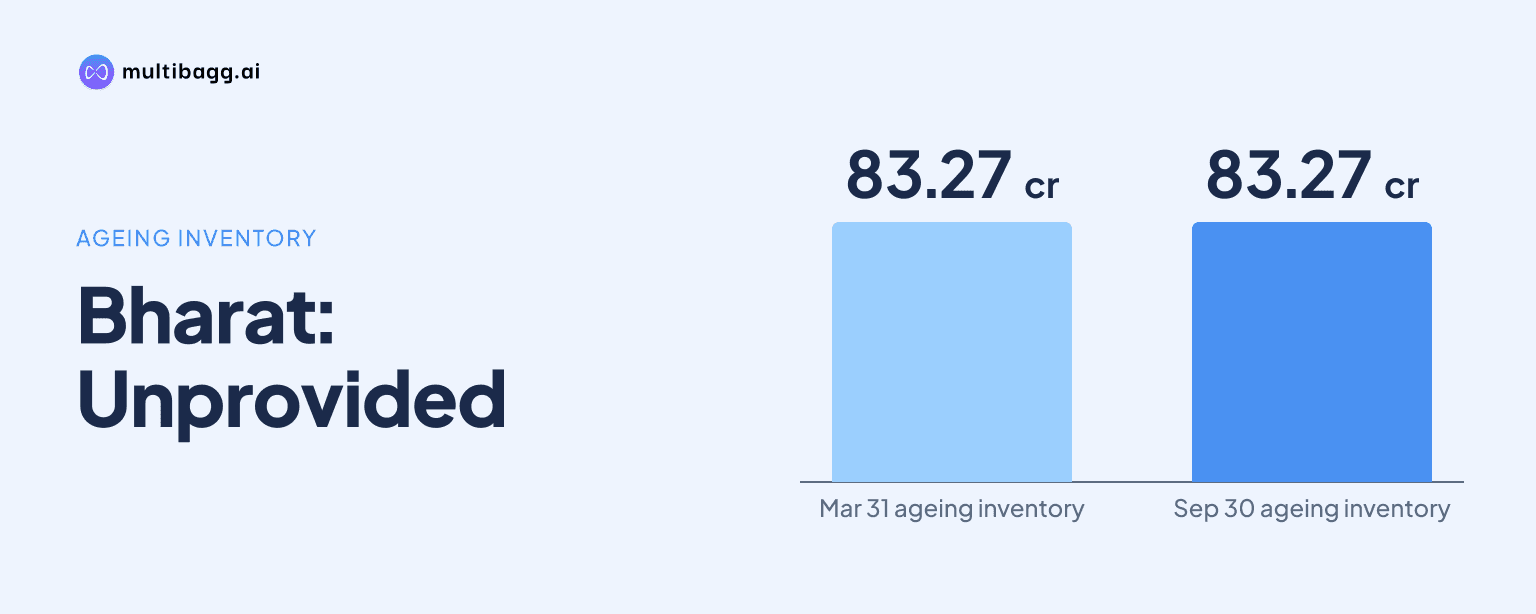
Bharat Dynamics Limited carried Rs 83.27 crore of inventory that had not moved for more than five years at September 30, 2026 without a redundancy provision, citing Rs 362.34 crore of customer advances from the related contracts. The inventory had been bought for firm orders or letters of intent subsequently short-closed by customers.
Know Bharat Dynamics inside out
Results, valuation, peers and who's buying, in one view.
Why did Bharat Dynamics retain ageing inventory without a provision?
Bharat Dynamics said it did not consider a provision necessary because advances received against the firm orders and letters of intent exceeded the assets acquired, including inventory, and expenditure incurred on those contracts. The Rs 83.27 crore balance represented material procured for orders that customers later short-closed, rather than inventory identified as having resumed movement or been sold by September 30, 2026.
The company disclosed Rs 362.34 crore of advances against the contracts linked to the old stock. That figure was higher than the Rs 83.27 crore non-moving inventory balance, and management cited the excess of advances over related assets and spending as the basis for its accounting treatment. The filing does not name customers, identify products, or provide a contract-by-contract reconciliation of advances, inventory and expenditure.
The inventory amount was unchanged from March 31, 2026, when Bharat Dynamics also reported Rs 83.27 crore of stock unmoved for more than five years. The six-month comparison does not show a reduction, write-off or provision against this identified inventory pool. It also does not disclose a recovery date, settlement timetable or disposal programme for material associated with the short-closed orders.
What does Bharat Dynamics' policy say about inventory older than five years?
Bharat Dynamics' accounting policy requires a redundancy provision for inventory that has not moved for more than five years, according to the September 30, 2026 financial-results note and the auditor's emphasis-of-matter paragraph. Management nevertheless concluded that no provision was necessary for the Rs 83.27 crore balance because of the advances and related contract expenditure it described.
The disclosed five-year threshold matters because the stock had crossed that period at both September 30, 2026 and March 31, 2026. The filing does not quantify a redundancy charge, reversal or write-back in the half year ended September 30, 2026. It instead presents the customer advances of Rs 362.34 crore as the mechanism supporting the continued carrying amount.
Bharat Dynamics prepared its standalone unaudited results under Indian Accounting Standards, or Ind AS, prescribed under the Companies Act, 2013. The Audit Committee reviewed the results and the Board approved them on November 12, 2026. Statutory auditors conducted a limited review of the quarter and half-year results, rather than a full annual audit of the September 2026 statements.
How large is the old stock within Bharat Dynamics' total inventory?
The Rs 83.27 crore of inventory unmoved for more than five years was about 1.8% of Bharat Dynamics' total inventory of Rs 4,684.99 crore at September 30, 2026. Total inventory rose from Rs 4,625.64 crore at March 31, 2026, while the separately disclosed old-stock balance did not change. The increase in inventory therefore occurred outside the pool linked to the short-closed customer orders.
The Rs 362.34 crore of advances was about 4.35 times the stated ageing-inventory amount. That comparison supports the scale of management's stated rationale, but it does not establish coverage for each item of stock because Bharat Dynamics did not disclose individual contracts, asset values or expenditure by customer order. The note supports an overall assessment rather than a product-level valuation analysis.
Bharat Dynamics reported a Rs 65.67 crore increase in inventories in its cash-flow statement for the half year ended September 30, 2026, compared with a Rs 561.51 crore increase in the corresponding 2025 period. The balance-sheet comparison of Rs 59.36 crore differs from the cash-flow line because the statements present different financial-reporting measures, and the filing does not attribute either movement specifically to the Rs 83.27 crore old-stock balance.
Got a follow-up? Ask IRIS
What did the auditor say about Bharat Dynamics' ageing inventory?
The auditor highlighted the ageing inventory in an emphasis-of-matter paragraph but did not modify its limited-review conclusion. Umamaheswara Rao & Co. stated that Bharat Dynamics had Rs 83.27 crore of inventory unmoved for more than five years at September 30, 2026, procured against firm orders or letters of intent that customers subsequently short-closed.
The auditor also cited the Rs 362.34 crore of advances received against those contracts and noted that the company had not considered a provision necessary for the reasons in its note. Its conclusion, dated November 12, 2026, was not modified in respect of this matter. The report said the review was conducted under Standard on Review Engagements 2410 and provided moderate assurance.
The audit firm explained that a limited review is substantially narrower than an audit under the Standards on Auditing and does not provide assurance that all significant matters would be identified. It said nothing had come to its attention causing it to believe the September 2026 statement had not disclosed required information or contained a material misstatement. The emphasis paragraph therefore drew specific attention to the inventory judgement without changing the review conclusion.
How did Bharat Dynamics perform in the September 2026 half year?
Bharat Dynamics reported revenue from operations of Rs 2,236.38 crore for the half year ended September 30, 2026, compared with Rs 1,394.96 crore in the corresponding half year ended September 30, 2025. Profit for the period rose to Rs 302.27 crore from Rs 234.23 crore. These reported operating results sit alongside, rather than resolve, the separate accounting treatment for the Rs 83.27 crore old-stock balance.
Profit before tax was Rs 411.79 crore in the September 2026 half year, compared with Rs 310.75 crore a year earlier. Bharat Dynamics also reported total assets of Rs 16,557.70 crore at September 30, 2026, versus Rs 14,261.50 crore at March 31, 2026. The filing does not connect the increase in assets or profit directly to the contracts behind the ageing inventory.
The half-year disclosure also recorded a final dividend of Rs 0.40 per equity share for financial year 2025-26, approved by shareholders at the annual general meeting on September 28, 2026. This corporate action is separate from the inventory note, which concerns procurement under customer orders and the advances received against those contracts. No customer settlement or inventory disposal target was disclosed with the dividend information.
Conclusion
The disclosure shows that Bharat Dynamics has retained a specific pool of inventory despite it remaining unmoved for more than five years and despite its policy addressing redundancy provisions for such stock. Management's stated basis is the Rs 362.34 crore of customer advances and its assessment that those advances exceed related assets and expenditure; the auditor highlighted that judgement without modifying its conclusion.
The unresolved matter to watch is whether the short-closed customer orders lead to any movement in the Rs 83.27 crore balance, a settlement of the advances, or a revised provision assessment. Bharat Dynamics disclosed no customer-wise recovery timetable, inventory-disposal target or contract-by-contract allocation, so later financial statements would be needed to show any change in the accounting treatment.