










BharatRohan Airborne Profit Falls 10.9% Despite Revenue Rise
Key highlights
- BharatRohan Airborne's H1 FY27 revenue from operations rose 28.6% to ₹42.34 crore.
- BharatRohan Airborne reported H1 FY27 net profit of ₹4.15 crore, down 10.9% year on year in the results summary.
- Operating cash flow was negative ₹2.74 crore, while cash and cash equivalents fell to ₹4.92 crore from ₹12.96 crore.
- BharatRohan Airborne had utilised ₹28.90 crore of its ₹39.79 crore IPO proceeds as of September 30, 2026.
powered by IRIS
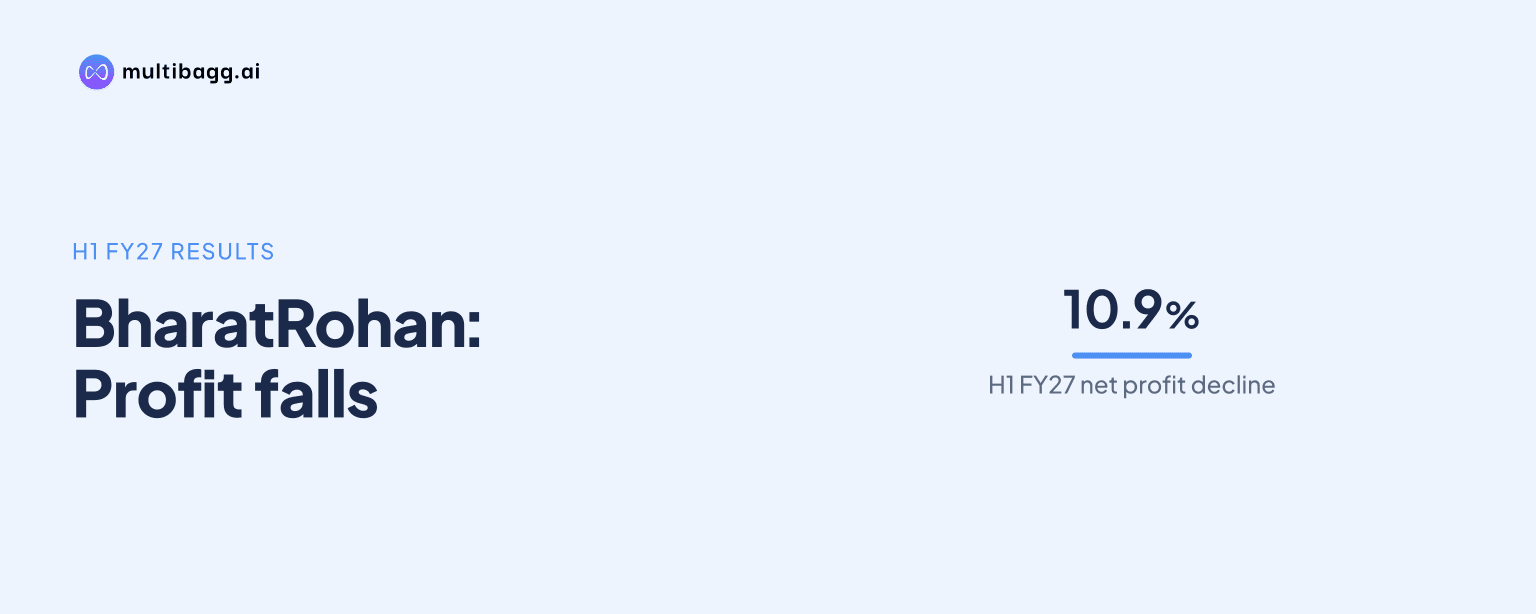
BharatRohan Airborne Innovations Limited reported a 10.9% year-on-year decline in H1 FY27 net profit to ₹4.1 crore, even as revenue from operations rose 28.6% to ₹42.3 crore, as employee, depreciation and other costs increased and operating cash flow turned negative.
Know BharatRohan Airborne Innovations inside out
Results, valuation, peers and who's buying, in one view.
Why did BharatRohan Airborne's H1 FY27 profit decline?
BharatRohan Airborne's reported net profit declined despite a sharp increase in sales because its expenses rose faster than the additional revenue could support. Consolidated net profit was ₹4.15 crore for the half year ended September 30, 2026, compared with ₹4.61 crore in H1 FY26. The company described the year-on-year decline as 10.4%, while the results summary reported a 10.9% fall.
Revenue from operations increased to ₹42.34 crore from ₹32.93 crore a year earlier. The growth was linked to higher sales of agricultural inputs and outputs, supported by the company's drone and hyperspectral imaging technology platform. Total income stood at ₹42.4 crore, including about ₹0.1 crore of other income.
The Board of Directors approved the unaudited standalone and consolidated results on November 13, 2026. The meeting, conducted through video conferencing, had been scheduled to consider financial results for the half year ended September 30, 2026.
Which expenses put pressure on BharatRohan Airborne's margins?
The rise in employee costs, depreciation and other expenses put pressure on BharatRohan Airborne's profitability. Employee benefit expense rose 70.9% year on year to ₹2.57 crore. Depreciation and amortisation more than tripled to ₹1.06 crore, while other expenses increased 65.8% to ₹2.60 crore.
These increases accompanied a period of investment and business expansion. Profit before tax was ₹6.17 crore, compared with about ₹4.7 crore in H1 FY26, but the higher operating-cost base reduced the conversion of revenue into net profit. The reported operating margin was 14.6%, compared with 14.2% in the comparable prior-year half.
The results summary also showed lower profitability against H2 FY26, when net profit was ₹5.8 crore and revenue from operations was ₹52.5 crore. Such half-on-half comparisons are influenced by the timing of sales and expenses, but the figures show that the first-half revenue growth did not translate into higher reported earnings.
What do BharatRohan Airborne's cash flows show?
BharatRohan Airborne recorded negative operating cash flow of ₹2.74 crore in H1 FY27 despite generating profit before tax of ₹6.17 crore. The difference reflects cash being tied up in working-capital items rather than being collected or retained as operating cash.
Trade receivables resulted in a cash outflow of ₹2.33 crore during the period, while loans and advances accounted for an outflow of ₹7.16 crore. These movements explain why accounting profit and operating cash generation diverged in the half year.
Cash and cash equivalents fell to ₹4.92 crore as of September 30, 2026, from ₹12.96 crore at the start of the period. The company also spent ₹4.66 crore on property, plant and equipment. The figures indicate that expansion, working-capital requirements and capital expenditure drew on available liquidity during the period.
Got a follow-up? Ask IRIS
How is BharatRohan Airborne using its IPO proceeds?
BharatRohan Airborne had used ₹28.90 crore of the ₹39.79 crore raised through its IPO as of September 30, 2026. The disclosed utilisation shows that working-capital requirements had been fully funded at ₹16.68 crore.
Capital-expenditure utilisation was ₹4.71 crore against a planned ₹14.21 crore. The use of IPO proceeds alongside short-term borrowings is relevant because the company is simultaneously funding operating working capital and investment in property, plant and equipment. The remaining planned capital expenditure leaves part of the announced deployment programme unfinished as of the reporting date.
The increase in depreciation is also consistent with a business adding or using more fixed assets, although the filing does not provide an asset-by-asset breakdown. Investors will need to assess future financial disclosures for the pace of capital deployment, collections from customers and changes in cash balances.
What is BharatRohan Airborne's defence investment plan?
BharatRohan Airborne's Board approved an investment in BharatRohan Defence Private Limited, an unlisted entity that was under incorporation at the time of the disclosure. BharatRohan Airborne will hold a 15% stake in the new venture.
The proposed entity aims to design, develop and manufacture unmanned aerial vehicles and defence-grade drones. The announcement marks an extension into a defence-focused UAV opportunity, separate from the agricultural applications referred to in the company's revenue update.
The disclosure does not state an investment amount, launch timeline, contracts or expected revenue from BharatRohan Defence. It therefore establishes the ownership plan and intended area of activity, but does not provide a quantified financial contribution to BharatRohan Airborne's future results.
Conclusion
BharatRohan Airborne's H1 FY27 results show a business with 28.6% revenue growth but lower net profit as employee expenses, depreciation and other costs rose sharply. Negative operating cash flow, larger receivables and advances, lower cash reserves, and capital expenditure make working-capital management a central financial issue alongside reported earnings.
Investors can watch the company's progress in collecting receivables, managing loans and advances, and deploying the remaining IPO proceeds, particularly the unutilised capital-expenditure allocation. Further disclosures on BharatRohan Defence Private Limited, including its incorporation and funding structure, will also clarify the scope of the planned 15% investment.