










Bharti Hexacom Limited ARPU reaches Rs 264 as data use climbs
Key highlights
- Bharti Hexacom’s mobile ARPU rose to Rs 264 in September 2026 from Rs 251 a year earlier.
- Mobile data usage per customer reached 38.1 GB per month, up 23.9% year-on-year.
- The mobile base declined by 16,000 sequentially to 28.97 million, but remained 3.3% above the prior year.
- Mobile services revenue increased 10% year-on-year to Rs 2,461 crore in the September 2026 quarter.
powered by IRIS
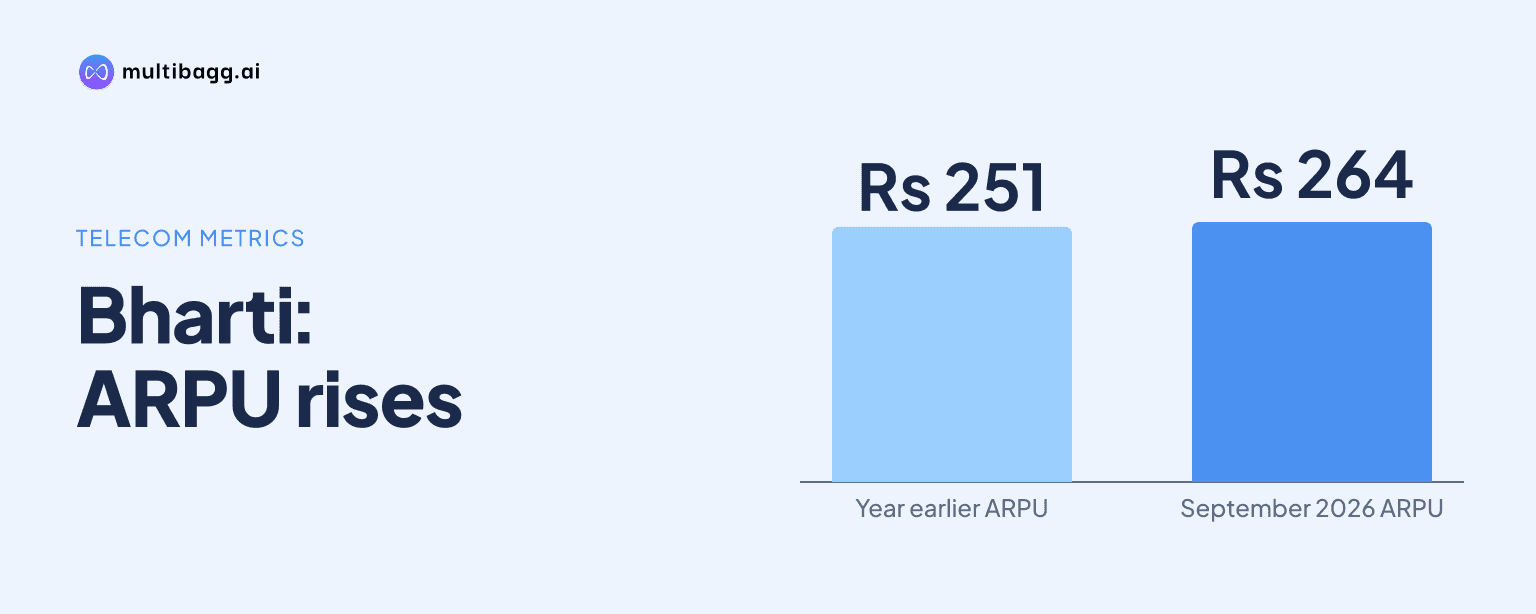
Bharti Hexacom Limited raised mobile average revenue per user, or ARPU, to Rs 264 in the quarter ended September 2026, up 5.4% year-on-year, as monthly data usage per customer increased 23.9% to 38.1 gigabytes despite its mobile customer base declining by 16,000 sequentially to 28.97 million.
Know Bharti Hexacom inside out
Results, valuation, peers and who's buying, in one view.
How did Bharti Hexacom’s mobile ARPU change?
Bharti Hexacom’s mobile ARPU was Rs 264 in September 2026, compared with Rs 259 in June 2026 and Rs 251 a year earlier. The Rs 5 sequential increase came as the mobile base was nearly unchanged at 28.97 million, following net additions of 210,000 in the June quarter and net disconnections of 16,000 in the September quarter.
The customer-base trend contrasts with the ARPU trend. Mobile subscribers increased 3.3% from 28.04 million in September 2025, while ARPU rose 5.4% over the same period. Monthly churn was 2.6% in September 2026, up from 2.3% in June but unchanged from September 2025, indicating that the quarter’s subscriber decline occurred alongside higher revenue per user.
Bharti Hexacom’s revenue per tower per month also rose to Rs 3.04148 lakh, 2.4% above June 2026 and 8.4% above September 2025. That movement is consistent with the company generating more mobile revenue from its network footprint, which grew by 51 towers sequentially to 26,940 and by 411 towers from a year earlier.
What drove Bharti Hexacom’s higher data consumption?
Higher smartphone penetration and usage drove Bharti Hexacom’s data consumption: its smartphone data customer base reached 23.12 million in September 2026, up 1.15 million from September 2025. Smartphone data customers represented 80.0% of the mobile base, compared with 79.8% in June 2026 and 78.6% a year earlier.
Total traffic on the network was 2,649 million GB in the September quarter, increasing 6.1% sequentially and 30.6% year-on-year from 2,029 million GB. Data usage per customer per month rose to 38.1 GB from 36.2 GB in June and 30.7 GB in September 2025, a 5.0% quarter-on-quarter and 23.9% year-on-year increase.
Voice consumption did not follow the same pattern. Minutes on the network were 96,119 million, down 0.5% from the June quarter but 2.6% above the prior year, while voice usage per customer declined to 1,105 minutes per month from 1,114 minutes sequentially and 1,111 minutes a year earlier. The disclosed operating metrics therefore show data use expanding faster than voice use.
Bharti Hexacom added 1,164 mobile broadband base stations during the quarter, taking the total to 97,176, compared with 96,012 in June and 92,455 in September 2025. The 4,721 year-on-year addition in base stations coincided with the 620 million GB rise in total data traffic, although the presentation does not separately quantify how network additions affected ARPU.
Got a follow-up? Ask IRIS
How did mobile monetisation affect Bharti Hexacom’s results?
Bharti Hexacom’s mobile services revenue reached Rs 2,461 crore in the September 2026 quarter, up 10% year-on-year from Rs 2,238.5 crore. Mobile EBITDA, or earnings before interest, tax, depreciation and amortisation, increased 11% to Rs 1,363.5 crore, and the segment EBITDA margin increased 0.6 percentage points to 55.4%.
Mobile was substantially larger than the Homes, Office and Other Services segment, which reported Rs 131.2 crore of quarterly revenue, up 49% year-on-year. However, mobile generated Rs 1,177 crore of operating free cash flow, defined by Bharti Hexacom as EBITDA minus capital expenditure, while the homes segment recorded negative Rs 96.7 crore because its Rs 149.8 crore capital expenditure exceeded Rs 53.1 crore EBITDA.
At the company level, total revenue increased 11% to Rs 2,581.8 crore and EBITDA rose 13% to Rs 1,416.6 crore in the September quarter. Net income was Rs 566.1 crore, 34% above Rs 421.2 crore a year earlier, while net finance cost declined 17% to Rs 115.2 crore. These results combine the higher mobile revenue with the faster percentage growth in homes services.
The company’s five-quarter trend also shows rising revenue and margins. Total revenue increased from Rs 2,317.3 crore in the September 2025 quarter to Rs 2,581.8 crore in September 2026, while EBITDA margin moved from 54.2% to 54.9%. Operating expenses excluding access charges, cost of goods sold, licence fees, charity and donations were 28.6% of revenue in September 2026, down from 30.8% a year earlier.
What is Bharti Hexacom doing to support higher-value customers?
Bharti Hexacom is seeking to enhance its higher-value postpaid offering through family plans priced at Rs 999 and above. During the September 2026 quarter, it added Apple’s expanded iCloud+, Apple TV and Apple Arcade to those plans, combining connectivity, cloud storage, entertainment and gaming in one proposition.
The company describes its strategy as premiumising its portfolio by acquiring and retaining quality customers, using an omni-channel approach and data science, and offering family and converged plans through Airtel Black. The presentation does not disclose the number of customers on the Rs 999-and-above plans, their ARPU, or the direct revenue effect of the Apple additions.
Network expansion remains part of the operating plan disclosed alongside these propositions. Bharti Hexacom had coverage through 26,940 network towers and 97,176 mobile broadband base stations at September 2026, versus 26,529 towers and 92,455 base stations a year earlier. Its capital expenditure was Rs 336.3 crore in the quarter, 9% below the Rs 367.6 crore reported a year before.
Conclusion
Bharti Hexacom’s September 2026 operating data show that ARPU growth outpaced mobile subscriber growth: ARPU rose 5.4% to Rs 264 while the mobile base was down 0.1% sequentially. The supporting shifts were a 1.4-percentage-point year-on-year increase in smartphone penetration, 30.6% growth in total data traffic and a 23.9% increase in data use per customer, alongside 10% mobile revenue growth.
The next reported indicators to watch are whether mobile net additions recover from the 16,000 quarterly decline, whether churn moves below 2.6%, and whether data usage continues to rise from 38.1 GB per customer per month. Management’s disclosed Rs 999-and-above family-plan enhancement and continued broadband network additions are the stated initiatives most directly linked to its premiumisation strategy.