










Blue Dart reports 34,220 contractual workers among 47,549
Key highlights
- Blue Dart reports 34,220 contractual workers within total headcount of 47,549.
- Blue Dart reports 13,329 FTEs, compared with 34,220 contractual workers.
- Blue Dart’s Great Place To Work rank improved from 98th in January 2023 to 39th in January 2026-January 2027.
- Blue Dart reports 5.5 average training hours and 5,847 employees trained in an average month.
powered by IRIS
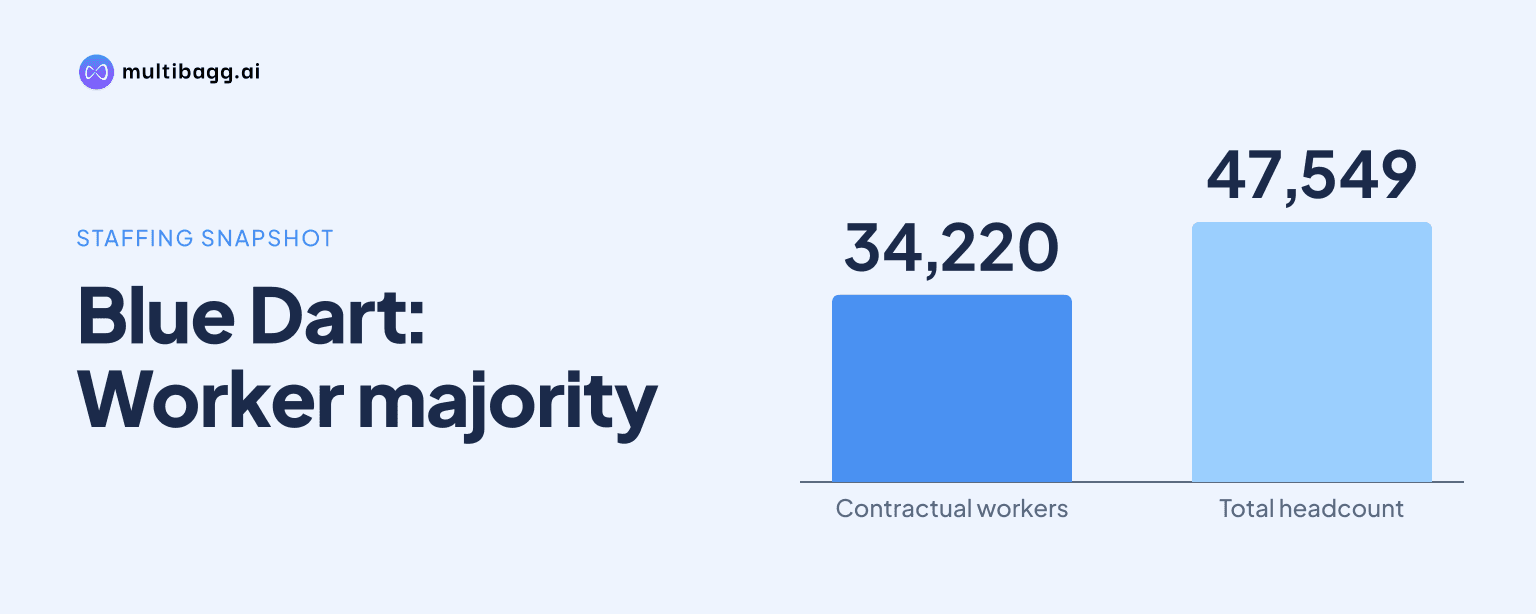
Blue Dart Express reports 34,220 contractual workers among its 47,549 total headcount in its People disclosure, alongside 13,329 full-time equivalents (FTEs). The staffing mix was disclosed with an India Great Place To Work ranking of 39th for January 2026-January 2027, compared with 98th in January 2023.
Know Blue Dart Express inside out
Results, valuation, peers and who's buying, in one view.
How is Blue Dart’s workforce split between contractual workers and FTEs?
Blue Dart’s disclosed workforce comprises 34,220 contractual workers and 13,329 FTEs, or full-time equivalents, within total headcount of 47,549. Contractual workers therefore account for about 72% of the reported total, based on the company’s counts, while FTEs account for about 28%. The presentation does not provide a previous headcount, turnover measure, role-level split or definition of its contractual arrangements.
The contractual category exceeds the FTE category by 20,891 people. Blue Dart also identifies hub automation, real-time courier tracking, automated dimension capture for volume weight, digital vendor billing and digital payments as parts of its digital interface. However, the presentation does not assign contractual workers to delivery, hubs, technology, administration or another operating function.
Blue Dart places the headcount disclosure alongside a medium-term objective to increase pin-code coverage and footprint to cover 98% of the country’s gross domestic product. It identifies small and medium enterprises, e-tailing, fast-moving consumer goods, automotive, consumer durables and ready-made garments as focus areas. The document does not quantify the staffing required for those initiatives or indicate whether the contractual-worker and FTE mix will change.
How has Blue Dart’s Great Place To Work ranking changed since 2023?
Blue Dart’s India Great Place To Work ranking improved by 59 places, from 98th in January 2023 to 39th for January 2026-January 2027. The presentation records an 80th-place ranking in January 2024 and a 65th-place ranking in January 2025, showing improvement at each of the four disclosed ranking points.
The presentation labels the latest period “Great Place To Work. Certified” and describes the sequence as laying the foundation in 2023, building momentum in 2024 and growing stronger in 2025. Those descriptions are Blue Dart’s characterisation of the ranking progression. The page also lists World Happiness Congress & Awards and ET NOW Best Organisations for Women 2025 without providing award categories, scores or methodologies.
The ranking appears on the same People page as the 47,549 total headcount and 34,220 contractual-worker count. Blue Dart does not state whether contractual workers were included in the assessment, whether it covered all locations, or whether it uses a separate engagement measure for its 13,329 FTEs. The disclosure therefore does not establish how the ranking applies across worker categories.
Got a follow-up? Ask IRIS
What training and talent measures does Blue Dart disclose?
Blue Dart reports average training hours of 5.5 and an average of 5,847 employees trained in a month. The presentation does not specify whether 5.5 hours applies per employee, per trainee, per month or another measurement period. It also does not state how many of the 34,220 contractual workers are included in the monthly trained figure.
For 2026, Blue Dart lists live Certified programmes including Certified Ecommerce Manager, CEM Supervisory Academy, Coaching For Success, Certified Ecommerce Specialist, Certified Safety First Awareness, Certified Sales Foundation, Certified Facilitation Skills and Bite Sized: Feedback Culture. Blue Dart says these programmes develop certified experts and leaders across functions to create a consistent culture, strengthen the talent pipeline and enhance organisational resilience. It does not disclose completion rates, course durations, participant numbers or programme costs.
The People page also records 253 employees in AI hiring as of June 2026 and 225 persons with disabilities as of June 2026. No baseline is supplied for either figure, so the presentation does not show the change over time. Blue Dart’s long-term strategy includes a digitally enabled workforce, human-capital investment and leadership-pipeline development.
What does Blue Dart’s strategy say about workforce requirements?
Blue Dart says its medium-term initiatives include enhancing skill development and developing a comprehensive people empowerment and engagement module that it considers critical for growth. The plan also includes process simplification and standardisation, increased automation and greater adaptability in its product and solution portfolio. Management provides no staffing, training-hours or contractual-worker target for these initiatives.
The company’s operating agenda includes artificial intelligence and machine learning solutions built on data, automation to drive efficiencies and faster implementation of digital solutions. Blue Dart says drones are operational for deliveries in Gurugram, where it says they can reduce carbon dioxide emissions relative to conventional delivery methods and avoid traffic congestion in last-mile fulfilment. The source does not disclose drone-delivery volumes, drone staffing or any effect on the 47,549-person workforce.
Over the longer term, Blue Dart says it aims to maintain leadership in air and ground express, enhance its air fleet, leverage freight corridors and logistics parks, and create state-of-the-art infrastructure. It also says it will aggressively invest in human-capital development and develop its leadership pipeline. These are management plans rather than quantified forecasts, and no completion date is provided for the workforce-development, fleet or infrastructure measures.
Conclusion
Blue Dart’s People disclosure shows a workforce of 47,549, of which 34,220 are contractual workers and 13,329 are FTEs. The same disclosure records a rise in its India Great Place To Work ranking from 98th in January 2023 to 39th in January 2026-January 2027, together with 5.5 average training hours and 5,847 employees trained in an average month.
The next disclosures to watch are whether Blue Dart provides a role-based contractual-worker breakdown, identifies their coverage in training and workplace measures, or sets workforce targets alongside its 98% of gross domestic product pin-code coverage objective. Management’s plans for automation, digital solutions, Gurugram drone deliveries and human-capital development leave unresolved how technology and network expansion could affect the balance between contractual workers and FTEs.