








Bombay Coated’s appliance mix rose to 86.9% in H1 FY27

Find your next multibaggerBe a Pro Investor
Research stocks and track your picks on the go. Download the app.
Key highlights
- Home and commercial appliances generated Rs 588.59 crore, or 86.9% of Bombay Coated revenue, in H1 FY27.
- Bombay Coated’s appliance revenue share rose from 81.8% in FY25 to 86.5% in FY26 and 86.9% in H1 FY27.
- Bombay Coated reported 215 customers in H1 FY27 across appliance, electrical and engineering markets.
- Bombay Coated operates four sites covering 65,559 square metres and identifies a 34,300-square-metre future site at Supa.
powered by IRIS
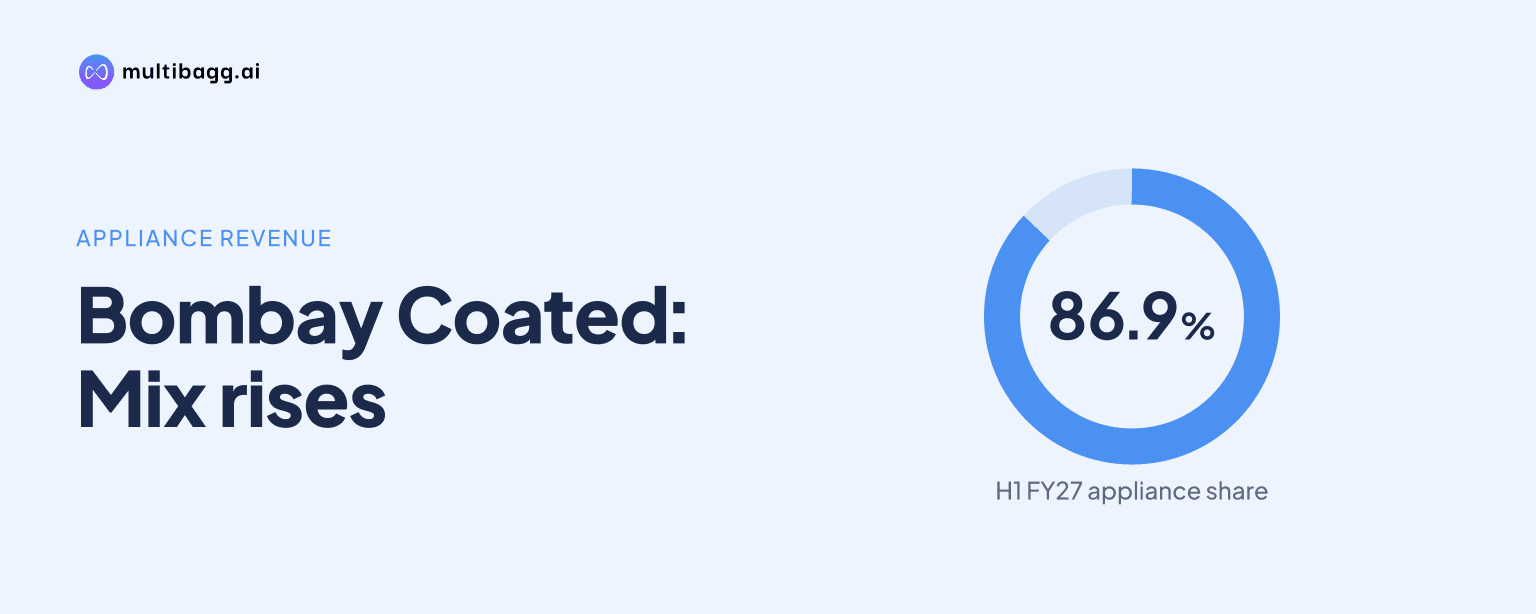
Bombay Coated & Special Steels Limited derived 86.9% of H1 FY27 revenue, or Rs 588.59 crore, from home and commercial appliances, compared with an 81.8% share in FY25. Bombay Coated reported Rs 677.32 crore of total revenue in H1 FY27, leaving general engineering with Rs 88.73 crore, or 13.1%.
Know Bombay Coated and Special Steels inside out
Results, valuation, peers and who's buying, in one view.
How dependent is Bombay Coated on appliances?
Bombay Coated is predominantly dependent on home and commercial appliances, which generated Rs 588.59 crore in H1 FY27. The segment includes processed steel applications in air conditioners, refrigerators, washing machines and water heaters. Its steel processing centre model takes raw coils and processes them through slitting, cut-to-length and embossing before supply to original equipment manufacturers and original design manufacturers.
General engineering generated the remaining Rs 88.73 crore in H1 FY27, equal to 13.1% of revenue. The company identifies automotive, electrical equipment and heating, ventilation and air-conditioning applications within this segment. Appliance revenue was therefore about 6.6 times general-engineering revenue in the half year, making appliance demand the principal disclosed end-market driver.
Bombay Coated’s product range serves these markets through pre-painted galvanised iron, galvanised iron steel, galvalume steel and cold-rolled sheet. Pre-painted galvanised iron is used in refrigerator, washing-machine and air-conditioner panels, while cold-rolled sheet has automotive-component, precision-engineering, electrical-panel and appliance uses. The stated product applications show why both consumer durables and engineering demand affect its processed-steel volumes.
How has Bombay Coated’s revenue mix changed?
Bombay Coated’s appliance share rose by 5.1 percentage points from FY25 to H1 FY27, while general engineering’s share fell by the same amount. Home and commercial appliances represented 81.8% of revenue in FY25, 86.5% in FY26 and 86.9% in H1 FY27. General engineering moved from 18.2% to 13.5% and then 13.1% over those reported periods.
Appliance revenue increased by Rs 232.75 crore from FY25 to FY26, while general-engineering revenue declined by Rs 21.64 crore. Total revenue consequently increased by Rs 211.11 crore in FY26. The shift in segment mix was driven by the increase in appliance revenue rather than by growth in general engineering.
H1 FY27 appliance revenue of Rs 588.59 crore was 53.7% of FY26 appliance revenue, while H1 general-engineering revenue of Rs 88.73 crore was 52.0% of the FY26 figure. These are partial-year comparisons rather than full-year growth measures, but they show that the reported mix remained appliance-led in the first half of FY27.
What does Bombay Coated disclose about its customers?
Bombay Coated reported 215 customers in H1 FY27 across appliance, heating, ventilation and air-conditioning, electrical and engineering markets. Its presentation displays customer logos including Amber, Haier, PG Electroplast, Epack Durable, Havells, Dixon Technologies, IFB, Godrej, Voltas and Whirlpool. It does not provide customer-wise revenue or a top-customer revenue percentage in the supplied material.
The disclosed customer set spans both of Bombay Coated’s revenue segments. Appliance-oriented applications include refrigerator panels and air-conditioner components, while general-engineering applications include automotive components, electrical equipment and heating, ventilation and air-conditioning systems. With 86.9% of H1 FY27 revenue coming from appliances, the reported end-market mix remains more concentrated in appliances than the 215-customer count alone indicates.
Bombay Coated’s processing steps are designed to customer specifications. Slitting narrows coils to required widths, cut-to-length creates sheets or blanks, embossing creates raised or recessed patterns, and shearing resizes blanks. The company specifically identifies embossing as relevant for refrigerator panels, linking a processing capability to a key appliance application.
Got a follow-up? Ask IRIS
How does Bombay Coated’s facility network support sales?
Bombay Coated operates four sites covering 65,559 square metres at Wada and Bhiwandi in Maharashtra, Ghiloth in Rajasthan, and Sri City in Andhra Pradesh. The presentation states that proximity to customer plants enables just-in-time deliveries with minimal freight costs. Wada serves markets including Pune, Nashik and Chhatrapati Sambhajinagar, while Ghiloth serves Gurgaon, Noida, Manesar and Rudrapur.
Ghiloth has the largest listed slitting capacity, at 144,000 metric tonnes per annum, followed by Wada at 61,800 metric tonnes per annum. Sri City and Bhiwandi have listed slitting capacities of 22,500 and 9,720 metric tonnes per annum, respectively. Ghiloth also has 105,600 metric tonnes per annum of cut-to-length capacity, compared with 82,200 metric tonnes per annum at Wada.
The company acquired 8.48 acres of industrial land at Supa, Maharashtra, in 2026 for future expansion in home appliances and automotive sectors. The network presentation lists Supa as a 34,300-square-metre future site intended to serve Pune and Chhatrapati Sambhajinagar. That plan is directed at both the dominant appliance segment and the automotive-linked portion of general engineering.
What market indicators does Bombay Coated present?
Bombay Coated presents room air-conditioner volume growth of about 15% in Q1 FY27 as an appliance-demand indicator. It also cites an expectation by ICRA for FY27 room air-conditioner volumes of 12.6 million to 12.9 million units, representing growth of 12% to 14%. These figures provide sector context and do not represent Bombay Coated’s own sales volumes.
For automotive demand, the presentation reports 26.37 lakh passenger vehicles sold in April to September 2026, up 28.3% year on year. India’s finished-steel consumption rose from 79.0 million tonnes in H1 FY26 to 84.9 million tonnes in H1 FY27, while finished-steel production increased from 78.9 million tonnes to 81.8 million tonnes. The comparison shows consumption increased by 5.9 million tonnes, exceeding the 2.9-million-tonne increase in finished-steel production.
September 2026 average prices cited by the company were Rs 76,085 per tonne for hot-rolled coil, Rs 84,972 per tonne for cold-rolled coil and Rs 94,148 per tonne for galvanised plain sheet. Bombay Coated states that firmer flat-steel prices can increase realisations but also raise working-capital needs for steel processing centres. This mechanism applies across its Rs 588.59 crore appliance business and Rs 88.73 crore general-engineering business in H1 FY27.
Conclusion
Bombay Coated’s disclosed revenue profile became more appliance-oriented between FY25 and H1 FY27, with the appliance share increasing from 81.8% to 86.9%. Revenue growth in FY26 was led by a Rs 232.75 crore increase in home and commercial appliances, while general engineering declined by Rs 21.64 crore, underscoring the relative weight of consumer-durable demand in the reported mix.
The next disclosed development is the Supa expansion plan. Bombay Coated acquired 8.48 acres there in 2026 and identifies a 34,300-square-metre future facility for home-appliance and automotive expansion; subsequent reporting can show whether this site changes the balance between its appliance and general-engineering revenue streams.

