










Bondada Engineering Term Loan Supports 225 MW Solar Project
Key highlights
- State Bank of India sanctioned a term loan for Bondada Engineering's 225 MW solar IPP project.
- Bondada Engineering received a notification of award for a separate 250 MW solar project at Sitapur, Uttar Pradesh.
- The company plans the first 250 MW of its Andhra Pradesh 2 GW solar IPP expansion in FY27.
- Bondada Engineering cited BESS build-own-operate orders of 400 MWh from TNGECL and 450 MWh from APTRANSCO.
powered by IRIS
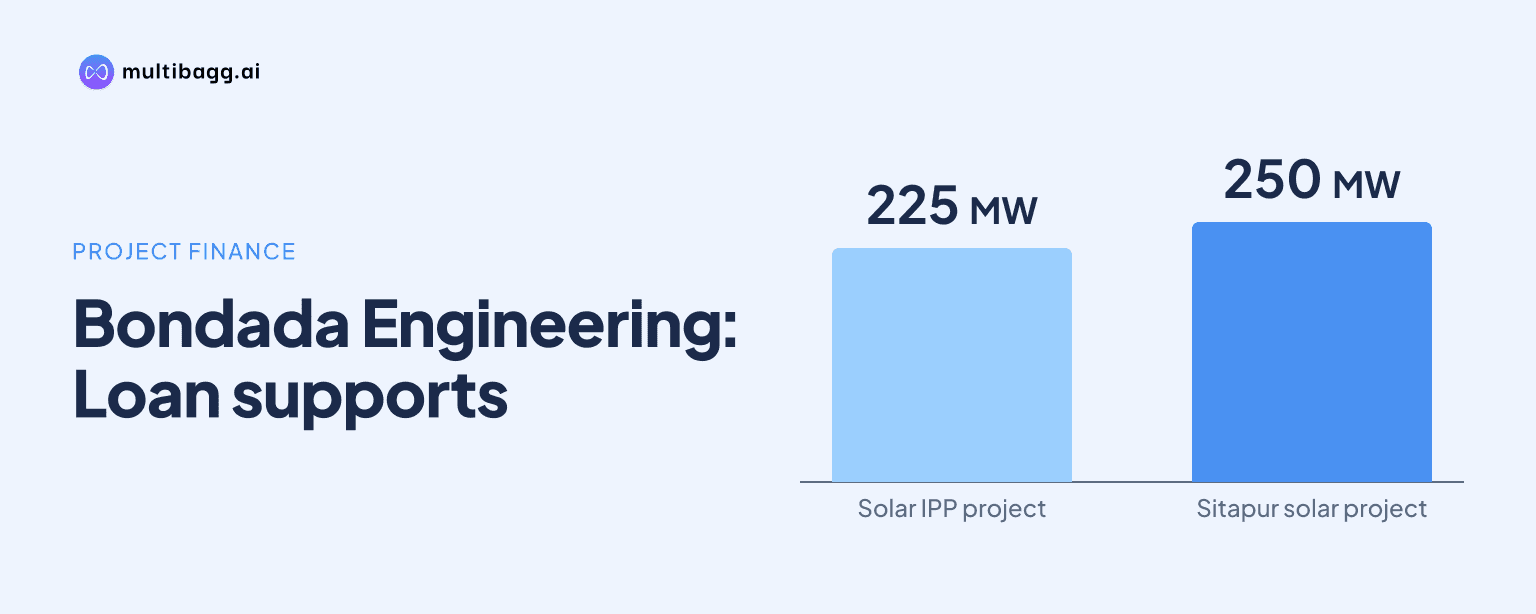
Bondada Engineering Limited said it had received State Bank of India sanction for a term loan for its 225 MW solar independent power producer project, a disclosed financing milestone alongside a separate notification of award for a 250 MW solar project in Sitapur, Uttar Pradesh.
Know Bondada Engineering inside out
Results, valuation, peers and who's buying, in one view.
What did Bondada Engineering disclose about the 225 MW solar project?
Bondada Engineering disclosed that it received sanction of a term loan from State Bank of India for a 225 MW solar IPP project. The filing identifies the lender, the financing category and the project capacity, but it does not state the loan amount, interest rate, tenure, repayment schedule, collateral or disbursement conditions.
A term-loan sanction is distinct from a project commissioning update. The information provided does not specify the project location, construction status, expected commissioning date, capital expenditure or anticipated generation from the 225 MW asset. It also does not disclose whether the sanction has been drawn down or whether further financing approvals are required.
For Bondada Engineering, the disclosure is relevant because it records a named bank's sanction for a project being developed under the IPP model. Under this model, the developer typically owns and operates the generating asset, rather than only executing construction work for another asset owner. The filing itself, however, does not provide commercial or operating details beyond the project capacity and the lender's name.
What is the separate 250 MW Sitapur solar award?
Bondada Engineering also announced receipt of a notification of award for development of a 250 MW solar project at Sitapur in Uttar Pradesh. This is a separate disclosure from the State Bank of India term-loan sanction for the 225 MW solar IPP project.
The award notification concerns project development at a specified location, while the term-loan disclosure concerns financing for a project with a different stated capacity. The supplied information does not say that the two announcements relate to the same project, and their capacities differ by 25 MW.
No order value, project timeline, off-taker details, tariff, execution scope or payment terms were disclosed for the Sitapur project in the material provided. As a result, the notification establishes the existence of an award but does not allow an assessment of its revenue contribution or profitability.
How does this fit Bondada Engineering's renewable-energy plans?
The announcements fit within Bondada Engineering's stated expansion into renewable energy and energy-storage activities. The company has said that the first 250 MW of its Andhra Pradesh 2 GW solar IPP plan is intended for FY27, with the remaining capacity planned over four to five years.
That stated Andhra Pradesh plan should not be treated as the same project as either the 225 MW loan-backed IPP or the 250 MW Sitapur award unless the company provides a direct link. The available material identifies Sitapur as being in Uttar Pradesh, whereas the 2 GW IPP expansion plan refers to Andhra Pradesh.
Bondada Engineering has also cited build-own-operate battery energy storage system orders of 400 MWh from TNGECL and 450 MWh from APTRANSCO. The company said the TN project is scheduled for commissioning by 31 December 2026. These energy-storage activities show that the renewable platform includes both solar generation and storage, although the disclosures do not provide a combined project economics or capital-allocation figure.
Got a follow-up? Ask IRIS
What information matters for investors after the loan sanction?
For investors, the State Bank of India sanction provides a specific financing datapoint for the 225 MW solar IPP project, but the financial impact cannot be quantified from the disclosure. The loan size, cost of borrowing, equity contribution, project cost and expected revenue have not been provided.
The 250 MW Sitapur award adds another identified solar development opportunity. Yet the disclosure does not state the award value or execution period, so it cannot be translated into an order-book addition or a revenue timeline based on the supplied information. Investors also have no disclosed basis here to calculate potential margins from either solar project.
No share-price movement, trading volume or market reaction is included in the material. Therefore, there is no verified evidence in the supplied information to attribute a direct stock-market response to either announcement. The principal factual takeaway is the combination of a bank loan sanction for one 225 MW IPP project and a separate 250 MW project award.
How could these projects affect Bondada Engineering's operations?
The disclosures indicate work across two different stages of solar-project activity: financing for a 225 MW IPP project and a development award for a 250 MW project in Sitapur. Financing availability is relevant to an IPP because ownership and operation require funding over the asset's development and operating life, while an award establishes a project-development mandate.
The company has expanded beyond its earlier telecom infrastructure base into renewable energy, railways, battery energy storage and infrastructure products. Its reported data-centre activity includes an operations and maintenance contract from Microsoft India in Telangana and a February 2026 memorandum of understanding with Bryanston Renewables for green-powered data-centre facilities in Hyderabad and Vizag.
These broader activities provide context for Bondada Engineering's expansion, but the supplied material does not indicate whether the 225 MW or Sitapur project will supply any data-centre development. It also does not disclose workforce additions, local procurement, land requirements or community impacts associated with either solar project.
Conclusion
Bondada Engineering has reported two separate solar-sector developments: State Bank of India has sanctioned a term loan for its 225 MW solar IPP project, and the company has received a notification of award to develop a 250 MW solar project at Sitapur in Uttar Pradesh. The announcements add financing and project-development milestones, but their financial implications remain unquantified because key commercial terms have not been disclosed.
The next disclosed operating milestone is the planned FY27 start for the first 250 MW of Bondada Engineering's Andhra Pradesh 2 GW solar IPP expansion, while the remainder is planned over four to five years. Further company disclosures on loan drawdown, project locations, construction schedules, order value, power-sale arrangements and commissioning will be needed to assess execution progress.