










CDSL says paid search API reduced KRA transactions in Q2
Key highlights
- CVL revenue rose 20% to Rs 99.91 crore in H1 FY27 from Rs 83.52 crore in H1 FY26.
- CVL total expenditure increased 33% to Rs 75.81 crore in H1 FY27.
- CDSL said search API transactions declined after the formerly free service became chargeable.
- CDSL disclosed KRA rack rates of 5 rupees for creation and 28 rupees for fetching records.
powered by IRIS
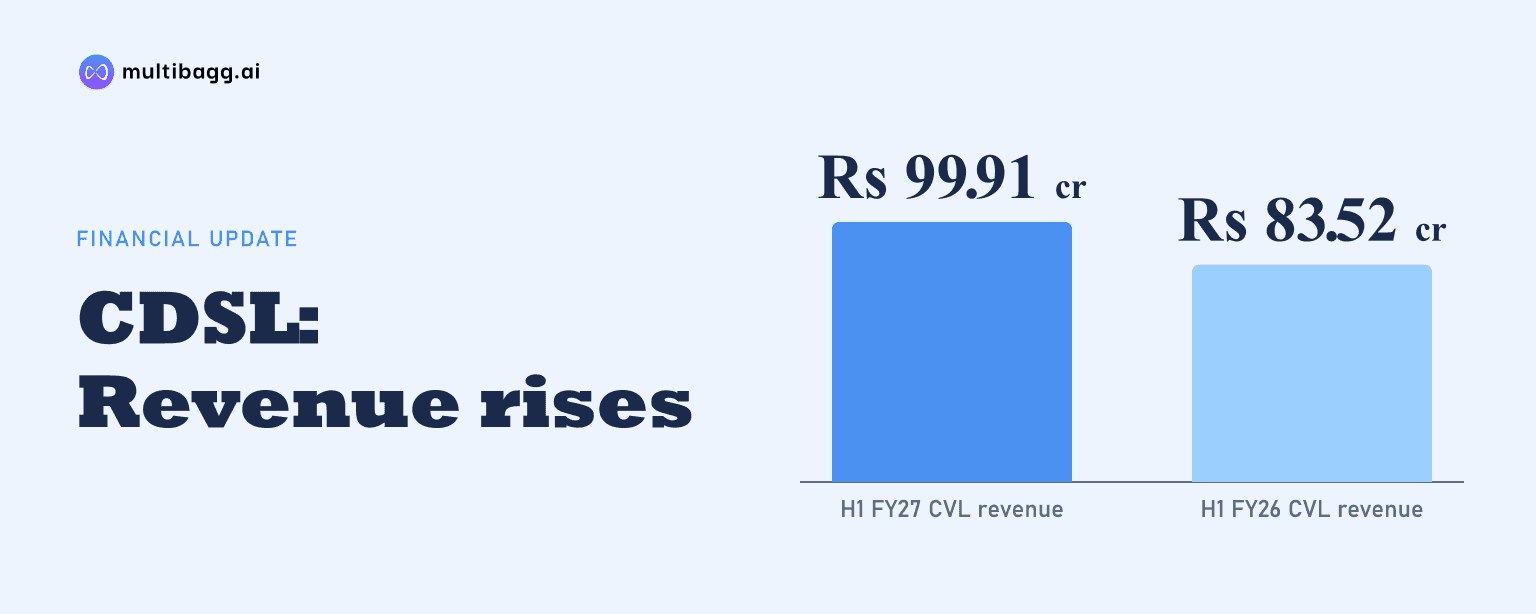
CDSL said its paid search application programming interface (API) reduced KRA transactions in the second quarter because intermediaries fine-tuned their systems after a formerly free service became chargeable. The change came as CVL reported H1 FY27 revenue of Rs 99.91 crore, up 20% from Rs 83.52 crore a year earlier.
Know Central Depository Services (India) inside out
Results, valuation, peers and who's buying, in one view.
Why did CDSL's paid search API transactions decline in Q2?
CDSL said search API revenue and transaction volumes declined from the first quarter after the service changed from free to chargeable. Management said intermediaries began fine-tuning their systems once charges applied, reducing the number of searches they conducted. It did not disclose search API revenue, transaction volumes or the size of the sequential decline.
The shift reflects a change in usage behaviour rather than a disclosed reduction in the API's stated price. CDSL said the service had earlier been free, while the later introduction of charges led intermediaries to optimise their processes. That means the lower volume followed a new payment mechanism, although management gave no timeline beyond comparing the quarter with the first quarter.
Search API activity differed from the broader KRA record-creation and record-fetching business. Management said higher numbers of records were created and fetched, and that these volumes had largely absorbed the effect of a pricing revision introduced on April 1, 2026. CDSL did not provide a revenue split between search API, record creation and record fetching.
The company also did not disclose blended realised KRA prices, saying it does not discuss them publicly. This limits the ability to measure how much lower search API usage affected CVL revenue relative to higher creation and fetch activity. The disclosed movement is therefore directional: search API transactions fell, while other KRA volumes increased.
What KRA prices did CDSL disclose after April 2026?
CDSL disclosed rack rates of 5 rupees for record creation and 28 rupees for record fetching after the April 1, 2026 pricing revision. Management said the creation rate had been reduced by 75%, while the fetching rate had been reduced by 20%. These were rack rates, not blended prices realised across clients.
The lower rates were discussed in the context of rising operating activity. Management said the higher number of records created and fetched had, to a large extent, offset the pricing effect introduced from April 2026. It did not state whether the volume growth fully compensated for the lower rates or identify the revenue contribution of each service.
Fetch volumes also affect costs. CDSL said interoperability expenses increased with higher fetch volumes, making that cost directly connected to KRA activity. Thus, fetching more records can support revenue after a price cut while also increasing the related expense base.
This distinction matters for the business-model change disclosed in the call. Search API transactions declined after charging began, whereas higher fetch volumes raised both operating activity and interoperability expense. Management did not provide quarterly KRA profitability or a separate expense amount for interoperability.
How are e-sign and Aadhaar eKYC affecting CVL costs?
CDSL said higher e-sign volumes in the quarter increased the amount payable to UIDAI because Aadhaar-based eKYC must be completed before an e-sign. Management did not disclose the number of e-signs, the UIDAI charge per transaction or the total payment made during the quarter.
The resulting cost is volume-linked rather than described as a fixed technology expense. As more e-signs are completed, more Aadhaar-based eKYC records must be processed and UIDAI payments rise accordingly. CDSL identified this as one reason other expenses increased in the KRA business.
CDSL has also started providing Aadhaar-based eKYC separately and registering sub-KUAs for the facility. Management said income from that service has increased. It also said UIDAI is paid according to the number of records CDSL processes for sub-KUAs, creating a linked revenue and transaction-cost model.
The call did not quantify either the newer Aadhaar-based eKYC income or its UIDAI-linked cost. Still, the disclosed mechanism differs from the search API change: search API revenue fell as usage was reduced after charges began, while eKYC income can rise with records processed but carries a corresponding UIDAI payment.
Got a follow-up? Ask IRIS
What do CVL's H1 FY27 results show?
CVL reported revenue of Rs 99.91 crore in H1 FY27, up 20% from Rs 83.52 crore in H1 FY26, while total expenditure increased 33% to Rs 75.81 crore. Revenue growth therefore lagged the increase in expenditure during the six-month period, alongside the activity-linked costs described by management.
Other income declined 16% to Rs 7.82 crore, while total income rose 16% to Rs 107.70 crore from Rs 92.84 crore. Management said profit before tax moderated 11% to Rs 21.91 crore and profit after tax declined 12% to Rs 23.74 crore. The source did not allocate the expenditure increase between interoperability, UIDAI, technology or other cost categories.
The figures show that CVL's reported revenue increased despite the decline in search API revenue versus the first quarter. Higher record creation and fetching, as well as income from separately offered Aadhaar-based eKYC, were the relevant operating developments management identified. However, the company did not disclose their individual contributions to the 20% revenue increase.
Which other revenue and cost items did CDSL disclose?
CDSL said other administrative expenses increased sequentially because certain costs, including short message service alerts and revenue expenses, are linked directly to operating activity. Management did not provide an absolute quarterly figure for other administrative expenses, but said they increase when business activity rises.
For the wider business, CDSL reported quarterly margin-pledge income of Rs 6.19 crore, e-CAS income of Rs 12.77 crore and e-voting income of Rs 22 crore. It also reported unlisted issuer-fee revenue of Rs 87 lakh and application-processing fees of Rs 2.2 crore.
IPO and corporate-action income is monitored as one consolidated revenue item, CDSL said. Management does not internally track separate IPO, corporate-action and IPO verification revenue. The BO verification charge for an IPO application is 2 rupees, but CDSL did not disclose the amount generated from that charge.
Management attributed higher IPO and corporate-action activity to the number of IPOs and the number of subscribers to those offerings. It said the revenue outcome depends on how many times an IPO is oversubscribed. CDSL did not provide a break-up of the Rs 102 crore IPO and corporate-action revenue figure raised by an analyst.
Conclusion
CDSL's disclosure shows two different transaction patterns within its KRA-related services. Charging for the search API reduced usage as intermediaries refined their systems, while higher record creation, fetching, e-sign and Aadhaar-based eKYC activity supported CVL revenue of Rs 99.91 crore in H1 FY27. The same volume growth also increased interoperability and UIDAI-linked costs.
The next results should indicate whether search API volumes stabilise after intermediaries' system changes and whether e-sign, sub-KUA registration and separately offered Aadhaar-based eKYC continue to add income. Management also said the ability to provide ISINs for unlisted companies remains under regulatory supervision and is still in process, without providing a resolution date.