










Ceinsys Tech Limited Q2 FY27 Profit Rises 26.7% as Revenue Slips
Key highlights
- Ceinsys Tech reported Q2 FY27 consolidated net profit of ₹32.61 crore, up 26.7% year on year.
- Q2 FY27 consolidated revenue declined 2.4% year on year to ₹159.48 crore.
- H1 FY27 geospatial revenue rose 52% to ₹224.70 crore, while Technology Solutions revenue fell 46%.
- Ceinsys Tech received in-principle approval to establish a wholly owned UAE subsidiary with an investment of ₹1 crore.
powered by IRIS
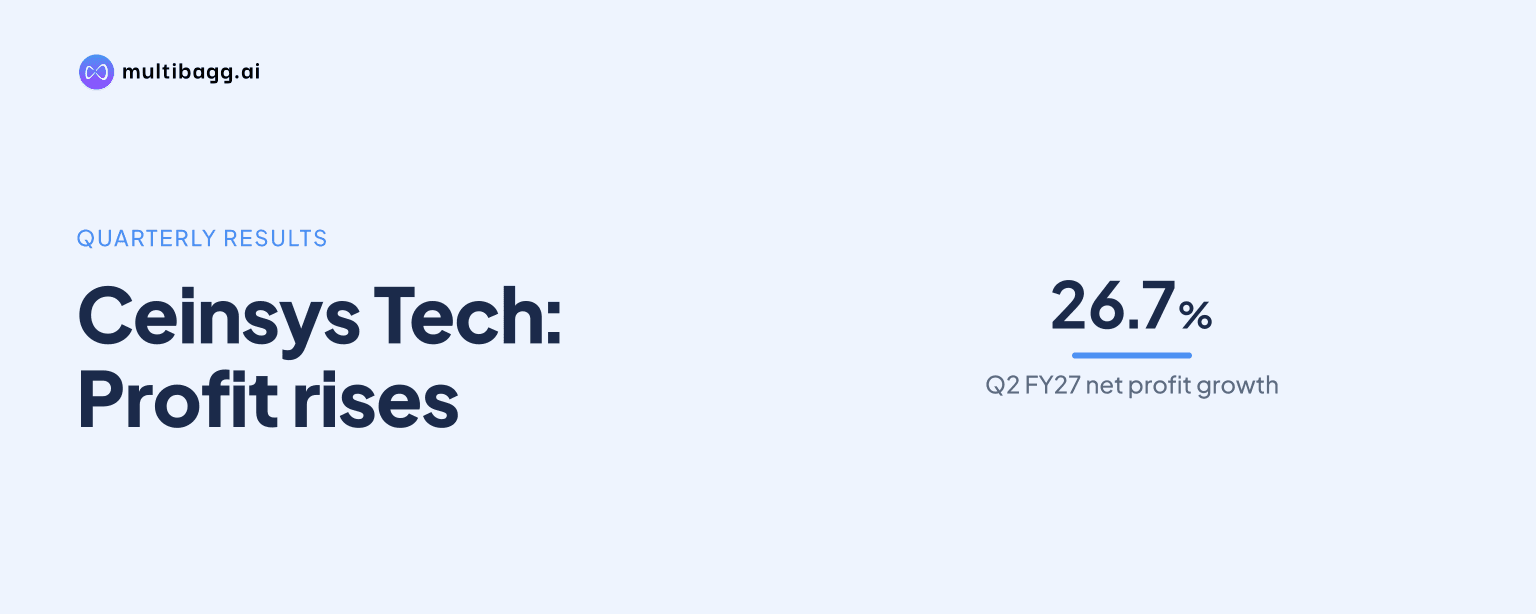
Ceinsys Tech Limited reported a 26.7% year-on-year increase in Q2 FY27 consolidated net profit to ₹32.61 crore, while consolidated revenue declined 2.4% to ₹159.48 crore. The results show that profit growth continued despite a modest top-line decline, with geospatial operations supporting the half-year performance.
Know Ceinsys Tech inside out
Results, valuation, peers and who's buying, in one view.
What did Ceinsys Tech report for Q2 FY27?
Ceinsys Tech reported consolidated revenue of ₹159.48 crore for the quarter ended September 30, 2026, compared with ₹163.45 crore in the corresponding quarter of the previous year. The 2.4% year-on-year revenue decline came alongside a consolidated net profit of ₹32.61 crore, up from ₹25.74 crore a year earlier.
The company’s Q2 results were unaudited and received unmodified limited-review conclusions. On a sequential basis, consolidated revenue increased 1.1%, according to the earnings summary. The board approved the Q2 and H1 FY27 financial results on November 12, 2026.
Standalone figures showed a different profit base from the consolidated statement. Standalone revenue was ₹148.16 crore, down 6.2% year on year from ₹157.96 crore, while standalone profit after tax rose 6.67% to ₹42.20 crore. Standalone operating profit increased 2.74% to ₹43.19 crore.
How did Ceinsys Tech perform in the first half of FY27?
Ceinsys Tech recorded H1 FY27 consolidated revenue of ₹317.27 crore and consolidated net profit of ₹63.56 crore. Half-year revenue was broadly flat year on year, while profit increased 10.8%, indicating improved earnings despite limited overall revenue growth.
The geospatial business was the main reported growth driver during the half year. Geospatial revenue rose 52% to ₹224.70 crore, helping offset a 46% decline in Technology Solutions revenue. This business mix shift is important because it explains why profit growth outpaced the consolidated revenue trend.
The company had reported Q1 FY27 revenue of ₹158 crore and net profit of ₹31 crore. Together with the second-quarter numbers, those reported figures provide the basis for the H1 consolidated revenue and profit disclosed by the board.
Why did profit rise when revenue declined?
Ceinsys Tech’s reported profit growth coincided with stronger geospatial revenue in H1 FY27, even as Technology Solutions revenue fell sharply. The disclosed figures do not provide a detailed segment-level profitability split, but the 52% geospatial revenue increase and 10.8% rise in half-year profit point to the importance of the segment mix during the period.
The comparison also needs to distinguish between standalone and consolidated accounts. Consolidated profit was ₹32.61 crore in Q2, whereas standalone profit after tax was ₹42.20 crore. Investors should use the consolidated figures when assessing the performance of the full group and the standalone figures when reviewing the parent company’s own operations.
Ceinsys Tech had previously highlighted a ₹990 crore order book at the end of Q1 FY27. The company had identified geospatial enterprise solutions, transport, energy, and satellite defence data analytics as areas expected to support growth. The Q2 filing does not quantify how much of that order book converted into quarterly revenue.
Got a follow-up? Ask IRIS
What board and leadership decisions were announced?
Ceinsys Tech appointed Richa Jain, previously Deputy Chief Financial Officer, as Chief Financial Officer. The board also appointed Bala Pavan Kumar Tsunduru as President, effective December 7, 2026.
Separately, the board granted in-principle approval to establish a wholly owned subsidiary in the United Arab Emirates with an investment of ₹1 crore. The filing identifies the approval but does not specify a revenue target, operating start date, or financial contribution expected from the proposed UAE entity.
These decisions come as the company pursues operations across geospatial, mobility, and technology-related businesses. The UAE proposal represents an intended overseas corporate expansion, while the finance and leadership appointments formalise changes in key management roles.
What should investors monitor after the Q2 FY27 results?
Investors will monitor whether geospatial growth remains sufficient to offset the decline in Technology Solutions revenue. The 52% increase in H1 geospatial revenue was the clearest reported operating growth figure, while H1 consolidated revenue remained broadly unchanged at ₹317.27 crore.
Working-capital trends also remain relevant. The earnings summary noted that receivables increased by about 36%, contributing to negative operating cash flow. Higher receivables can affect cash conversion even when reported profits rise, making future disclosures on collections and operating cash generation important.
The company’s order book, segment revenue mix, progress on the UAE subsidiary, and the impact of the leadership changes will be relevant in subsequent filings. No forward revenue or profit guidance was provided in the supplied results information.
Conclusion
Ceinsys Tech delivered higher Q2 and H1 profit despite a decline in quarterly consolidated revenue. The performance was supported by strong geospatial revenue growth, while Technology Solutions weakened, leaving the company with a more concentrated dependence on the faster-growing segment.
The next disclosures should clarify whether geospatial momentum continues, whether receivables and operating cash flow improve, and how the proposed UAE subsidiary progresses after its in-principle approval. Investors can also track the company’s ₹990 crore reported Q1 FY27 order book for evidence of conversion into revenue.