










Chadha Papers Returns to Profit With ₹4.61 Crore Q2 FY27 Gain
Key highlights
- Chadha Papers reported standalone profit of ₹4.61 crore in Q2 FY27, versus a ₹0.54 crore loss in Q2 FY26.
- The disclosed year-on-year change in Chadha Papers' quarterly earnings was ₹5.15 crore.
- Chadha Papers' board meeting for Q2 FY27 results was scheduled for 14 November 2026 at 12:30 PM.
- Chadha Papers reported a consolidated FY26 net loss of ₹7.70 crore after a ₹3.50 crore profit in FY25.
powered by IRIS
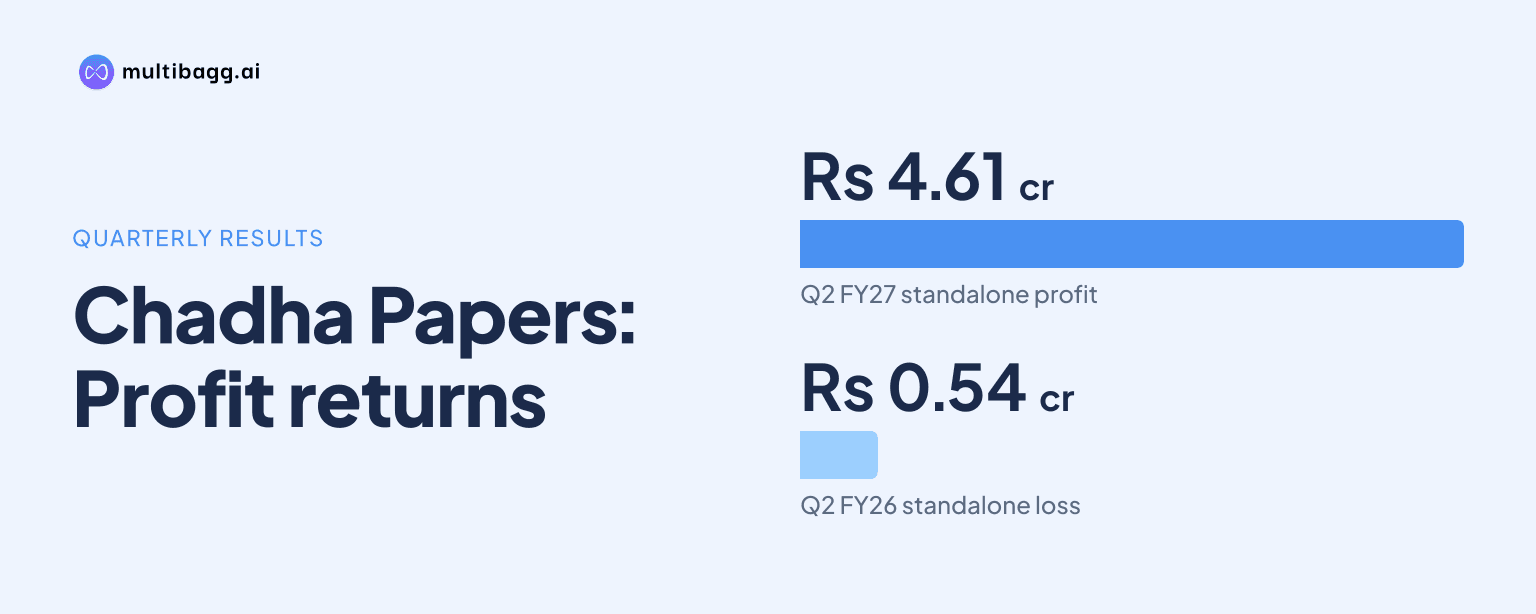
Chadha Papers Ltd reported a standalone profit of ₹4.61 crore for the quarter ended 30 September 2026, reversing a standalone loss of ₹0.54 crore a year earlier. The shift marks a material year-on-year improvement in the company’s quarterly earnings after a loss-making comparable period.
Know Chadha Papers inside out
Results, valuation, peers and who's buying, in one view.
What did Chadha Papers report for Q2 FY27?
Chadha Papers Ltd reported standalone profit of ₹4.61 crore in Q2 FY27, compared with a loss of ₹0.54 crore in Q2 FY26. The quarter ended on 30 September 2026, and the reported change represents a turnaround in the company’s standalone bottom line on a year-on-year basis.
The result was listed in the 14 November 2026 Q2 FY27 results calendar, which covered 833 companies. Chadha Papers is identified by the scrip code 531946. The available information specifies the quarterly profit figure and the prior-year loss, but does not provide standalone revenue, expense or margin details for the September 2026 quarter.
The distinction between profit and loss is significant because the comparable quarter in the previous financial year ended with a negative result. On the disclosed figures, the change in quarterly earnings was ₹5.15 crore, calculated from a ₹4.61 crore profit against a ₹0.54 crore loss in Q2 FY26.
When did the board consider the September quarter results?
Chadha Papers scheduled its board meeting for 14 November 2026 at 12:30 PM to consider, approve and take on record the unaudited financial results for the quarter ended 30 September 2026. The meeting was to be held at the company’s registered office at R-11, Nehru Enclave, New Delhi-110019.
The company’s board-meeting intimation stated that the results would be accompanied by limited review reports from its statutory auditors. A limited review is relevant for investors because it is part of the reporting process for unaudited quarterly financial statements.
Earlier notices dated 21 October and 11 November 2026 also referred to a board meeting for reviewing financial results for the quarter and half-year. The final scheduled meeting date remained 14 November, with approval of the Q2 FY27 unaudited results as the stated primary agenda item.
How does Q2 FY27 compare with Chadha Papers' recent performance?
The Q2 FY27 standalone profit follows a difficult FY26 disclosed in the company’s earlier results coverage. For FY26, Chadha Papers reported a consolidated net loss of ₹7.70 crore, compared with a consolidated profit of ₹3.50 crore in FY25.
Revenue from operations for FY26 declined 4% to ₹500.20 crore from ₹513.30 crore in FY25, while total income fell to ₹502.60 crore from ₹522.80 crore. These annual figures are consolidated, whereas the latest Q2 FY27 figure is standalone, so they should not be treated as directly comparable on the same reporting basis.
The company had also reported a consolidated loss of ₹4.10 crore for the March 2026 quarter. In the September 2025 quarter, Chadha Papers reported a consolidated loss of ₹1.33 crore. The reported Q2 FY27 standalone profit therefore provides a more favourable quarterly earnings data point, although the available disclosure does not provide a full consolidated comparison for the latest quarter.
Got a follow-up? Ask IRIS
What does the profit turnaround mean for investors and operations?
The reported profit turnaround matters because Chadha Papers moved from a standalone loss in the September 2025 quarter to a profit in the September 2026 quarter. It gives investors a current earnings figure following FY26, when consolidated sales declined and the company recorded a full-year consolidated loss.
However, the disclosed information does not explain the individual drivers of the Q2 FY27 profit. There are no provided figures for quarterly sales, operating costs, finance costs, exceptional items, margins or segment performance. Investors should therefore avoid attributing the improvement to a particular operational factor until the detailed unaudited financial statements are available.
The company’s historical results also show why reporting basis matters. The latest headline is a standalone number, while several prior figures cited for FY26 and previous quarters are consolidated. Reviewing the detailed result document and the statutory auditors’ limited review report would help establish whether the improvement is reflected across the wider reporting structure.
Why is the reporting basis important in this result?
The reporting basis is important because standalone and consolidated financial results capture different sets of entities and may not measure earnings on an identical basis. Chadha Papers has disclosed the Q2 FY27 headline result as standalone profit, while prior reported FY26 and quarterly performance data in the available information include consolidated figures.
For the latest quarter, the clearest like-for-like comparison supplied is the standalone result for Q2 FY26: a loss of ₹0.54 crore. This supports the stated year-on-year turnaround, but it does not establish changes in consolidated earnings, revenue growth or operating profitability for Q2 FY27.
The board’s consideration of unaudited results and the associated limited review reports are therefore central to the update. They provide the formal context for the September-quarter disclosure, while the fuller financial statements would provide the line-item detail required for a broader assessment.
Conclusion
Chadha Papers reported a standalone profit of ₹4.61 crore for Q2 FY27 after a ₹0.54 crore loss in the comparable quarter a year earlier. The result marks a clear improvement in the disclosed quarterly bottom line, particularly after FY26 saw a consolidated loss of ₹7.70 crore and a decline in revenue from operations.
The next point to watch is the detailed unaudited September-quarter financial statement approved by the board on 14 November 2026, along with the statutory auditors’ limited review report. These disclosures can clarify the revenue, cost and reporting-basis factors behind the quarterly turnaround.