








Chatha Foods Limited Files H1 FY27 Presentation With ₹4.2 Crore Loss
MAX Plan at ₹4,999/yr

Find your next multibaggerBe a Pro Investor
Research stocks and track your picks on the go. Download the app.
Key highlights
- Chatha Foods filed its H1 FY27 investor presentation on November 27, 2026.
- The presentation reported H1 FY27 revenue of ₹94.4 crore, up 12.3% year on year.
- Chatha Foods reported an EBITDA loss of ₹4.2 crore for H1 FY27.
- The presentation disclosed an attributable loss of ₹5.2 crore for H1 FY27.
powered by IRIS
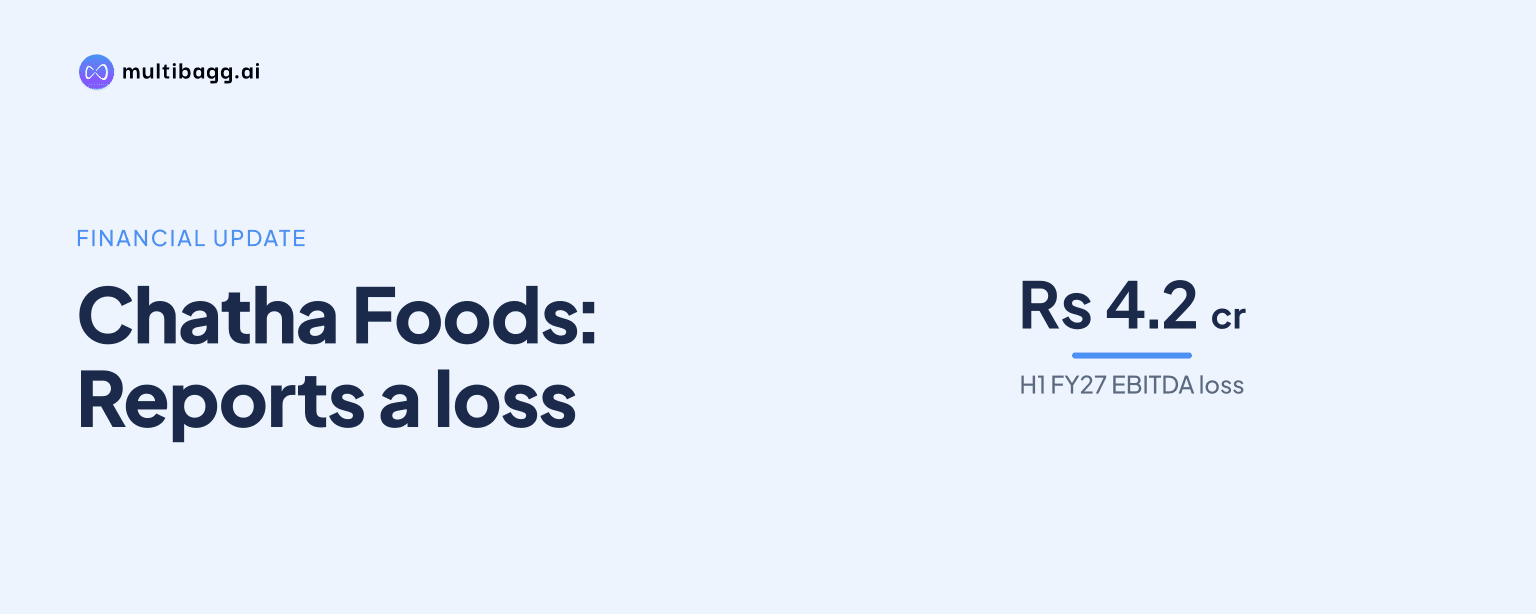
For H1 FY27, Chatha Foods Limited filed an investor presentation reporting a ₹4.2 crore EBITDA loss. The presentation reported revenue of ₹94.4 crore, up 12.3% year on year, while attributing a ₹5.2 crore loss to the period. The filing gives investors an updated view of the company’s revenue growth and profitability position.
Know Chatha Foods inside out
Results, valuation, peers and who's buying, in one view.
What did Chatha Foods disclose in its H1 FY27 presentation?
Chatha Foods disclosed H1 FY27 revenue of ₹94.4 crore, representing year-on-year growth of 12.3%, alongside an EBITDA loss of ₹4.2 crore. The investor presentation also reported an attributable loss of ₹5.2 crore for the six months ended September 30, 2026.
The presentation was submitted on November 27, 2026. It follows the company’s November 14 disclosure of unaudited standalone and consolidated financial results for the same half-year period. The earlier results disclosure reported consolidated revenue from operations of ₹94.4 crore and a consolidated net loss of ₹6.3 crore.
The figures show that revenue expanded from the comparable H1 FY26 period, but costs and operating developments weighed on profitability. Chatha Foods had previously said that higher costs, a new plant and subsidiary start-up affected margins in the half year.
Why did revenue growth not translate into profit?
Revenue growth did not translate into profit because Chatha Foods previously identified higher costs, a new plant and a subsidiary start-up as factors that weighed on margins. The supplied results information states that the company commissioned its vegetarian plant on July 27, 2026, while the Allana joint venture began on July 9, 2026.
These developments occurred during the reported half year and coincided with a shift from profit to loss in the statutory results. Chatha Foods’ standalone revenue rose 11.4% year on year to ₹93.6 crore, but standalone net results moved to a loss of ₹3.5 crore from a profit of ₹3.2 crore a year earlier.
The filing summary does not provide a detailed bridge between the EBITDA loss of ₹4.2 crore, the attributable loss of ₹5.2 crore and the ₹6.3 crore consolidated net loss reported in the November 14 results announcement. Investors should therefore treat these as separately disclosed measures and refer to the underlying presentation and financial statements for their definitions and scope.
How does H1 FY27 compare with the previous half year?
H1 FY27 compares unfavourably with H1 FY26 on profitability, although revenue was higher. Consolidated revenue from operations increased to ₹94.4 crore from ₹84.1 crore, while consolidated net profit changed to a loss of ₹6.3 crore from a profit of ₹2.9 crore.
The change was also visible against H2 FY26. Revenue from operations was ₹81.7 crore in H2 FY26, while H1 FY27 revenue was ₹94.4 crore. However, H2 FY26 had reported a consolidated net profit of ₹3.5 crore, compared with the H1 FY27 loss.
Got a follow-up? Ask IRIS
What does the presentation mean for Chatha Foods investors?
The presentation gives Chatha Foods investors a current operating update in which double-digit revenue growth was accompanied by negative EBITDA and an attributable loss. For shareholders, the key point is that the expansion in sales has not yet offset the cost impact associated with the new plant and subsidiary start-up mentioned in the company’s earlier results disclosure.
The reported loss is material when compared with Chatha Foods’ recent annual profitability. The supplied financial data shows FY26 net income of ₹6.38 crore, while the consolidated H1 FY27 results reported a net loss of ₹6.3 crore. This comparison illustrates the scale of the earnings reversal during the first half.
The investor presentation itself does not provide a share-price movement, valuation update or fresh management guidance in the supplied information. There are also no direct management quotes in the filing summary. As a result, the disclosure should primarily be read as a financial and operational update rather than as a statement of a revised outlook.
What operating background is relevant to the filing?
The relevant operating background is Chatha Foods’ ongoing capacity and business expansion. The company is described in the supplied material as an Indian manufacturer of frozen and ready-to-eat processed foods. Its earlier investor material referred to operational capacity of 30,800 metric tonnes and distribution across more than 5,000 stores in India.
In its April 2026 investor presentation, Chatha Foods had reported H1 FY26 revenue of ₹84.1 crore, gross profit of ₹22.5 crore and profit after tax of ₹2.9 crore. The H1 FY27 filing therefore marks a period where revenue continued to rise but profitability weakened after the company began new operations.
The November 14 results announcement stated that the limited review report was unqualified. This means the supplied information does not indicate a qualification in that review, although investors assessing the financial position will need to consider the full presentation and the separate unaudited results together.
Conclusion
Chatha Foods’ H1 FY27 investor presentation records revenue of ₹94.4 crore and 12.3% year-on-year growth, but also an EBITDA loss of ₹4.2 crore and an attributable loss of ₹5.2 crore. The filing places the company’s sales growth alongside a deterioration in profitability during a half year that included new plant commissioning and a subsidiary start-up.
The next relevant disclosures will be those that clarify the operating contribution, costs and margin trajectory of the new facilities and businesses. Investors can also monitor subsequent financial results for whether revenue growth and the company’s stated expansion plans translate into an improvement from the H1 FY27 loss position.

