










CleanMax H1 EBITDA rises 56% as portfolio reaches 13.2 GW
Key highlights
- CleanMax reported 67% H1 FY27 revenue growth and 56% adjusted EBITDA growth year-on-year.
- H1 FY27 consolidated revenue was ₹1,559.81 crore and profit after tax was ₹120.12 crore.
- CleanMax commissioned 550 MW in H1 FY27, taking operational renewable power sales capacity to 3,638 MW.
- CleanMax raised ₹2,500 crore through green bonds and retained an FY28 reported EBITDA target of at least ₹3,000 crore.
powered by IRIS
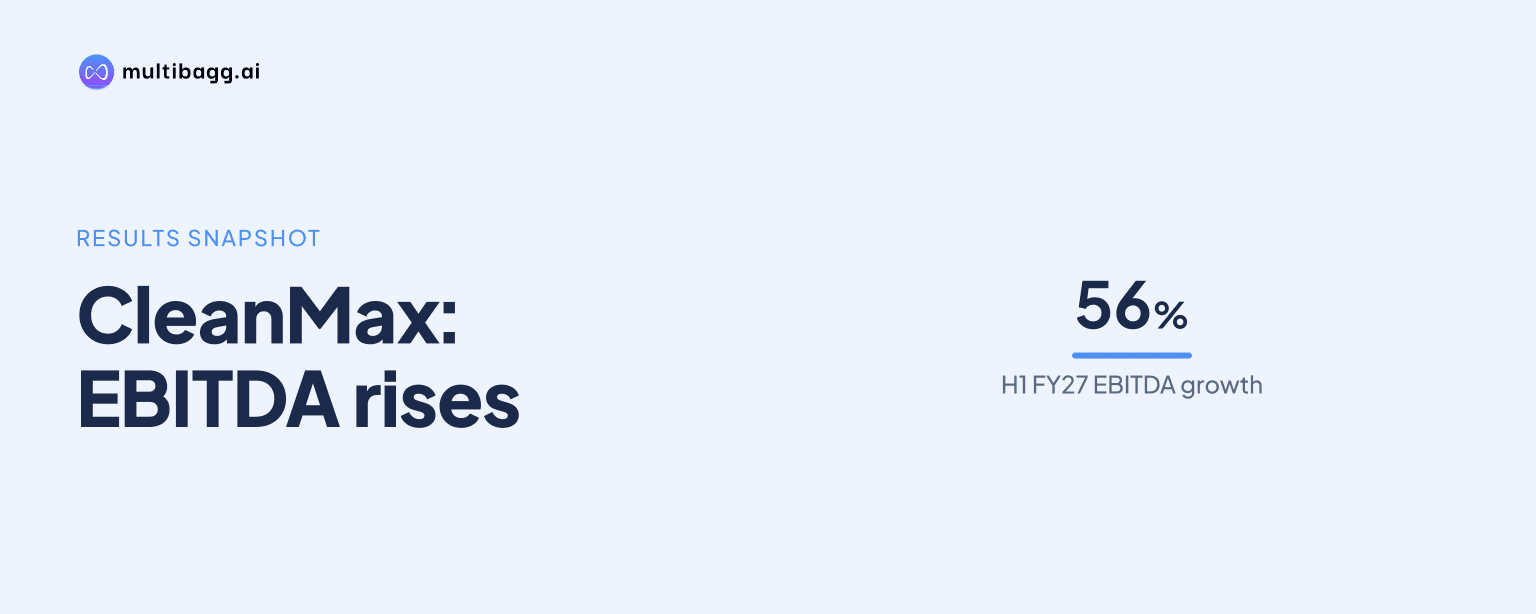
Clean Max Enviro Energy Solutions Limited, or CleanMax, reported 67% revenue growth and 56% adjusted EBITDA growth in H1 FY27, supported by 0.6 GW of commissioning that took its total portfolio to 13.2 GW. The company has retained its FY28 target of at least ₹3,000 crore in reported EBITDA, subject to project commissioning and ramp-up.
Know Clean Max Enviro Energy Solutions inside out
Results, valuation, peers and who's buying, in one view.
What did CleanMax report for H1 FY27?
CleanMax reported stronger first-half financial performance as its renewable power sales capacity expanded. Consolidated H1 FY27 revenue was ₹1,559.81 crore, while profit after tax was ₹120.12 crore. The company said H1 revenue increased 67% year-on-year and adjusted EBITDA rose 56% from the corresponding period a year earlier.
The profit improvement was more pronounced than revenue growth. H1 profit after tax increased more than six-fold from ₹19 crore in the prior-year period to about ₹120 crore. This reflects the contribution of a larger operational renewable portfolio, according to the company’s disclosures.
For the September quarter, consolidated revenue was ₹727.65 crore and profit after tax was ₹64.95 crore. The company separately reported that quarterly revenue from operations rose 37% year-on-year from ₹531 crore, while adjusted EBITDA increased 43% to ₹553 crore. Reported EBITDA for the quarter was ₹548 crore, up 51% year-on-year, and quarterly profit after tax was about ₹65 crore, compared with ₹36 crore a year earlier.
How did project commissioning support CleanMax's growth?
CleanMax commissioned 550 MW of renewable power sales capacity across six states during H1 FY27, while its presentation referred to about 0.6 GW of commissioning. This increased operational renewable power sales capacity to 3,638 MW, which was approximately 57% above the level a year earlier.
The capacity additions are important because operational projects can support recurring electricity sales and improve the use of development and execution infrastructure. CleanMax’s total portfolio stood at 13.2 GW, a figure that indicates the scale of projects across its operating and development pipeline but is distinct from its 3,638 MW operational renewable power sales capacity.
The company has maintained FY27 guidance to add at least 1.5 GW of renewable power sales capacity. For the second half, it expects to execute at least 450 MW of State Transmission Utility-connected and onsite projects. These projects form part of the capacity programme that management has linked to its medium-term earnings objectives.
What are CleanMax's key financial and operating figures?
CleanMax’s reported figures show growth in earnings alongside continued investment in capacity and funding. The company’s FY28 EBITDA target relies on both commissioning projects and bringing them to planned operating levels.
CleanMax also raised ₹2,500 crore through a green bond issuance during the period. The green non-convertible debentures had fixed coupons and tenors of up to 10 years. The funding adds medium- to long-term capital for the company’s renewable project activity.
The interim disclosure also noted that standalone current liabilities exceeded current assets. This makes cash-flow management, project execution and the timing of debt servicing relevant factors alongside the company’s reported profit and capacity additions.
Got a follow-up? Ask IRIS
Which projects and funding actions are scheduled next?
CleanMax’s 534 MW Koppal Central Transmission Utility project in Karnataka is scheduled for phased commissioning between December 2026 and March 2027. Its delivery is a material near-term operational milestone because it is among the identified projects that can contribute to the company’s planned capacity expansion.
The company also expects to execute State Transmission Utility-connected and onsite projects in the second half of FY27. The mix of transmission-connected and onsite capacity indicates that CleanMax is serving more than one route to market, including projects linked to grid infrastructure and customer locations.
Earlier in October, the board approved the sale of a 26% stake in Clean Max Alps Private Limited to Bayer Vapi for ₹26,000, with completion expected by 31 December 2026. The disclosed consideration was ₹26,000. The transaction reduces the group’s ownership in that subsidiary, while the company continues to pursue project funding through debt instruments.
How does the update affect investors and the renewable energy sector?
The H1 update gives investors measurable evidence of revenue, EBITDA and profit growth alongside a higher operating base. The FY28 reported EBITDA target of at least ₹3,000 crore remains dependent on capacity being commissioned as planned and on projects reaching expected ramp-up levels. The company has not disclosed a share-price reaction to these results.
For the wider renewable sector, CleanMax’s update illustrates the capital-intensive nature of scaling commercial and industrial clean-power operations. Capacity execution requires project development, transmission connectivity and long-tenor funding. The ₹2,500 crore green bond issuance and the planned project pipeline show how debt financing is being used alongside operating cash generation to support expansion.
The reported balance-sheet observation on standalone current liabilities and current assets also places attention on liquidity management. Stronger operating results may support financial flexibility, but the disclosures do not provide a projection of future cash flows or a revised debt-repayment schedule.
Conclusion
CleanMax delivered higher H1 FY27 revenue, adjusted EBITDA and profit while commissioning 550 MW of renewable capacity and expanding operational renewable power sales capacity to 3,638 MW. Its 13.2 GW portfolio and ₹2,500 crore green bond funding provide the operational and financing context for its stated FY28 reported EBITDA ambition of at least ₹3,000 crore.
The next disclosed milestones are execution of at least 450 MW of State Transmission Utility-connected and onsite projects in H2 FY27, and phased commissioning of the 534 MW Koppal project from December 2026 to March 2027. Investors will also watch delivery against the company’s guidance of at least 1.5 GW of renewable power sales capacity additions in FY27.