










CleanMax H1 revenue rises 67% as EBITDA reaches ₹1,011 crore
Key highlights
- CleanMax's H1 FY27 revenue from operations rose 67% year-on-year to ₹1,560 crore.
- Reported H1 FY27 EBITDA increased 58% to ₹1,011 crore, while H1 profit after tax rose to ₹120 crore from ₹19 crore.
- CleanMax commissioned 550 MW in H1 FY27, taking operational renewable power sales capacity to 3,638 MW.
- The company had a 7.1 GW operational and contracted portfolio as of September 30, 2026, and retained FY27 capacity-addition guidance of at least 1.5 GW.
powered by IRIS
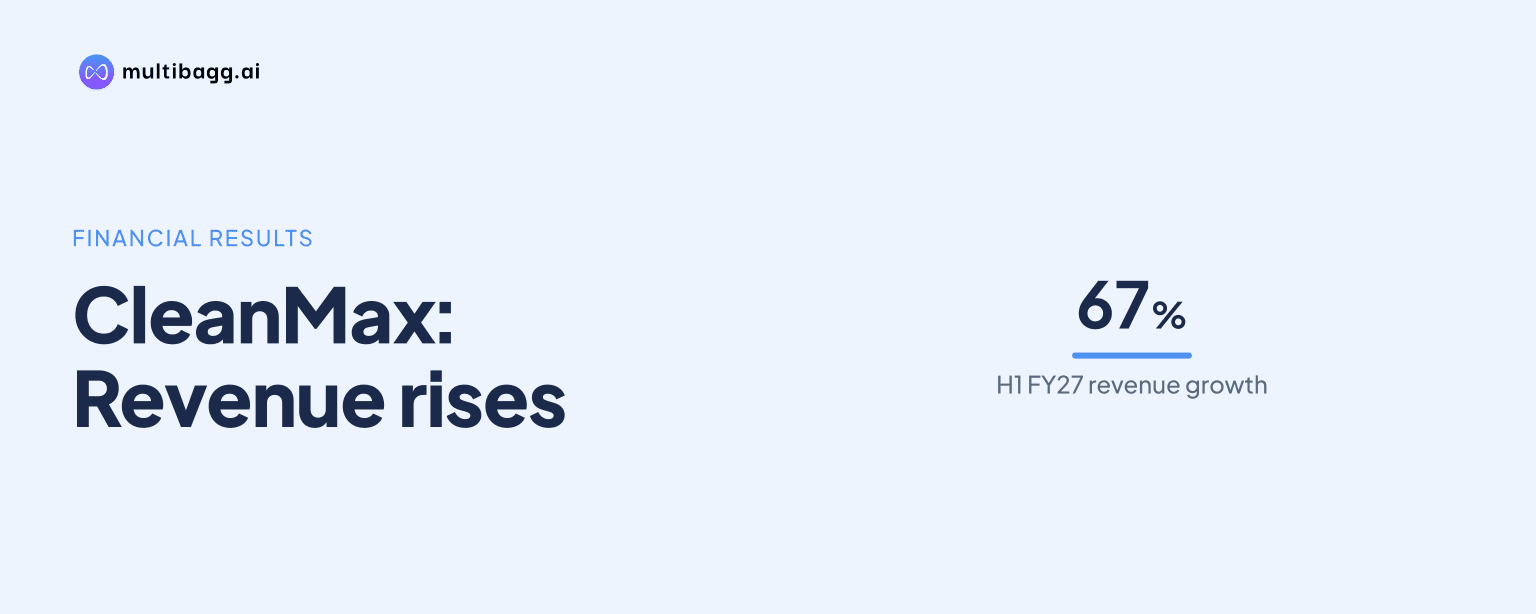
Clean Max Enviro Energy Solutions Limited reported H1 FY27 revenue growth of 67% to ₹1,560 crore and reported EBITDA growth of 58% to ₹1,011 crore, supported by expansion in its renewable power sales portfolio. Profit after tax rose to ₹120 crore from ₹19 crore a year earlier, while the total operational and contracted portfolio reached 7.1 GW as of September 30, 2026.
Know Clean Max Enviro Energy Solutions inside out
Results, valuation, peers and who's buying, in one view.
What did CleanMax report for Q2 and H1 FY27?
CleanMax reported a 37% year-on-year increase in Q2 FY27 revenue from operations to ₹728 crore, compared with ₹531 crore in the corresponding quarter a year earlier. Adjusted EBITDA rose 43% to ₹553 crore, while reported EBITDA increased 51% to ₹548 crore. Q2 profit after tax rose 82% to ₹65 crore from ₹36 crore.
For the first half of FY27, revenue from operations grew to ₹1,560 crore from ₹933 crore in H1 FY26. Reported EBITDA increased from the prior-year period by 58% to ₹1,011 crore, while adjusted EBITDA rose 56% to ₹1,047 crore. H1 profit after tax was ₹120 crore, more than six times the ₹19 crore recorded a year earlier.
The company said its EBITDA exceeded Street estimates for the third consecutive quarter. The disclosed figures point to continued operating growth alongside an improvement in reported profitability during the half year.
What drove CleanMax's H1 FY27 growth?
CleanMax attributed the expansion to its RE Power Sales business and the addition of renewable generation capacity. The company commissioned 550 MW of renewable power sales capacity across six states during the first half, taking operational renewable power sales capacity to 3,638 MW. That operating capacity was about 57% higher than a year earlier.
Corporate demand for renewable electricity remained a stated driver of new business. CleanMax said hyperscalers as well as conventional commercial and industrial customers were seeking tailored, reliable and cost-effective renewable energy arrangements. Repeat customers represented about 85% of newly contracted capacity, indicating that existing clients remained a significant source of new orders.
The company also cited growth in its commissioned and under-construction assets. Its RE Power Sales segment recorded 57% revenue growth in H1 FY27, according to the disclosed segmental information. RE Services revenue, meanwhile, declined 24% in Q2 but rose 107% for the first half, showing different quarterly trends across the two businesses.
How large is CleanMax's renewable energy portfolio?
CleanMax had a contracted RE Power Sales portfolio of 6.3 GW as of September 30, 2026, with another 0.8 GW in RE Services. Its combined operational and contracted portfolio therefore stood at 7.1 GW at the end of the reporting period.
The company said its wider platform capacity crossed 13 GW, including available grid evacuation capacity and connectivity applications. This measure is broader than operational and contracted capacity, as it includes infrastructure availability and applications that support future development.
CleanMax has retained its FY27 guidance to add at least 1.5 GW of renewable power sales capacity. During the second half, it expects to execute at least 450 MW of State Transmission Utility-connected and onsite projects. The 534 MW Koppal Central Transmission Utility project in Karnataka is scheduled for phased commissioning between December 2026 and March 2027.
Got a follow-up? Ask IRIS
What does the result mean for CleanMax's financial position and investors?
The earnings update shows that CleanMax is expanding its operating asset base while increasing revenue and EBITDA. Higher commissioned capacity can support power sales under long-term corporate arrangements, but execution of under-construction projects and their commissioning schedules remain central to translating the portfolio into operating revenue.
The company is also raising funds for medium- to long-term requirements. It disclosed green non-convertible debentures of ₹2,500 crore, while an interim report noted that standalone current liabilities exceeded current assets. These disclosures place funding and working-capital management alongside capacity delivery as relevant factors for investors assessing the business.
CleanMax has reiterated guidance for reported EBITDA above ₹3,000 crore in FY28. The target is materially above the ₹1,011 crore reported in the first half of FY27 and is linked to the company’s stated pipeline, project execution and capacity ramp-up.
Why is the commercial and industrial renewable market important to CleanMax?
Commercial and industrial customers are increasingly using renewable power purchase arrangements to meet their electricity needs. CleanMax’s business is focused on this segment, where customers can use onsite systems or projects connected through state and central transmission networks. The company’s customer mix includes hyperscalers and conventional industrial and commercial users.
For CleanMax, the large proportion of repeat customers among new contracts provides evidence of ongoing engagement with its installed customer base. At the same time, the company’s growth requires additions in generation capacity, grid connectivity and evacuation infrastructure, which is why its platform-capacity disclosure is relevant alongside its operating portfolio.
Conclusion
CleanMax delivered stronger Q2 and H1 FY27 financial results, with revenue rising 67% to ₹1,560 crore in the first half and reported EBITDA reaching ₹1,011 crore. The higher earnings coincided with capacity commissioning, a 7.1 GW operational and contracted portfolio, and continued demand from commercial and industrial renewable-energy customers.
The next key milestones are execution of at least 450 MW of projects in the second half, progress on the 534 MW Koppal project between December 2026 and March 2027, and delivery against the FY27 target to add at least 1.5 GW. Investors will also track how project commissioning and financing support CleanMax’s stated FY28 EBITDA target of more than ₹3,000 crore.