










Cohance targets 26% tariff savings through renewable SPV
Key highlights
- Cohance proposes a cash investment of about Rs 5.72 crore for 26% equity in an SPV.
- The proposed captive project has 5.3 MW of wind capacity and 4.45 MWp of solar capacity.
- Cohance expects tariff savings of nearly 26% from renewable captive consumption.
- The company gives an indicative completion period of 12 to 15 months.
powered by IRIS
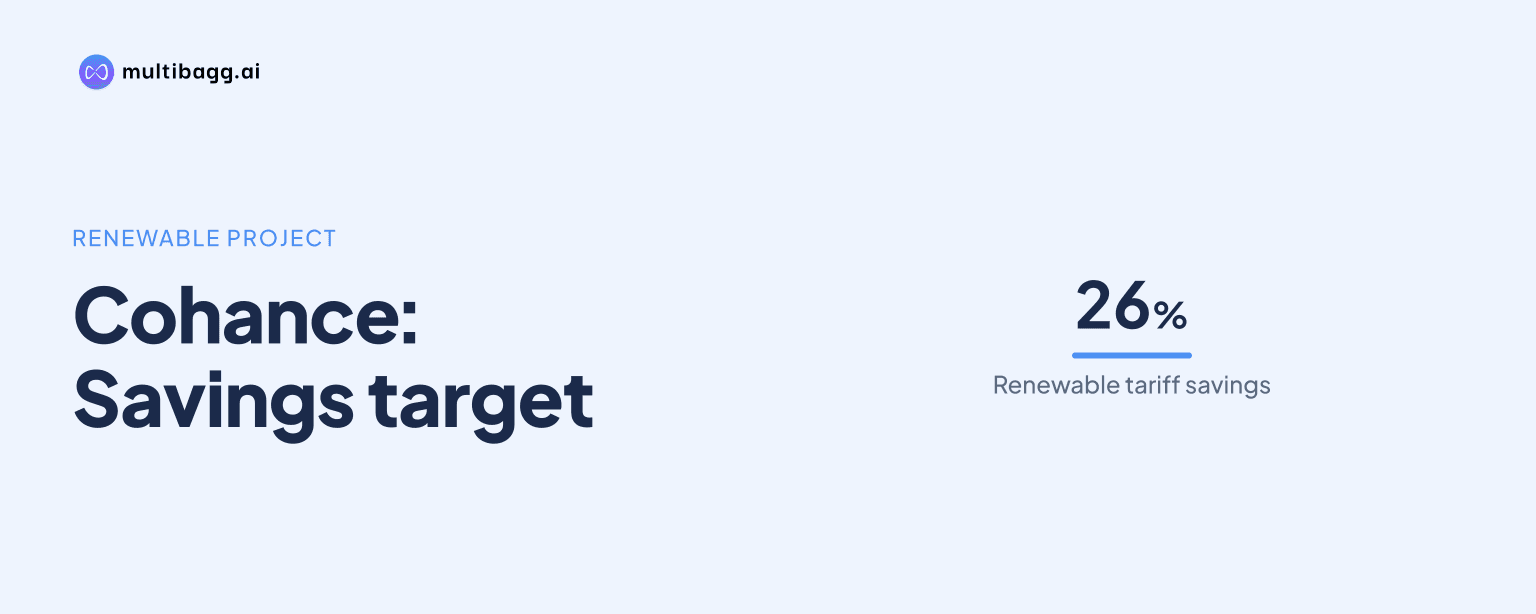
Cohance Lifesciences Limited plans a cash investment of about Rs 5.72 crore for 26% of a captive renewable-power special purpose vehicle, targeting tariff savings of nearly 26% from contracted capacity of 5.3 MW wind and 4.45 MWp solar. The SPV remains under incorporation in India.
Know Cohance Lifesciences inside out
Results, valuation, peers and who's buying, in one view.
What is Cohance acquiring in the renewable-power project?
Cohance is proposing to acquire 26% equity in an SPV that is under incorporation in India, subject to finalisation of contractual terms. The proposed vehicle will operate a renewable-power plant with contracted capacity of 5.3 megawatts (MW) of wind and 4.45 megawatt peak (MWp) of solar generation for captive power supply to Cohance.
The filing does not name the target because the SPV has not yet been incorporated. Its incorporation date, three-year turnover history and operating record are therefore stated as not applicable, unlike an acquisition of an established operating business with reported historical financial information.
The target is in the renewable-energy sector, while the purpose is captive consumption by Cohance. The announced 26% holding is consequently linked to a project vehicle intended to supply power to Cohance, rather than to an acquisition of a renewable-energy company with existing revenue or disclosed past turnover.
How much will Cohance invest and when could it close?
Cohance expects to invest approximately Rs 5.72 crore in cash for the proposed 26% equity interest. The filing gives an indicative completion period of 12 to 15 months, and describes the stake as subject to finalisation of contractual terms.
The consideration is identified as cash rather than a share swap or another payment method. Cohance has not disclosed a valuation of the SPV, the number of shares involved, or a construction-cost allocation between the 5.3 MW wind and 4.45 MWp solar installations.
The filing says the acquisition is not a related-party transaction and that the promoter, promoter group and group companies have no interest in the entity being acquired. It also lists no governmental or regulatory approvals as required for the acquisition, although the SPV is still under incorporation and the 26% investment remains conditional on contractual terms.
How does Cohance expect the project to reduce power costs?
Cohance says captive renewable consumption through the proposed SPV could produce tariff savings of nearly 26% and reduce operational expenditure. The company does not disclose the current electricity tariff, the tariff assumed for the 5.3 MW wind and 4.45 MWp solar project, annual electricity consumption, or an annual rupee value for the expected savings.
The project combines 5.3 MW of wind capacity with 4.45 MWp of solar capacity rather than disclosing a single renewable technology. Cohance provides the contracted capacity separately by source and does not state a combined generation forecast, utilisation rate, plant-load factor or expected proportion of its total electricity requirement.
The nearly 26% figure is Cohance's stated tariff-saving estimate under the proposed captive arrangement. What the filing identifies is a change in the intended procurement structure: Cohance would receive captive renewable power from an SPV in which it plans to hold 26% equity, but it does not provide the tariff benchmark or calculation methodology.
Got a follow-up? Ask IRIS
Why is Cohance pursuing captive renewable power?
Cohance says the proposed 26% SPV investment is intended to support captive consumption of renewable power, achieve Green Industry status and transition toward sustainable energy sources. It also says the 5.3 MW wind and 4.45 MWp solar project would save carbon dioxide, or CO2, emissions alongside the anticipated tariff savings of nearly 26%.
The filing presents two stated mechanisms for the investment. Cohance cites lower tariffs and reduced operational expenditure on the cost side, while linking renewable captive generation to lower CO2 emissions and its Green Industry objective on the environmental side.
Cohance has not quantified CO2 reductions, disclosed a baseline-emissions figure, or set a date for achieving Green Industry status. It also does not disclose projected annual generation from the 5.3 MW wind and 4.45 MWp solar facilities, meaning the emissions impact and electricity contribution cannot be calculated from the filing.
What remains unresolved before Cohance completes the SPV investment?
The main unresolved item is finalisation of contractual terms, since Cohance describes the 26% stake as proposed and conditional on those terms. The SPV's name remains unavailable because it is under incorporation in India, while the disclosed completion window is 12 to 15 months rather than a fixed closing date.
Cohance has not provided the SPV's share count, other investors, project developer, financing terms or allocation of electricity from the 5.3 MW wind and 4.45 MWp solar capacities. The absence of three-year turnover and operating history reflects the fact that the target has not yet been incorporated.
The filing specifies that no governmental or regulatory approvals are required for the acquisition itself. It does not provide construction milestones or a date for the start of captive supply, so the next disclosed timetable remains completion of the proposed acquisition within 12 to 15 months.
Conclusion
Cohance's proposed Rs 5.72 crore cash investment would give it a 26% interest in a captive renewable-power SPV with 5.3 MW of wind and 4.45 MWp of solar capacity. The company links the proposal to nearly 26% tariff savings, lower operational expenditure, renewable captive consumption and lower CO2 emissions.
The next items to watch are incorporation and naming of the SPV, final contractual terms and progress toward the indicated 12-to-15-month completion period. Cohance has not disclosed a commissioning date, annual generation, annual rupee savings or quantified CO2 reduction, leaving those measures unresolved until further information is provided.