










Coreintegra first-half profit falls 47% as revenue rises 9%
Key highlights
- Coreintegra’s consolidated revenue rose 9% to Rs 278.20 crore in the six months ended 30 September 2026.
- Coreintegra’s consolidated profit fell 47% to Rs 1.57 crore from Rs 2.95 crore a year earlier.
- Operating cash flow was negative Rs 16.36 crore as trade receivables increased by Rs 24.80 crore.
- Coreintegra raised Rs 21.99 crore in its IPO, with none of the fresh-issue proceeds utilised at 30 September 2026.
powered by IRIS
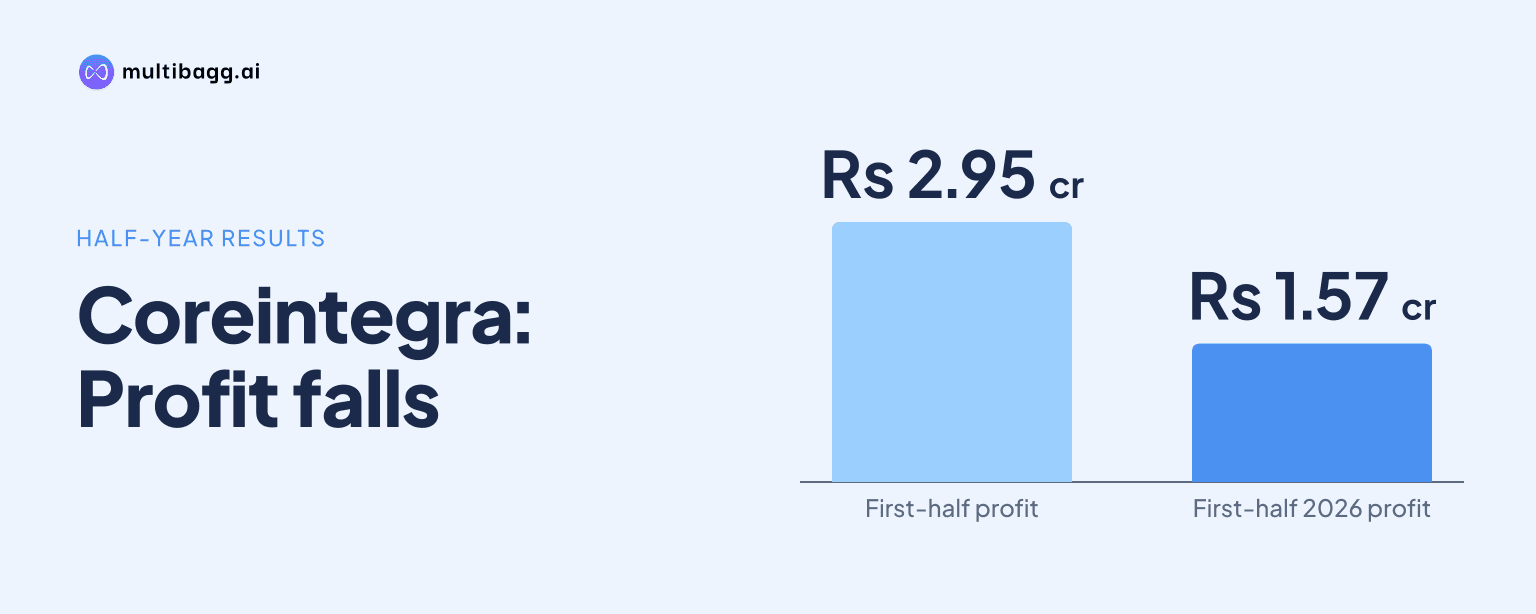
Coreintegra Consulting Services Limited reported consolidated profit of Rs 1.57 crore for the six months ended 30 September 2026, down 47% from Rs 2.95 crore a year earlier, even as revenue from operations increased 9% to Rs 278.20 crore. Higher employee benefit expenses and an exceptional item reduced profit despite revenue growth.
Know Coreintegra Consulting Services inside out
Results, valuation, peers and who's buying, in one view.
What did Coreintegra report for the first half?
Coreintegra reported revenue from operations of Rs 278.20 crore in the six months ended 30 September 2026, compared with Rs 254.80 crore in the six months ended 30 September 2025. Total income rose to Rs 278.57 crore from Rs 255.53 crore, while profit for the period fell to Rs 1.57 crore from Rs 2.95 crore.
Coreintegra’s profit before exceptional item and tax was Rs 1.85 crore, down from Rs 3.08 crore in the previous corresponding period. Coreintegra recorded an exceptional item of Rs 12.70 lakh in the latest first half, against no exceptional item in the year-earlier period, taking profit before tax to Rs 1.73 crore from Rs 3.08 crore.
Why did Coreintegra’s profit decline despite higher revenue?
Coreintegra’s profit declined because total expenses rose faster than total income and the period included a Rs 12.70 lakh exceptional item. Total expenses increased by Rs 24.26 crore to Rs 276.71 crore, while total income increased by Rs 23.04 crore to Rs 278.57 crore during the six months ended 30 September 2026.
Employee benefit expenses were Rs 191.18 crore, up from Rs 157.33 crore a year earlier, an increase of Rs 33.85 crore. Finance costs rose to Rs 25.82 lakh from Rs 6.52 lakh, and depreciation and amortisation increased to Rs 1.20 crore from Rs 96.99 lakh. Other expenses, however, declined to Rs 84.06 crore from Rs 94.08 crore.
Other income also fell to Rs 36.46 lakh from Rs 73.37 lakh. Tax expense increased to Rs 15.71 lakh from Rs 13.07 lakh, comprising current tax of Rs 4.65 lakh and a deferred-tax charge of Rs 11.06 lakh. Coreintegra reported basic and diluted earnings per share of Rs 1.50 for the six-month period, compared with Rs 3.25 in the comparable period.
What happened to Coreintegra’s operating cash flow and receivables?
Coreintegra generated negative operating cash flow of Rs 16.36 crore in the six months ended 30 September 2026, compared with positive operating cash flow of Rs 4.31 crore a year earlier. Cash generated from operations turned negative after working-capital movements and tax paid, despite operating profit before working-capital changes of Rs 2.02 crore.
The principal working-capital movement was a Rs 24.80 crore increase in trade receivables, compared with a Rs 4.49 crore increase in the corresponding period of 2025. The consolidated balance sheet showed trade receivables of Rs 52.21 crore at 30 September 2026, up from Rs 27.42 crore at 31 March 2026.
Trade payables decreased by Rs 3.09 crore in the cash-flow statement, while other current liabilities increased by Rs 8.45 crore. Coreintegra also paid Rs 1.91 crore in tax, compared with Rs 3.86 crore in the previous corresponding period. Investing activities used Rs 2.16 crore, including Rs 2.13 crore spent on tangible and intangible assets and Rs 77.36 lakh placed in fixed deposits.
Got a follow-up? Ask IRIS
How did Coreintegra’s financing and balance sheet change?
Coreintegra’s financing cash inflow was Rs 37.92 crore in the first half, led by Rs 21.99 crore from the issue of equity shares and Rs 13.15 crore of bank overdraft proceeds. The resulting net increase in cash and cash equivalents was Rs 19.46 crore, with closing cash of Rs 22.09 crore at 30 September 2026, versus Rs 2.63 crore at the start of the financial year.
Coreintegra allotted 28,19,200 equity shares at Rs 78 each on 28 September 2026 and listed them on the NSE SME platform on 30 September 2026. The fresh issue raised Rs 21.99 crore, and Coreintegra said none of the proceeds had been utilised as at 30 September 2026.
Share capital increased to Rs 10.49 crore at 30 September 2026 from Rs 7.67 crore at 31 March 2026, while reserves and surplus rose to Rs 36.88 crore from Rs 19.74 crore. Short-term borrowings stood at Rs 16.25 crore at the reporting date, compared with nil at 31 March 2026, and other current liabilities were Rs 40.08 crore, up from Rs 31.63 crore.
What disclosures should readers watch after Coreintegra’s results?
Coreintegra disclosed Rs 3.65 crore of initial public offering-related liabilities for the six months ended 30 September 2026. Of that amount, Rs 4.92 lakh was charged to expenses, while Rs 3.60 crore covering merchant banker, auditor, banker, underwriter and credit agency fees was adjusted against the securities premium account.
Coreintegra also revised the estimated useful life of computers to six years from three years, based on vendor certificates. The unamortised depreciation will be charged over the revised remaining useful life; the auditor drew attention to this accounting estimate but did not modify its review conclusion.
Coreintegra took an unsecured, interest-free Rs 60 lakh loan from a director and an unsecured Rs 2.50 crore shareholder loan carrying 12.5% interest during the six months. Both loans are short term and repayable on demand. The statutory auditor’s limited review stated that nothing had come to its attention to suggest the consolidated statement failed to meet the required disclosure standards.
Conclusion
Coreintegra’s first-half figures show a divergence between sales and earnings: revenue increased 9% to Rs 278.20 crore, but profit fell 47% to Rs 1.57 crore as employee benefit expenses rose by Rs 33.85 crore, other income declined and an exceptional item was recorded. The cash-flow statement also shows that a Rs 24.80 crore rise in receivables contributed to negative operating cash flow of Rs 16.36 crore.
The next disclosures to watch are Coreintegra’s use of the Rs 21.99 crore fresh-issue proceeds, which remained unutilised at 30 September 2026, and movements in the Rs 52.21 crore receivables balance. Coreintegra’s future statements can also show the effect of the revised six-year computer useful life and the repayment status of the Rs 3.10 crore in short-term director and shareholder loans.