










Coromandel Q2 profit falls 34% as costs outpace subsidies
Key highlights
- Consolidated Q2 FY27 PAT fell 34% year on year to Rs 523 crore.
- Consolidated Q2 FY27 total income rose 6% to Rs 10,348 crore while EBITDA declined 18% to Rs 944 crore.
- Coromandel’s phosphatic-fertiliser market share increased to 19% from 17% a year earlier.
- Crop Protection revenue grew 22% in Q2 FY27, and the Retail network exceeded 1,300 stores after close to 100 additions.
powered by IRIS
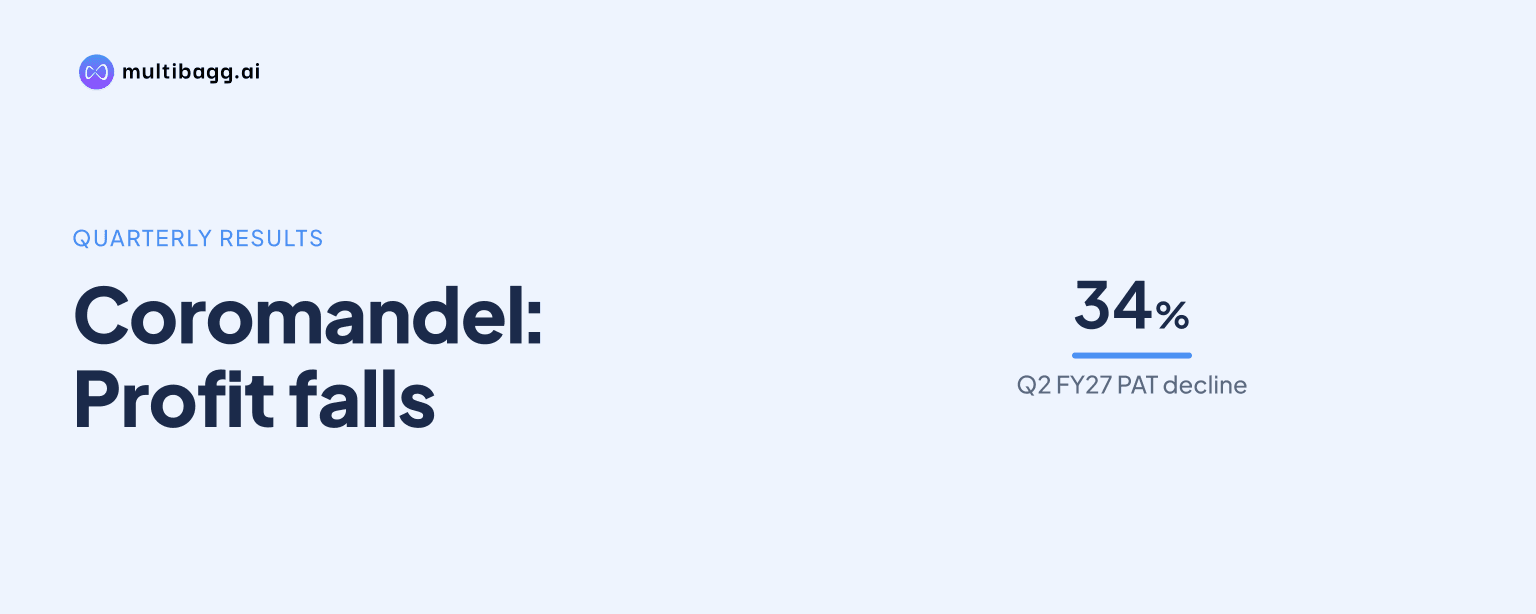
Coromandel International Limited reported a 34% year-on-year fall in consolidated profit after tax to Rs 523 crore in Q2 FY27, even as total income rose 6% to Rs 10,348 crore, because higher fertiliser raw-material costs linked to the Middle East crisis were not adequately covered by Kharif subsidies.
Know Coromandel International inside out
Results, valuation, peers and who's buying, in one view.
How did Coromandel perform in Q2 FY27?
Coromandel’s consolidated profit after tax, or PAT, declined to Rs 523 crore in Q2 FY27 from Rs 793 crore in Q2 FY26, while total income increased to Rs 10,348 crore from Rs 9,771 crore. The result shows that the increase in income did not offset pressure on profitability during the quarter ended September 30, 2026.
Consolidated earnings before interest, taxes, depreciation and amortisation, or EBITDA, fell 18% to Rs 944 crore from Rs 1,147 crore. Profit before tax, or PBT, declined 33% to Rs 706 crore from Rs 1,059 crore. On a standalone basis, PAT dropped 33% to Rs 548 crore, while total income rose 5% to Rs 9,987 crore.
Why did Coromandel’s fertiliser margins decline?
Coromandel said fertiliser margins declined because raw-material costs rose sharply amid the ongoing Middle East crisis and the Kharif Nutrient Based Subsidy, or NBS, rates did not adequately cover that increase. Management also cited deficit rainfall, elevated input prices and lower Kharif NBS rates as factors that affected offtake and margins in the NP/NPK segment, referring to nitrogen-phosphorus and nitrogen-phosphorus-potassium fertilisers.
The effect was visible in the difference between income and operating earnings: consolidated total income grew 6%, while EBITDA fell 18% in Q2 FY27. For the first half, income increased 10% to Rs 18,563 crore, but EBITDA declined 12% to Rs 1,705 crore, indicating that the pressure extended beyond the single quarter.
Management said the newly commissioned phosphoric acid and sulphuric acid plant at Kakinada helped mitigate external supply disruptions and enabled value accretion through timely government support. It also said it expects Rabi-season NBS rates to appropriately reflect raw-material price movements, an outcome that has not been confirmed in the filing.
What changed in Coromandel’s first-half results?
Coromandel’s consolidated PAT for H1 FY27 fell 30% to Rs 905 crore from Rs 1,295 crore in H1 FY26, although total income rose 10% to Rs 18,563 crore. PBT also declined 30% to Rs 1,220 crore from Rs 1,737 crore, while EBITDA fell 12% to Rs 1,705 crore from Rs 1,929 crore.
The first-half comparison shows a less severe EBITDA decline than in Q2 alone, where EBITDA was down 18%, but PAT fell 30% in H1 compared with a 34% decrease in Q2. Standalone H1 PAT declined 30% to Rs 925 crore and standalone total income rose 7% to Rs 17,779 crore, maintaining the same broad pattern of higher income and lower earnings.
Coromandel supplied about 3.3 million tonnes of fertilisers during H1 FY27 despite the conditions that affected its NP/NPK business. Its phosphatic-fertiliser market share increased to 19% from 17% a year earlier, meaning market position improved even as the fertiliser segment’s margins faced cost and subsidy pressure.
Got a follow-up? Ask IRIS
Which businesses and initiatives supported Coromandel during Q2?
Coromandel’s Crop Protection business recorded 22% revenue growth in Q2 FY27, supported by export-market performance, while domestic consumption conditions were softer. Management said the company focused in India on differentiated products and unique combination products, and launched 10 new products across the Nutrients and Crop Protection businesses during the quarter.
The Retail business opened close to 100 stores in Q2 FY27, taking its network to more than 1,300 stores. Management also said specialty nutrients, organic and biological businesses delivered strong performance, although the announcement did not disclose revenue or profit figures for those businesses.
Coromandel operates two principal segments, Nutrient and other allied businesses and Crop Protection. Its broader portfolio includes fertilisers, crop protection, bio-products, specialty nutrients and organic products; the company reported turnover of Rs 31,827 crore in FY26, providing context for the Rs 18,563 crore of consolidated income reported in the first six months of FY27.
What is Coromandel planning for the rest of FY27?
Coromandel expects its new NPK fertiliser capacity to be completed by Q4 FY27, while additional capacity for a key Crop Protection molecule is expected to start during Q3 FY27. These are project timelines disclosed by management rather than completed capacity additions as of September 30, 2026.
The company also plans to establish a launch plant for fluoro intermediates to support phased research-and-development-to-commercial scale-up in speciality chemistry. Alongside that plan, the close to 100 retail-store additions in Q2 took the network beyond 1,300 outlets, extending a business that provides agricultural inputs and services.
The filing did not quantify the capacity of the new NPK project, the additional Crop Protection facility or the proposed fluoro-intermediates plant. It did, however, identify the Kakinada phosphoric and sulphuric acid plant as already commissioned, separating it from the projects expected in Q3 and Q4 FY27.
Conclusion
Coromandel’s Q2 FY27 result combines higher income, a 19% phosphatic-fertiliser market share and 22% Crop Protection revenue growth with a 34% fall in consolidated PAT. The central factor was fertiliser-margin pressure: raw-material inflation associated with the Middle East crisis outpaced Kharif subsidy coverage, reducing EBITDA even as sales-related measures increased.
The next disclosed developments are additional Crop Protection capacity expected in Q3 FY27 and NPK fertiliser capacity expected in Q4 FY27. Management’s expectation that Rabi NBS rates will reflect raw-material movements is also a key unresolved matter, given that Kharif subsidy rates were cited as a reason for lower NP/NPK margins.