










CP CAPITAL Limited Q2 PAT jumps 175% as margin hits 64%
Key highlights
- CP CAPITAL’s Q2 FY27 standalone PAT rose 175.18% year on year to Rs 22.56 crore.
- Q2 FY27 standalone revenue from operations increased 131.39% to Rs 34.97 crore.
- Standalone PAT margin reached 63.91%, up 10.83 percentage points year on year.
- Digital lending disbursed Rs 3.75 crore through 1,570 loans in the seven days after its 24 September 2026 launch.
powered by IRIS
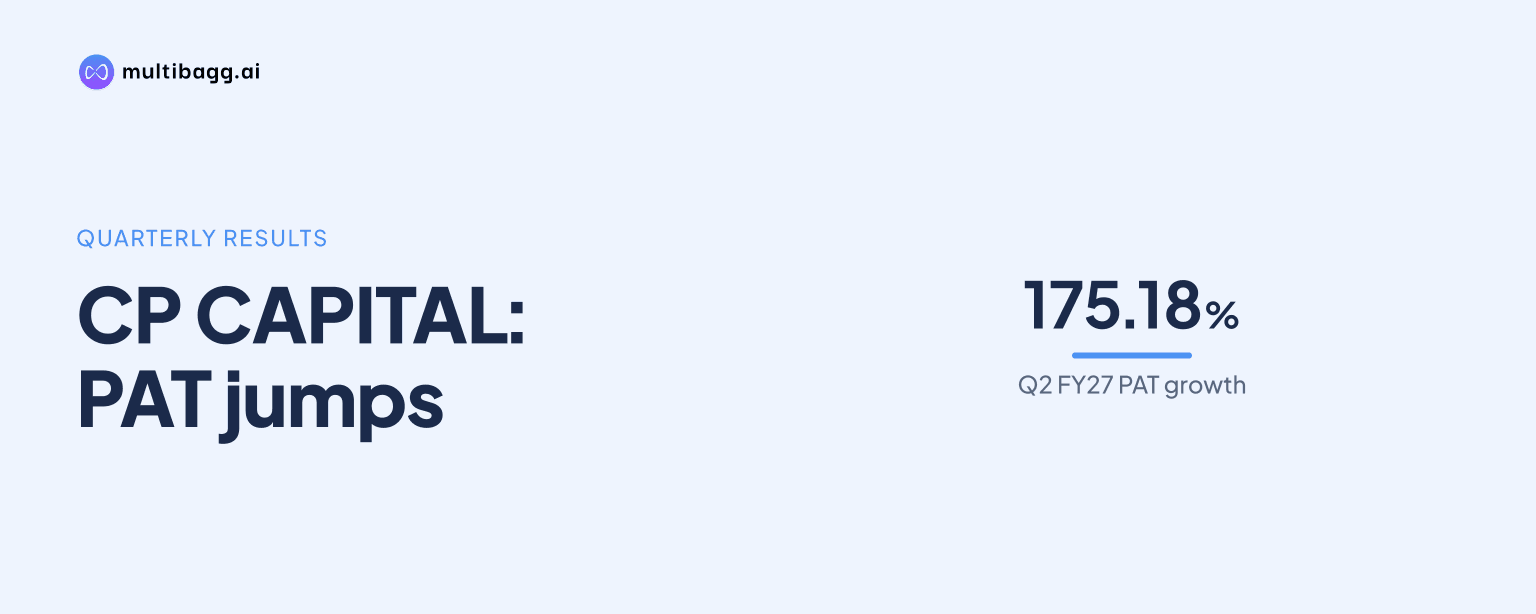
CP CAPITAL Limited reported Q2 FY27 standalone profit after tax of Rs 22.56 crore, up 175.18% year on year, while revenue from operations rose 131.39% to Rs 34.97 crore and the profit after tax margin reached 63.91%, up 10.83 percentage points.
Know CP Capital inside out
Results, valuation, peers and who's buying, in one view.
How did CP CAPITAL perform in Q2 FY27 on a standalone basis?
CP CAPITAL reported standalone profit after tax, or PAT, of Rs 22.56 crore in Q2 FY27, compared with Rs 8.20 crore in Q2 FY26 and Rs 11.48 crore in Q1 FY27. This was a 175.18% increase year on year and a 96.48% increase quarter on quarter.
Revenue from operations was Rs 34.97 crore, against Rs 15.11 crore a year earlier and Rs 19.37 crore in the preceding quarter. The 131.39% annual rise in revenue from operations was accompanied by 80.51% sequential growth, while total revenue rose 128.55% year on year to Rs 35.29 crore.
PAT grew faster than revenue in both reported comparisons. The 175.18% year-on-year PAT increase exceeded the 131.39% rise in revenue from operations, and the 96.48% quarter-on-quarter PAT rise was above the 80.51% revenue increase. Diluted earnings per share were Rs 12.40, compared with Rs 4.50 in Q2 FY26 and Rs 6.31 in Q1 FY27.
Why did CP CAPITAL’s standalone margin increase in Q2 FY27?
CP CAPITAL’s standalone PAT margin was 63.91% in Q2 FY27, up from 53.08% in Q2 FY26 and 59.21% in Q1 FY27. The changes were 10.83 percentage points year on year and 4.70 percentage points quarter on quarter; the company calculates this margin against total revenue of Rs 35.29 crore.
Operating earnings before interest, tax, depreciation and amortisation, or operating EBITDA, reached Rs 32.77 crore, up 144.27% from Rs 13.42 crore in Q2 FY26. Its margin, calculated on revenue from operations, increased 4.94 percentage points year on year to 93.71% and was 0.73 percentage points above Q1 FY27's 92.98%.
EBITDA was Rs 33.09 crore, compared with Rs 13.74 crore a year earlier and Rs 18.03 crore in Q1 FY27. The EBITDA margin, measured against total revenue, was 93.77%, versus 89.01% in Q2 FY26 and 92.99% in Q1 FY27, representing annual and sequential increases of 4.76 and 0.78 percentage points.
What were CP CAPITAL’s H1 FY27 standalone results?
CP CAPITAL generated H1 FY27 standalone PAT of Rs 34.04 crore, up 111.85% from Rs 16.07 crore in H1 FY26. Revenue from operations rose 78.71% to Rs 54.35 crore, while total revenue increased 77.90% to Rs 54.68 crore.
The H1 PAT margin was 62.25%, compared with 52.27% a year earlier, an increase of 9.98 percentage points. EBITDA rose 96.37% to Rs 51.12 crore and its margin increased 8.80 percentage points to 93.49%, while operating EBITDA was Rs 50.79 crore with a 93.45% margin.
Q2 accounted for Rs 22.56 crore of H1 PAT of Rs 34.04 crore and Rs 34.97 crore of H1 revenue from operations of Rs 54.35 crore. H1 diluted earnings per share were Rs 18.71, compared with Rs 8.83 in H1 FY26.
Got a follow-up? Ask IRIS
How did CP CAPITAL’s consolidated result compare with standalone?
CP CAPITAL reported consolidated Q2 FY27 PAT of Rs 25.44 crore, up 150.35% from Rs 10.16 crore in Q2 FY26 and 91.13% from Rs 13.31 crore in Q1 FY27. Consolidated revenue from operations was Rs 38.84 crore, increasing 115.56% year on year and 76.96% quarter on quarter.
The consolidated PAT margin was 65.49%, 1.58 percentage points higher than the standalone 63.91% margin. However, its 9.24-percentage-point year-on-year expansion was below the standalone increase of 10.83 percentage points; consolidated total revenue was Rs 38.85 crore and EBITDA was Rs 36.27 crore.
For H1 FY27, consolidated PAT was Rs 38.76 crore, up 85.06% from Rs 20.94 crore in H1 FY26. Consolidated revenue from operations increased 62.37% to Rs 60.78 crore, while the PAT margin rose to 63.72% from 55.87% and diluted earnings per share reached Rs 21.30 from Rs 11.51.
What changed in CP CAPITAL’s balance sheet and lending activity?
CP CAPITAL’s standalone cash and bank balances were Rs 162.16 crore on 30 September 2026, compared with Rs 2.56 crore on 31 March 2026. Over the same period, standalone loans declined 36.6% to Rs 258.08 crore from Rs 406.75 crore, while total assets increased 10.0% to Rs 710.96 crore.
Long-term borrowings rose 28.2% to Rs 112.42 crore and total equity increased 6.2% to Rs 582.23 crore at 30 September 2026. Total liabilities were Rs 128.74 crore, up 31.5% from Rs 97.91 crore at 31 March 2026, while other current assets rose 39.5% to Rs 195.69 crore.
CP CAPITAL launched digital lending on 24 September 2026 and reported Rs 3.75 crore of disbursements across 1,570 loans in the seven days through 30 September. A separate portfolio table reports digital lending of Rs 3.70 crore and 1,537 loans within a Rs 266.30 crore gross loan book; it represented 1.4% of the book by value but 90% of 1,700 loans by count. The company said the product uses website, lending service provider and affiliate sourcing, with loans retained entirely on its own book and no co-lending.
Conclusion
CP CAPITAL’s Q2 FY27 standalone results show PAT increasing faster than revenue, alongside a 10.83-percentage-point expansion in PAT margin to 63.91%. The H1 standalone result also recorded higher earnings and margins, while consolidated Q2 PAT of Rs 25.44 crore was higher than the standalone figure of Rs 22.56 crore.
The next disclosed development to watch is the scaling of digital lending after its 24 September 2026 launch, including its disbursements, loan count and share of the Rs 266.30 crore gross loan book. Changes in the standalone loan balance, which was Rs 258.08 crore on 30 September 2026 versus Rs 406.75 crore on 31 March 2026, are also relevant to subsequent reporting.