










Cochin Shipyard Limited Secures ₹9,805 Crore Navy Order
Key highlights
- CSL's six-vessel NGMV contract is valued at ₹9,805 crore, with deliveries scheduled to begin in March 2027.
- CSL recorded steel cutting and the first NGMV keel laying on September 19, 2026.
- The Ministry of Defence awarded CSL a ₹1,207.5 crore INS Vikramaditya refit and dry-docking contract in November 2024.
- CSL says it has completed more than 2,500 ship-repair projects across defence and commercial clients.
powered by IRIS
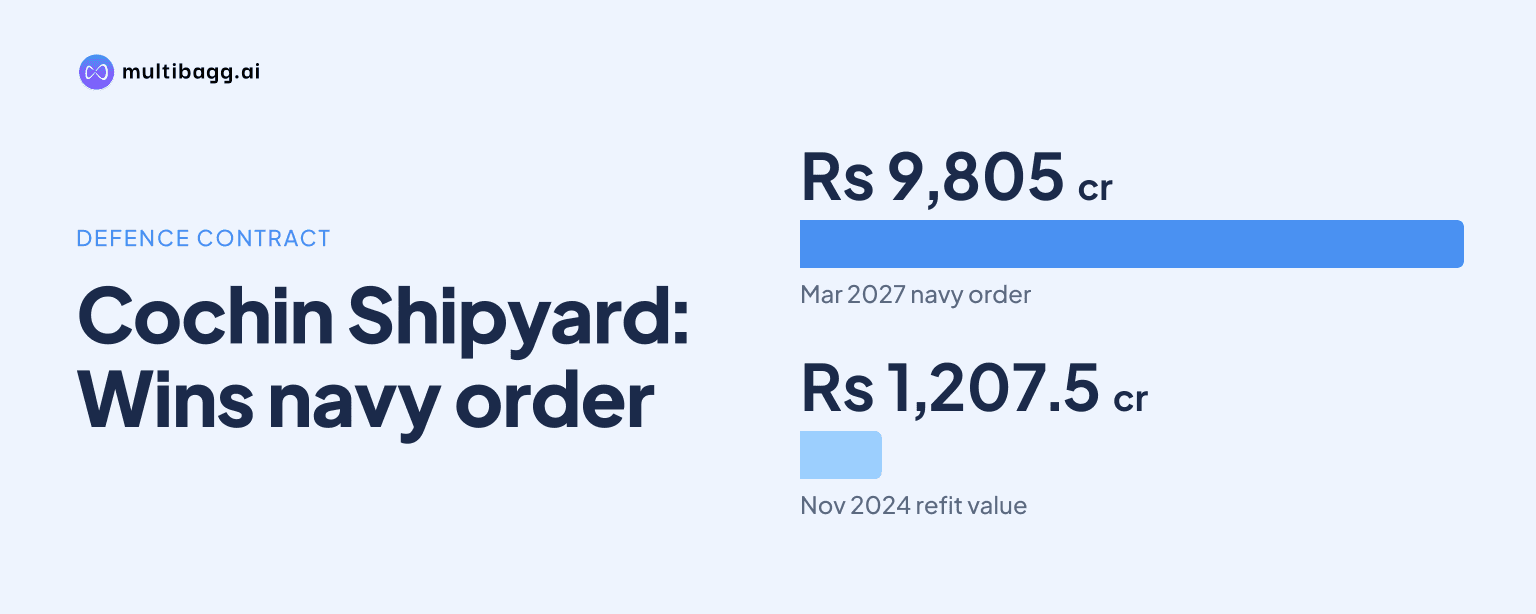
Cochin Shipyard Limited signed a ₹9,805 crore contract to build six Next Generation Missile Vessels for the Indian Navy, with deliveries scheduled to begin in March 2027. The order adds to CSL's naval shipbuilding workload, which also includes eight Anti-Submarine Warfare Shallow Water Crafts and aircraft-carrier repair work.
Know Cochin Shipyard inside out
Results, valuation, peers and who's buying, in one view.
What does the ₹9,805 crore NGMV contract cover?
The contract covers the design and construction of six Next Generation Missile Vessels, or NGMVs, for the Indian Navy. CSL announced that the vessels will be heavily armed warships incorporating stealth features, high speed and offensive capability. The contract value is ₹9,805 crore, and deliveries are scheduled to commence from March 2027.
The programme places CSL in the construction of weapon-intensive platforms for the Navy. A company update dated September 19, 2026 recorded the steel-cutting ceremony for the NGMV programme and the keel laying of the first vessel. The keel-laying announcement described the event as CSL's entry into construction of advanced weapon-intensive platforms for the Indian Navy.
The supplied information does not provide a vessel-wise delivery schedule, construction milestones after the first keel laying, or financial recognition timelines. It does, however, establish March 2027 as the starting point for deliveries, making programme execution a key operational milestone for the shipyard.
How does the NGMV programme fit CSL's naval workload?
The NGMV order sits alongside CSL's ongoing construction of eight Anti-Submarine Warfare Shallow Water Crafts, or ASWSWCs, for the Indian Navy. The yard has stated that these craft were at various stages of construction. An update dated August 21, 2026 also recorded the delivery of Mangrol to the Navy, describing it as a strengthening of indigenous anti-submarine warfare capability.
CSL's relationship with the Navy extends beyond new vessel construction. The shipyard delivered the first indigenously built aircraft carrier, IAC-1, Project-71, or Vikrant, to the Indian Navy. It has also said that all Indian Navy aircraft carriers have undergone their major refits and docking at CSL, deepening operational coordination between the yard and the Navy.
The shipyard's repair record includes refits of INS Viraat, INS Vikramaditya and INS Vikrant. CSL says it is the only yard in India capable of undertaking dry-dock repairs of aircraft carriers owned by the Indian Navy. This capability combines high-value repair work with the new-build pipeline represented by the NGMV and ASWSWC programmes.
What is CSL's role in aircraft-carrier maintenance?
CSL has completed more than 2,500 ship-repair projects for defence and commercial-sector clients, according to the company. Its long-standing Navy association includes fleet refits and maintenance work, with aircraft-carrier dry docking forming a specialised part of its repair operations.
On November 30, 2024, the Ministry of Defence signed a ₹1,207.5 crore contract with CSL for the short refit and dry docking of INS Vikramaditya. The carrier, commissioned into the Indian Navy in November 2013, is expected to rejoin the active fleet with upgraded combat capability after the refit, according to the ministry.
The Ministry of Defence said the Vikramaditya project is intended to support CSL's development as a maintenance, repair and overhaul hub. The project envisages participation by nearly 50 micro, small and medium enterprises and employment generation for more than 3,500 personnel. These figures show that naval repair contracts can extend work to suppliers and specialised service providers beyond the shipyard.
Got a follow-up? Ask IRIS
How could these orders affect CSL's business visibility?
The NGMV contract gives CSL a disclosed ₹9,805 crore naval construction programme with deliveries beginning from March 2027. The eight ASWSWCs, carrier-refit work and other repair assignments add further defence-related activity, although the supplied information does not provide a consolidated company order book or a timeline for every programme.
An ICICI Direct note included in the source material estimated CSL's order backlog at about ₹21,500 crore, or about seven times trailing-twelve-month revenue, after the company received a ₹500 crore order from a European client for a hybrid Service Operation Vessel. That vessel is intended for offshore-wind farm service, maintenance and operations in Europe and is due for delivery in 2026. The order-book estimate is attributed to the brokerage rather than to CSL.
The mix of defence and commercial work is relevant because it spans construction, repair and export-oriented vessel building. However, the supplied material does not provide updated revenue, profit, margin or share-price data. Investors therefore have clear contract values and programme dates, but not enough disclosed information in this material to quantify the effect on CSL's earnings.
Why do naval construction and repair programmes matter for CSL?
Naval contracts require long execution periods, specialised engineering and coordination with equipment suppliers, making delivery schedules important operating markers. For CSL, the NGMV programme adds advanced surface-combatant construction to its existing carrier-build and carrier-repair experience. The September 2026 keel laying is a tangible transition from contract award to physical construction.
The shipyard's aircraft-carrier work also supports its maintenance position. The Vikramaditya refit contract, valued at ₹1,207.5 crore, is distinct from new ship construction but uses related dry-dock and repair capabilities. Its planned involvement of nearly 50 MSMEs indicates a wider industrial component within naval maintenance work.
For the Indian Navy, the reported programmes cover different requirements: aircraft-carrier availability, anti-submarine warfare craft and missile vessels designed for high-speed offensive operations. The available disclosures establish these as active programmes, while detailed commissioning dates, acceptance milestones and final operational deployment plans have not been provided.
Conclusion
CSL's ₹9,805 crore contract for six NGMVs is its largest specifically disclosed naval construction value in the supplied material and strengthens its role across naval new-build and repair activity. The programme follows the delivery of IAC-1 and operates alongside ASWSWC construction, the Vikramaditya refit and commercial vessel work.
The next disclosed milestone is the start of NGMV deliveries from March 2027. Investors can also watch construction progress after the September 2026 steel cutting and first keel laying, developments in the ASWSWC programme, and execution of the ₹1,207.5 crore Vikramaditya refit.