










Cubical Financial Seeks Approval for Rs 200 Crore Secured Debt
Key highlights
- Cubical Financial seeks authority to secure aggregate indebtedness of up to Rs 200 crore under Item 10.
- Item 9 permits charges over present and future movable and immovable assets and company undertakings.
- Item 9 excludes temporary loans and cash credits from its proposed facilities or loan authority.
- Remote e-voting is scheduled from November 24, 2026 to November 26, 2026.
powered by IRIS
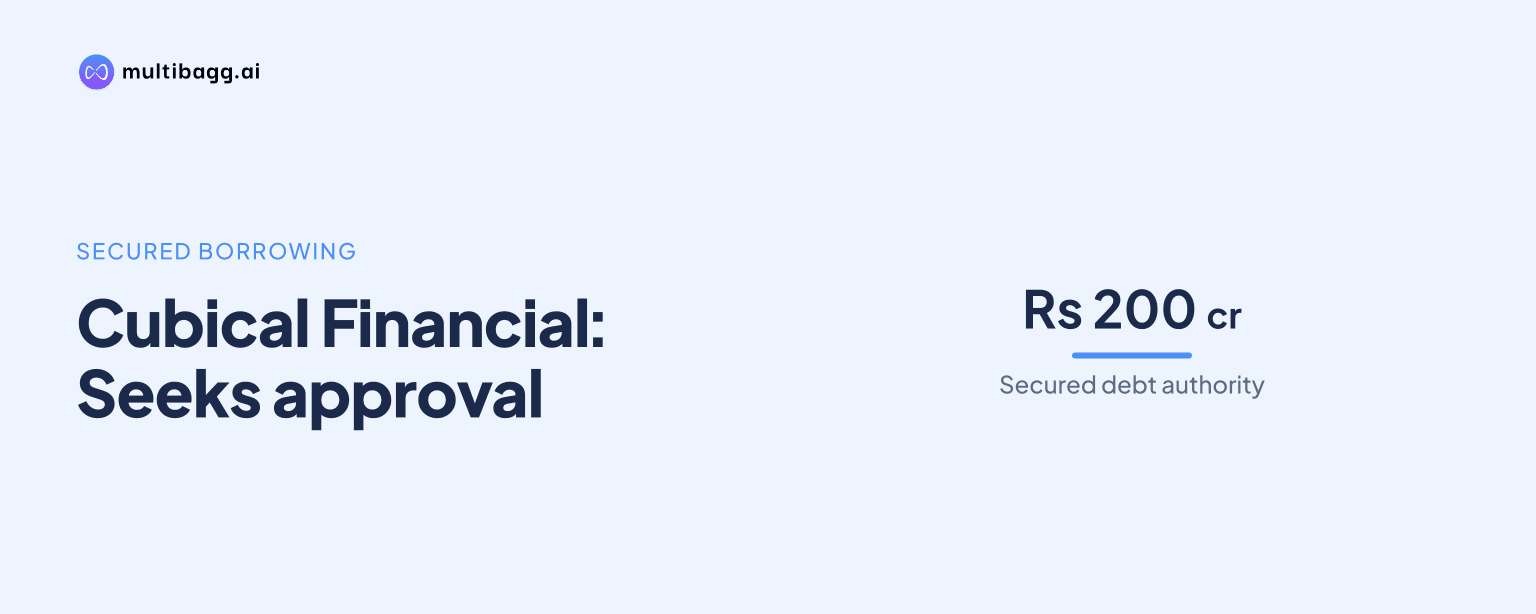
Cubical Financial Services Limited is seeking shareholder approval for powers to secure aggregate indebtedness of up to Rs 200 crore against its assets, under Items 9 and 10 of its notice dated October 19, 2026. The proposals would allow security over present and future movable and immovable property, subject to the resolutions and applicable approvals.
Know Cubical Financial Services inside out
Results, valuation, peers and who's buying, in one view.
What is Cubical Financial asking shareholders to approve?
Cubical Financial is seeking two special resolutions under Sections 180(1)(a) and 180(1)(c) of the Companies Act, 2013. Item 9 seeks authority to create mortgages, charges and hypothecations over assets and undertakings, while Item 10 seeks approval for borrowing powers through security arrangements with aggregate indebtedness capped at Rs 200 crore.
The two resolutions use the same Rs 200 crore figure but describe it differently. Item 9 permits security for facilities or loans up to Rs 200 crore over and above the aggregate of paid-up share capital and free reserves covered by a Section 180(1)(c) approval. Item 10 states that aggregate indebtedness secured by Cubical Financial’s assets must not exceed Rs 200 crore.
Item 9 is specifically presented as approval under Section 180(1)(a), which concerns the creation of a mortgage or charge on company assets, properties or undertakings. Item 10 is headed as an approval of borrowing powers under Section 180(1)(c), although its resolution text also focuses on pledging, mortgaging, hypothecating or charging property to secure amounts borrowed.
The notice does not disclose a specific loan drawdown, financing agreement, lender or use of proceeds connected with the Rs 200 crore authority. It instead asks members to approve a framework under which the board may create security and arrange financing, with the legal and operational terms to be determined later within the authority granted.
Which Cubical Financial assets could be used as security?
Cubical Financial proposes that security may be created over all or any part of its movable or immovable properties and assets, whether held now or acquired in the future. Item 9 also covers the whole or any part of the company’s undertakings, allowing security to extend beyond individually identified assets if the board uses the authority.
The mechanisms named in Item 9 are charges, mortgages and hypothecations. Item 10 adds pledges and floating charges to that list, and permits a floating charge over movable or immovable properties and over the whole or part of Cubical Financial’s undertaking. The notice does not identify any particular property, receivable, investment, lender or asset value.
A mortgage, charge, hypothecation, pledge and floating charge are all forms of security referred to in the resolutions, but the notice does not set out the final collateral terms for any transaction. Those terms, including the form, timing and conditions of security under Item 9, would be determined by Cubical Financial’s board if shareholders approve the resolution.
Item 9 also seeks approval, confirmation and ratification of mortgages and charges already created by Cubical Financial. However, the supplied notice does not quantify existing secured borrowings, identify prior charges, or provide a comparison between the proposed Rs 200 crore authority and any earlier borrowing limit, debt balance or asset base.
How do Cubical Financial’s Item 9 and Item 10 proposals differ?
Cubical Financial’s Item 9 is focused on the authority to create security for borrowings or facilities. It says those facilities or loans may be in any form, excluding temporary loans and cash credits, and places the Rs 200 crore amount over and above the borrowing amount linked to paid-up share capital and free reserves under Section 180(1)(c).
Item 10 is focused on aggregate indebtedness secured by Cubical Financial’s assets. It allows security in favour of banks, financial institutions, investors and other lenders, provided the aggregate indebtedness secured by the company’s assets does not exceed Rs 200 crore. The supplied Item 10 wording does not repeat Item 9’s exclusion for temporary loans and cash credits.
Item 9 permits Cubical Financial’s board to use, modify, amend, reduce or enhance existing or new borrowing facilities interchangeably among lenders, without restriction on borrowing from a particular lender, subject to the overall borrowing limit. Item 10 separately permits the company to create security for principal, interest, charges, costs, expenses and other monies payable by Cubical Financial or a third party.
Got a follow-up? Ask IRIS
What could Cubical Financial’s board do if members approve?
If members pass Item 9, Cubical Financial’s board, including a committee constituted to exercise the power, could decide the form, manner, timing and terms of mortgages, charges and hypothecations. It could also negotiate, finalise and execute deeds and documents required to implement secured facilities or loans within the authority sought.
Item 9 authorises the board and persons it appoints to take steps considered proper, necessary, desirable or expedient for the resolution. The board would also be able to resolve implementation issues connected with the security arrangements, while the stated Rs 200 crore authority and applicable regulatory approvals would continue to govern the proposal.
Under Item 10, Cubical Financial could create security in favour of banks, financial institutions, investors or other lenders. The resolution extends to security for principal, interest, costs, charges, expenses and other monies payable in relation to borrowings. The notice does not name a lender, disclose an interest rate, specify a maturity date or state a proposed borrowing amount.
Separately, Item 11 seeks approval for unsecured loans of up to Rs 15 crore each from managing director Manoj Agrawal and director Amit Saraogi, both described as promoter-group members. That proposal includes an option for the lenders to convert outstanding loans into fully paid-up equity shares, subject to applicable requirements; it is separate from Items 9 and 10.
When will Cubical Financial shareholders vote on the resolutions?
Cubical Financial has set November 20, 2026 as the cut-off date for determining which members may use remote e-voting or vote electronically at the extraordinary general meeting. Voting rights will be proportionate to members’ holdings in the paid-up equity share capital as of that date, according to the notice.
Remote e-voting for all matters in the notice, including Items 9 and 10, is scheduled to begin at 9:00 a.m. Indian Standard Time on November 24, 2026. The voting window is scheduled to close at 5:00 p.m. Indian Standard Time on November 26, 2026, after which Central Depository Services (India) Limited will disable the e-voting module.
The extraordinary general meeting is to be held through video conferencing or other audio-visual means. Cubical Financial states that members may join the meeting 15 minutes before and 15 minutes after its scheduled start time, while the facility will accommodate at least 1,000 members on a first-come, first-served basis, subject to listed exceptions.
The resolutions require member approval before Cubical Financial can use the authorities sought. The notice does not disclose the date or result of the shareholder vote, so it does not establish that either the Rs 200 crore secured-indebtedness authority or the separate Rs 15 crore-per-lender unsecured-loan proposal has been approved or implemented.
Conclusion
Cubical Financial is seeking a broad framework for secured financing, centred on a Rs 200 crore limit stated in both Items 9 and 10. Item 9 addresses the creation of security and links its amount to a separate Section 180(1)(c) borrowing approval, while Item 10 caps aggregate indebtedness secured by company assets at Rs 200 crore. The notice does not disclose a committed borrowing, lender or purpose for the authority.
The next disclosed milestones are the November 20, 2026 voting eligibility cut-off and the remote e-voting period from November 24 to November 26, 2026. Shareholders will decide whether to approve the special resolutions before Cubical Financial’s board can use the proposed powers to negotiate security arrangements or alter facilities among lenders.