










DCIL returns to Q2 profit as EBITDA rises 58.58% year-on-year
Key highlights
- DCIL reported Q2 FY 2026-27 profit after tax of Rs 7.31 crore versus a Rs 34.17 crore loss a year earlier.
- DCIL's Q2 EBITDA rose 58.58% to Rs 41.69 crore from Rs 26.29 crore.
- DCIL's own-dredger operational income increased 23.08% to Rs 198.66 crore in Q2.
- DCIL's half-year profit after tax was Rs 18.54 crore versus a Rs 57.51 crore loss in the prior-year period.
powered by IRIS
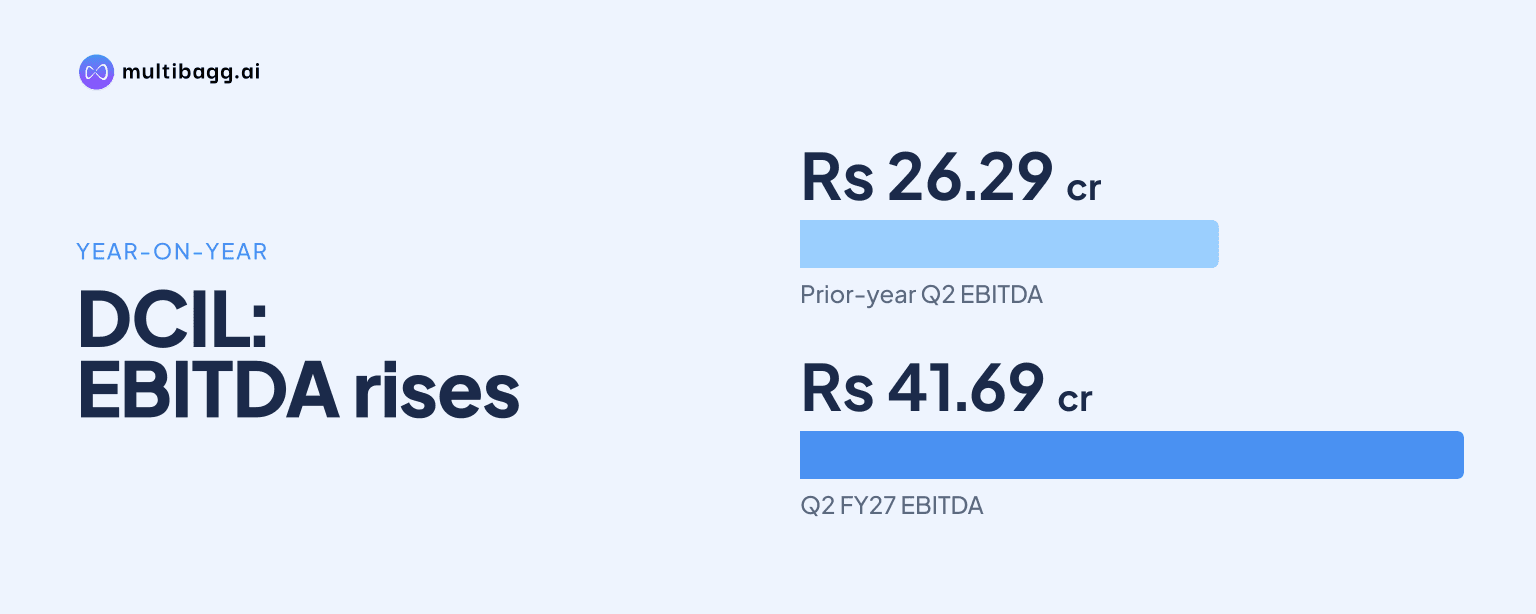
Dredging Corporation of India Limited reported profit after tax of Rs 7.31 crore in Q2 FY 2026-27, reversing a Rs 34.17 crore loss a year earlier, as earnings before interest, tax, depreciation and amortisation (EBITDA) rose 58.58% to Rs 41.69 crore for the quarter ended 30 September 2026.
Know Dredging Corporation of India inside out
Results, valuation, peers and who's buying, in one view.
What drove DCIL's return to Q2 profit?
DCIL returned to profit as higher income from its own dredgers was accompanied by lower depreciation and finance costs in Q2 FY 2026-27. Profit before tax was Rs 7.51 crore for the quarter ended 30 September 2026, compared with a loss before tax of Rs 33.06 crore in Q2 FY 2025-26. Profit after tax improved by Rs 41.48 crore year on year to Rs 7.31 crore.
EBITDA rose by Rs 15.40 crore to Rs 41.69 crore from Rs 26.29 crore, despite total revenue declining by Rs 1.54 crore to Rs 211.83 crore. DCIL attributed the result to operational execution and fleet deployment, while its chairman described the Q2 outcome as a milestone towards sustained profitability without providing a numerical earnings target.
How did DCIL's revenue mix change in Q2?
DCIL's operational income from its own dredgers increased 23.08% to Rs 198.66 crore in Q2 FY 2026-27 from Rs 161.41 crore a year earlier. The Rs 37.25 crore increase contrasted with total revenue, including subcontract revenue and other income, which fell to Rs 211.83 crore from Rs 213.37 crore over the same periods.
Own-dredger income therefore made up most of DCIL's reported revenue in the September 2026 quarter, with subcontract revenue and other income accounting for the remainder. The release does not provide separate values for those two components, dredger utilisation rates, project-wise revenue or the number of vessels deployed. Management linked the improvement to fleet deployment and project execution.
Which costs changed for DCIL in Q2?
DCIL reported lower depreciation and finance costs in Q2 FY 2026-27, while power, fuel and lubricants expenditure rose. Depreciation declined by Rs 11.00 crore to Rs 25.53 crore from Rs 36.53 crore, and finance costs fell by Rs 14.17 crore to Rs 8.65 crore from Rs 22.82 crore, alongside the move to Rs 7.51 crore of pre-tax profit.
The depreciation change followed the Board's approval, effective 4 August 2026, of revised estimated useful lives and residual values for eligible dredgers. DCIL applied the revision prospectively, rather than restating prior periods. The release does not quantify how much of the Rs 11.00 crore quarterly decline in depreciation resulted specifically from the accounting revision.
Power, fuel and lubricants expenditure increased by Rs 30.41 crore to Rs 101.02 crore in Q2 FY 2026-27 from Rs 70.61 crore in the corresponding quarter. DCIL said higher fuel procurement prices were the primary cause. The quarterly turnaround thus occurred despite higher fuel costs, rather than through a broad reduction in operating expenditure.
Got a follow-up? Ask IRIS
How did DCIL perform in the first half of FY 2026-27?
DCIL reported profit after tax of Rs 18.54 crore for the half-year ended 30 September 2026, compared with a Rs 57.51 crore loss in the corresponding period of FY 2025-26. Total revenue increased by Rs 111.86 crore to Rs 568.29 crore, while EBITDA increased by Rs 30.34 crore to Rs 104.60 crore.
The half-year revenue pattern differed from Q2, when total revenue was Rs 211.83 crore against Rs 213.37 crore a year earlier. DCIL did not provide standalone first-quarter figures in the 10 November 2026 release, so the first quarter's separate contribution to half-year EBITDA of Rs 104.60 crore and profit after tax of Rs 18.54 crore cannot be determined from this disclosure.
What will DCIL focus on after Q2?
DCIL said it will focus on efficient fleet deployment, timely project execution, prudent financial management and recovery of outstanding receivables after the 30 September 2026 results. Its managing director and chief executive officer also identified fleet reliability, operational efficiency and business expansion as priorities, but the release set no revenue, EBITDA or profit target for the remainder of FY 2026-27.
Fuel procurement costs, which drove power, fuel and lubricants expenditure to Rs 101.02 crore in Q2 FY 2026-27, remain a stated operating consideration. DCIL also plans to support Indian ports and maritime infrastructure, although the release discloses no order-book value, contract pipeline, receivables balance or collection timetable.
Conclusion
DCIL's Q2 FY 2026-27 turnaround combined a Rs 7.31 crore profit after tax with EBITDA of Rs 41.69 crore, even as total revenue edged down to Rs 211.83 crore and fuel-related expenditure rose to Rs 101.02 crore. Higher own-dredger income, lower depreciation and lower finance costs accompanied the move from the prior-year quarterly loss.
The next measures to watch are fleet deployment, project execution, fuel procurement costs and recovery of outstanding receivables. Management has also identified fleet reliability, efficiency and business expansion as priorities following the 4 August 2026 revision to useful lives and residual values for eligible dredgers, while providing no financial target for the balance of FY 2026-27.