










Deccan Health Care short-term borrowings rise more than sixfold
Key highlights
- Deccan Health Care’s short-term borrowings rose from Rs 1.26 crore at March 31, 2026 to Rs 8.20 crore at September 30, 2026.
- Total current liabilities increased by Rs 7.01 crore to Rs 41.06 crore at September 30, 2026.
- Deccan Health Care used Rs 5.94 crore in operating activities during the half year ended September 30, 2026.
- Other current assets rose to Rs 80.17 crore, while inventories fell to Rs 37.44 crore at September 30, 2026.
powered by IRIS
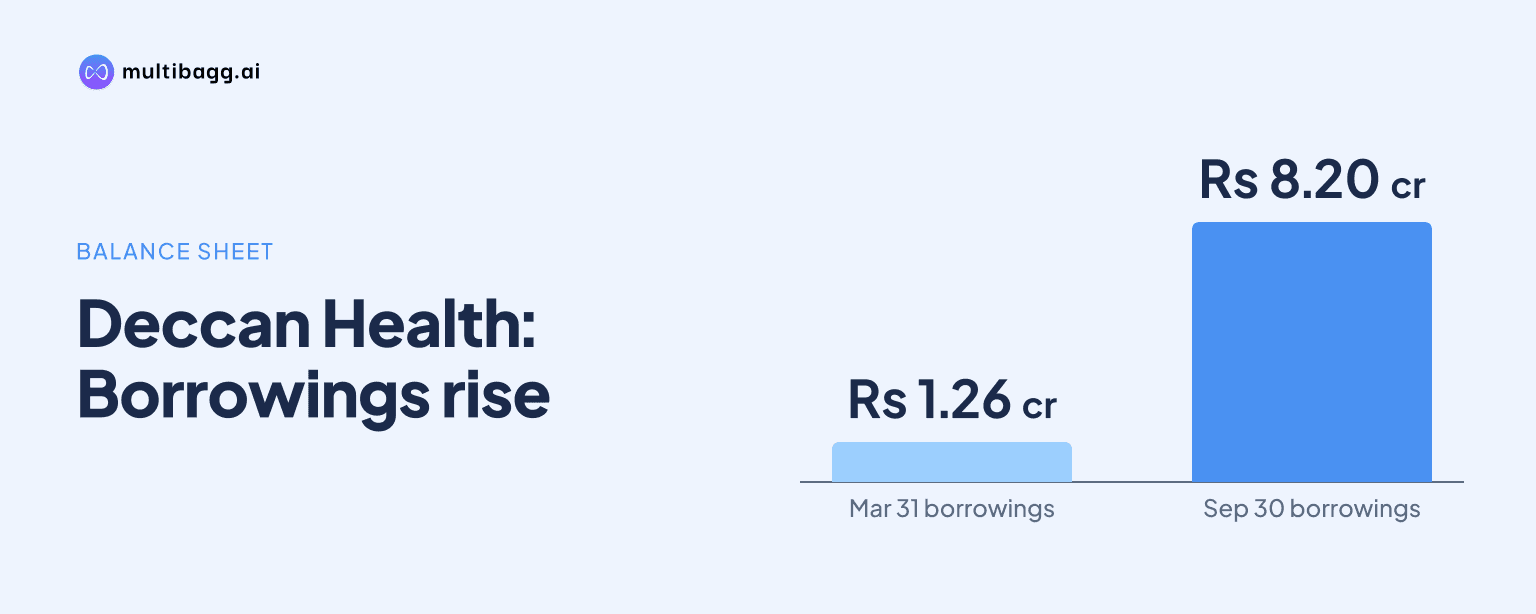
Deccan Health Care Limited’s short-term borrowings reached Rs 8.20 crore at September 30, 2026, up from Rs 1.26 crore at March 31, 2026, and total current liabilities rose to Rs 41.06 crore from Rs 34.05 crore in the unaudited consolidated balance sheet.
Know Deccan Health Care inside out
Results, valuation, peers and who's buying, in one view.
Why did Deccan Health Care’s current liabilities increase?
Deccan Health Care’s current liabilities increased chiefly because short-term borrowings rose by Rs 6.94 crore during the six months ended September 30, 2026. The short-term borrowing balance of Rs 8.20 crore was about 6.5 times the Rs 1.26 crore reported at March 31, 2026, while total current liabilities increased by Rs 7.01 crore.
Other current liabilities also contributed to the increase, rising to Rs 9.36 crore at September 30 from Rs 7.38 crore at March 31. Net current-tax liabilities rose to Rs 2.61 crore from Rs 1.29 crore, whereas other financial liabilities fell to Rs 1.08 crore from Rs 2.99 crore, partly offsetting the higher borrowing and tax balances.
Trade payables moved lower over the period rather than driving the increase. Dues to creditors other than micro and small enterprises were Rs 19.05 crore at September 30, down from Rs 19.33 crore at March 31, while dues to micro and small enterprises fell to Rs 41.98 lakh from Rs 43.53 lakh.
Short-term provisions were Rs 34.73 lakh at September 30, compared with Rs 36.85 lakh six months earlier. The balance-sheet movement therefore reflects higher short-term borrowings, other current liabilities and current tax liabilities, rather than an across-the-board rise in all current obligation categories.
How was Deccan Health Care’s borrowing increase reflected in cash flow?
Deccan Health Care’s cash-flow statement recorded a Rs 6.94 crore increase in short-term borrowings in the half year ended September 30, 2026, consistent with the balance-sheet movement from March 31. Net cash from financing activities was Rs 6.45 crore, compared with Rs 2.15 crore in the half year ended September 30, 2025.
The financing inflow came as operations used cash. Net cash used in operating activities was Rs 5.94 crore in the September 2026 half year, compared with an outflow of Rs 3.78 crore in the corresponding 2025 period, despite operating profit before working-capital changes of Rs 2.03 crore.
The largest disclosed working-capital use was a Rs 16.85 crore increase in other current assets. This was partly offset by a Rs 9.52 crore cash release from inventories, while trade receivables used Rs 38.71 lakh and trade payables reduced by Rs 29.93 lakh during the half year.
After an investing outflow of Rs 1.96 lakh, cash and cash equivalents increased by Rs 49.01 lakh in the six months. Deccan Health Care closed September 30 with cash and cash equivalents of Rs 2.13 crore, compared with Rs 1.64 crore at March 31, while interest and finance charges were Rs 31.69 lakh against Rs 18.15 lakh a year earlier.
Got a follow-up? Ask IRIS
What changed in Deccan Health Care’s current assets?
Deccan Health Care’s current assets increased to Rs 137.93 crore at September 30, 2026, from Rs 129.73 crore at March 31, 2026. The Rs 8.20 crore increase was led by other current assets, which rose by Rs 16.85 crore to Rs 80.17 crore during the six-month period.
Inventories moved in the opposite direction, declining to Rs 37.44 crore from Rs 46.96 crore. The Rs 9.52 crore reduction aligns with the inventory-related cash inflow reported in the cash-flow statement for the half year ended September 30.
Trade receivables rose to Rs 17.37 crore from Rs 16.99 crore, while cash and cash equivalents rose by Rs 49.01 lakh to Rs 2.13 crore. Other bank balances remained Rs 2.12 lakh at both reporting dates, and other financial assets and loans were Rs 78.55 lakh at September 30, compared with Rs 78.56 lakh at March 31.
Using the disclosed current-asset and current-liability totals, current assets equalled about 3.36 times current liabilities at September 30, compared with about 3.81 times at March 31. The change followed the Rs 7.01 crore rise in current liabilities and the Rs 8.20 crore rise in current assets over the same period.
What does Deccan Health Care’s balance sheet show about longer-term funding?
Deccan Health Care’s long-term borrowings declined to Rs 2.54 crore at September 30, 2026, from Rs 2.70 crore at March 31. The half-year cash-flow statement recorded Rs 16.69 lakh of long-term borrowing repayment, while short-term borrowings increased by Rs 6.94 crore.
Total liabilities rose to Rs 45.46 crore at September 30 from Rs 38.65 crore at March 31. Total equity increased to Rs 110.96 crore from Rs 110.26 crore, with equity share capital unchanged at Rs 24.75 crore and other equity attributable to owners rising to Rs 86.21 crore from Rs 85.51 crore.
Total assets were Rs 156.42 crore at September 30, compared with Rs 148.91 crore at March 31. Non-current assets declined to Rs 18.49 crore from Rs 19.18 crore, including property, plant and equipment falling to Rs 14.28 crore from Rs 15.00 crore, so the asset increase came from current assets.
The figures cover Deccan Health Care and its subsidiary, Beyoungstore Private Limited. The limited-review report dated November 13, 2026 said nothing had come to the auditor’s attention to indicate that the unaudited consolidated statement failed to disclose required information or contained a material misstatement; it noted the subsidiary’s interim financial information had not been reviewed by that auditor.
Conclusion
Deccan Health Care’s September 2026 consolidated balance sheet shows that the Rs 6.94 crore rise in short-term borrowings accounted for most of the Rs 7.01 crore increase in current liabilities. Current assets rose by Rs 8.20 crore, but this reflected a Rs 16.85 crore increase in other current assets alongside a Rs 9.52 crore inventory reduction.
The next reported balance sheet will show whether the Rs 8.20 crore short-term borrowing balance changes after the Rs 5.94 crore operating cash outflow in the half year ended September 30, 2026. Deccan Health Care did not disclose a borrowing-repayment target or a stated use for the additional short-term funding, leaving subsequent financing movements and the composition of other current assets to be monitored.