










Delhivery crosses Rs 3,000 crore revenue as EBITDA triples
Key highlights
- Delhivery reported Q2FY27 revenue from services of Rs 3,066 crore, up 20% year on year and its first quarterly total above Rs 3,000 crore.
- Delhivery’s Q2FY27 EBITDA tripled year on year to Rs 205 crore, representing a 6.7% margin.
- Delhivery’s PTL business moved 545,000 metric tonnes in Q2FY27, up 14% year on year, while PTL revenue grew 23%.
- Delhivery held a cash balance of Rs 4,676 crore at the end of Q2FY27.
powered by IRIS
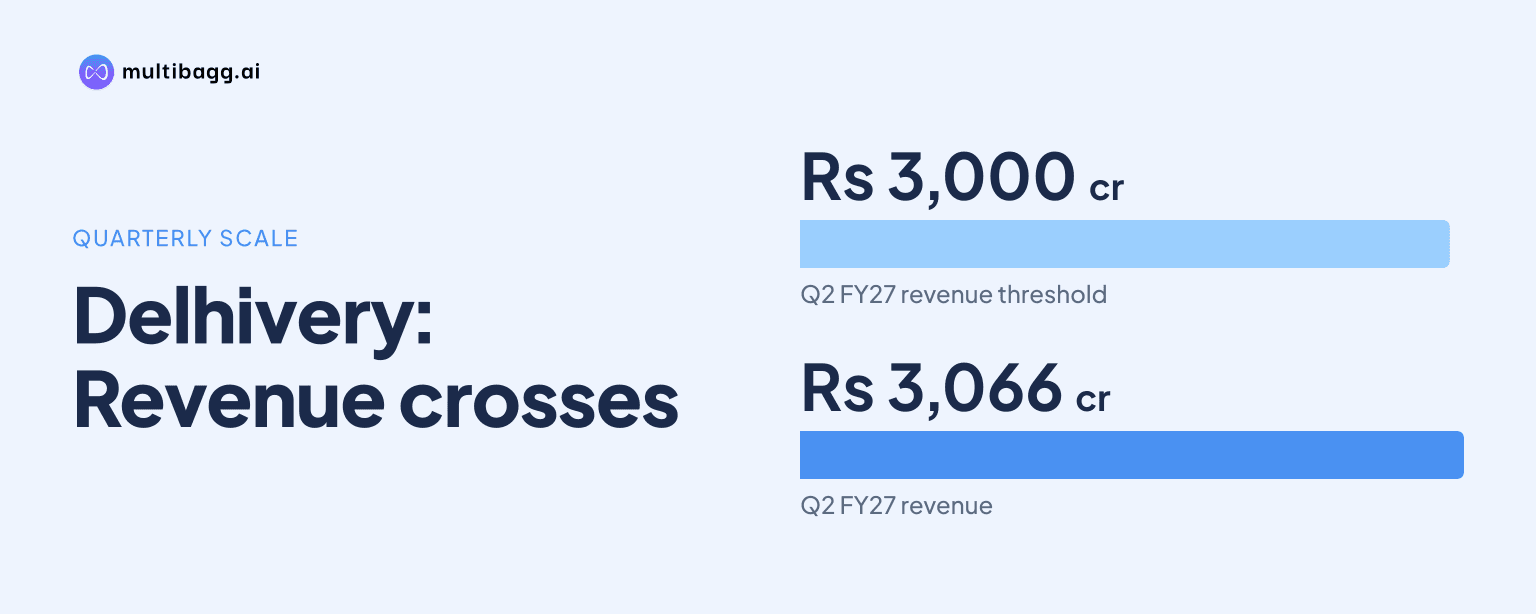
Delhivery Limited crossed Rs 3,000 crore of quarterly revenue from services for the first time in Q2FY27, reporting Rs 3,066 crore, 20% higher year on year. Delhivery said EBITDA tripled year on year to Rs 205 crore, a 6.7% margin, while consolidated profit after tax reached Rs 41 crore for the quarter ended September 30, 2026.
Know Delhivery inside out
Results, valuation, peers and who's buying, in one view.
How did Delhivery’s financial performance change in Q2FY27?
Delhivery reported Rs 3,066 crore of revenue from services in Q2FY27, its first quarterly total above Rs 3,000 crore, and said the figure was 20% higher year on year. EBITDA, or earnings before interest, tax, depreciation and amortisation, was Rs 205 crore, up three times year on year, while consolidated profit after tax was Rs 41 crore. Delhivery described the profitability outcome as a significant sequential improvement, but did not disclose the preceding quarter’s figures in the announcement.
Delhivery reported the Rs 205 crore EBITDA result against what it described as an inflationary cost backdrop. Management cited rising fuel prices, labour-availability issues and multiple statutory changes as macro pressures during Q2FY27. The announcement did not quantify fuel, labour or statutory costs, so it does not establish how much each factor affected the 6.7% EBITDA margin or the Rs 41 crore consolidated profit after tax.
Which Delhivery segments drove Q2FY27 growth?
Delhivery’s express parcel operation handled 325 million shipments in Q2FY27, up 32% year on year, while express parcel revenue rose 22%. Its part truck-load, or PTL, operation moved 545,000 metric tonnes, 14% more than a year earlier, and recorded 23% revenue growth. Both disclosed operating lines therefore grew revenue faster than Delhivery’s 20% increase in total revenue from services.
Express parcel volume growth of 32% exceeded its 22% revenue growth, whereas PTL volume growth of 14% was lower than its 23% revenue growth. Delhivery did not disclose revenue per shipment, revenue per tonne, segment revenue in rupees or prior-year operating volumes. The release therefore supports a comparison of growth rates between the 325 million-shipment express business and the 545,000-tonne PTL business, but not an assessment of their respective revenue contributions.
Delhivery listed e-commerce and express parcel transportation, PTL freight, full-truckload freight, warehousing and supply-chain solutions, international freight, intra-city on-demand logistics, data solutions and software services among its offerings. The release said Delhivery serves more than 59,000 clients, but gave quarterly volume and revenue-growth measures only for express parcel and PTL. That limits the disclosed segment comparison to the two businesses with Q2FY27 data.
Got a follow-up? Ask IRIS
What technology and automation actions did Delhivery disclose?
Delhivery said it is continuing technology investment to improve demand shaping and infrastructure productivity, reduce labour dependence in under-the-roof operations, and simplify customer experience. These initiatives were disclosed alongside Q2FY27 revenue of Rs 3,066 crore and EBITDA of Rs 205 crore. Delhivery did not state a rupee investment budget, an expected return, or a timetable for the broader technology programme.
Management said early artificial intelligence investments are beginning to improve sales productivity and customer onboarding, accelerate claims and dispute resolution, and aid fraud detection. The announcement did not provide figures for onboarding times, claims-resolution times, sales productivity or fraud cases. These are management’s reported operational applications of artificial intelligence rather than quantified financial benefits for Q2FY27.
Delhivery Robotics, Delhivery’s in-house automation laboratory, has commenced production of customised autonomous vehicles for in-facility movement operations. Delhivery also said it has begun testing robotics systems across under-the-roof operations with global leaders in the physical artificial-intelligence domain. The October 30, 2026 release did not disclose the number of vehicles produced, sites involved in testing or expected labour savings.
What will Delhivery focus on in the second half of FY27?
Delhivery said service levels entering the festive season were the best it had recorded, and that improved profitability in Q2FY27 gave its teams momentum entering the second half of FY27. This was management’s assessment after the September 30, 2026 quarter, in which express parcel shipments rose 32% to 325 million. Delhivery did not issue numerical revenue, EBITDA, margin or volume guidance for the second half.
The disclosed second-half plans focus on demand shaping, infrastructure productivity, under-the-roof automation and customer experience. Delhivery has also started robotics testing and said its customised autonomous vehicles are in production, but has not provided a wider deployment date or cost-saving target. Its Q2FY27 earnings call was scheduled for 6:00 PM Indian Standard Time on October 30, 2026, with an audio replay to be made available after the call.
Conclusion
Delhivery combined its first quarter above Rs 3,000 crore of revenue from services with a threefold year-on-year increase in EBITDA to Rs 205 crore and consolidated profit after tax of Rs 41 crore. The operating data showed different growth patterns across the two disclosed lines: express parcel shipments rose 32% to 325 million, while PTL tonnage increased 14% to 545,000 metric tonnes, with revenue growth of 22% and 23%, respectively.
The next disclosed areas to watch are festive-season service levels and the execution of Delhivery’s technology and automation plans. Management has identified artificial intelligence uses, autonomous vehicles and robotics testing as ongoing initiatives, but has not set financial targets, rollout dates, investment amounts or savings estimates for those programmes.