










Dhatre Udyog evaluates Jamshedpur development after closure
Key highlights
- Dhatre Udyog approved closure of its Vizianagaram manufacturing operations on February 14, 2025.
- Dhatre Udyog recorded a Rs 2.90 crore expected-credit-loss provision for the six months ended September 30, 2026.
- Cash and cash equivalents fell to Rs 5.46 lakh at September 30, 2026 from Rs 1.90 crore at April 1, 2026.
- Trade receivables were Rs 23.82 crore at September 30, 2026, compared with Rs 25.38 crore at March 31, 2026.
powered by IRIS
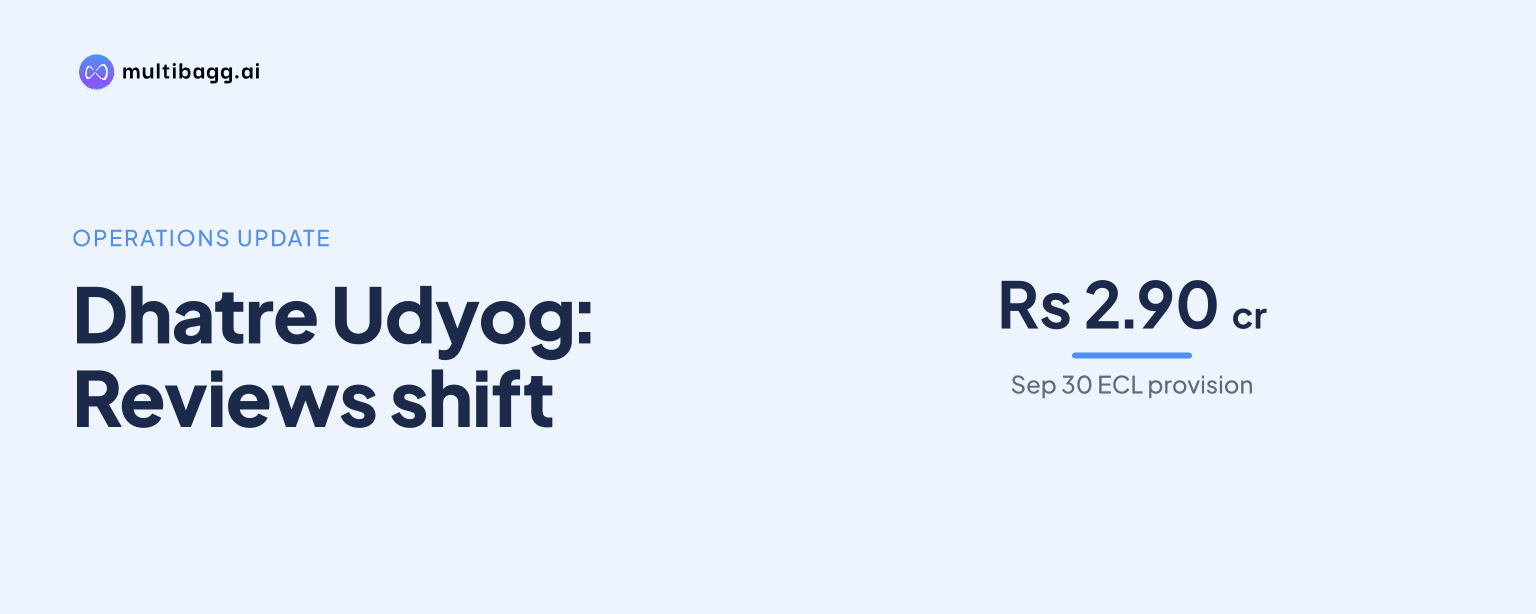
Dhatre Udyog Limited has suspended its business activities and is evaluating real-estate development on Jamshedpur land after closing manufacturing, scrapping plant and machinery, and selling the Vizianagaram factory land separately; it also recorded a Rs 2.90 crore expected-credit-loss provision for the six months ended September 30, 2026.
Know Dhatre Udyog inside out
Results, valuation, peers and who's buying, in one view.
Why did Dhatre Udyog close its manufacturing operations?
Dhatre Udyog closed manufacturing because its plant had aged, its machinery and technology had become obsolete, and production costs had risen. The board approved the closure of the Vizianagaram manufacturing operations, together with the sale, lease or other disposal of related assets, on February 14, 2025.
Dhatre Udyog stated that its business activities were suspended at September 30, 2026. It therefore reported no separate operating segment under Indian Accounting Standard 108, or Ind AS 108, in its unaudited results for the quarter and six months ended September 30, 2026.
The closure did not result in a sale of the factory as an operating business. Dhatre Udyog said it had received no viable offer to sell the manufacturing unit as a going concern, leading it to dispose of the production assets and land through separate transactions during the previous year.
The September 2026 results were reviewed by the audit committee and approved by the board on November 12, 2026. The statutory auditors conducted a limited review and issued a qualified conclusion, rather than an audit opinion, on the interim financial statements.
How did Dhatre Udyog dispose of the Vizianagaram facility?
Dhatre Udyog disposed of the Vizianagaram plant and machinery as scrap and sold the factory land separately during the previous year. The filing does not disclose the sale proceeds, buyer, land area or exact dates of those transactions.
Property, plant and equipment stood at Rs 28.28 lakh at September 30, 2026, down from Rs 51.77 lakh at March 31, 2026. The Rs 23.49 lakh reduction shows a smaller reported fixed-asset balance, although the filing does not provide an asset-by-asset reconciliation of the movement.
The cash-flow statement reported no proceeds from sales of property, plant and equipment in the six months ended September 30, 2026. In comparison, the six months ended September 30, 2025 included Rs 7.13 crore of proceeds from such sales, but the filing does not link that figure directly to the prior-year disposal of the Vizianagaram assets.
The remaining Jamshedpur land is distinct from the former Vizianagaram manufacturing facility. As of September 30, 2026, Dhatre Udyog said it was evaluating opportunities to undertake real-estate development on that Jamshedpur land, without disclosing a project approval or launch.
What changed in Dhatre Udyog's September 2026 financial position?
Dhatre Udyog recorded a Rs 2.90 crore provision for expected credit losses on trade receivables outstanding for more than one year in the six months ended September 30, 2026. The charge was included in other expenses and exceeded the Rs 1.30 crore expected-credit-loss provision reported for the six months ended September 30, 2025.
Trade receivables were Rs 23.82 crore at September 30, 2026, compared with Rs 25.38 crore at March 31, 2026, a decline of Rs 1.56 crore. However, the cash-flow statement recorded a Rs 1.34 crore increase in trade receivables as an operating cash use during the latest six-month period.
Operating activities used Rs 1.85 crore in the six months ended September 30, 2026, compared with cash generation of Rs 16.67 lakh in the corresponding 2025 period. The latest period had no reported investing or financing cash flow, whereas the earlier period included Rs 7.25 crore of investing inflows and Rs 8.16 crore of financing outflows.
Cash and cash equivalents fell from Rs 1.90 crore at April 1, 2026 to Rs 5.46 lakh at September 30, 2026. The cash-flow statement attributes the latest-period movement to the Rs 1.85 crore operating outflow, while the filing does not disclose a separate financing transaction in those six months.
Got a follow-up? Ask IRIS
How is Dhatre Udyog supporting its going-concern assessment?
Dhatre Udyog prepared its September 30, 2026 financial statements on a going-concern basis because management believes the proposed Jamshedpur real-estate development and other available resources will enable it to continue operations and meet obligations in the normal course. This is management's assessment, not a disclosed project approval, construction plan or revenue forecast.
The balance sheet reported total equity of Rs 49.88 crore and current liabilities of Rs 1.15 crore at September 30, 2026. Investments rose to Rs 14.73 crore from Rs 9.13 crore at March 31, 2026, but Dhatre Udyog did not identify how much of those investments or other resources could be used for the Jamshedpur opportunity.
No development budget, funding arrangement, partner, regulatory approval, project schedule or anticipated revenue was disclosed on November 12, 2026. The company described the Jamshedpur initiative as an evaluation of opportunities, so the filing does not establish that development activity has begun.
The auditor drew attention to the manufacturing closure, prior-year asset disposals and the Jamshedpur evaluation, but said its conclusion was not modified in respect of that matter. The qualified conclusion instead arose because trade receivables, debit or credit advances, and trade payables remained subject to confirmations, reconciliations and possible adjustments.
What remains uncertain in Dhatre Udyog's reported balances?
The auditor said it could not ascertain the consequential impact of pending confirmations and reconciliations for trade receivables, advances and trade payables. This uncertainty applies to balances reported in the September 30, 2026 financial statements, including trade receivables of Rs 23.82 crore.
The Rs 2.90 crore expected-credit-loss provision addresses receivables outstanding for more than one year, but the filing does not state whether pending confirmations will change that provision. It also does not quantify any possible adjustment to advances or trade payables following reconciliation.
Dhatre Udyog's current liabilities were Rs 1.15 crore at September 30, 2026, versus Rs 1.19 crore at March 31, 2026. Trade payables to creditors other than micro and small enterprises were Rs 3.05 lakh, compared with Rs 6.16 lakh at March 31, 2026, according to the balance sheet.
The auditor's review report was dated November 12, 2026 and stated that, except for the confirmation and reconciliation matter, nothing had come to its attention indicating that the results failed required disclosure standards. A review is narrower in scope than an audit and does not provide audit assurance, as the report explains.
Conclusion
Dhatre Udyog has moved from a closed Vizianagaram manufacturing operation to evaluating a possible Jamshedpur real-estate development. The transition follows the February 14, 2025 closure decision, the previous-year scrapping of machinery and separate factory-land sale, while the latest six-month results included a Rs 2.90 crore credit-loss provision and Rs 1.85 crore of operating cash use.
The next disclosed matters to watch are whether the Jamshedpur evaluation becomes a defined plan with funding, approvals, timing or commercial terms, and whether confirmations of receivables, advances and payables result in financial-statement adjustments. Neither a development schedule nor the outcome of those reconciliations had been disclosed by November 12, 2026.