








Domestic institutional investors sell ₹55,570 crore in rally
MAX Plan at ₹4,999/yr

Find your next multibaggerBe a Pro Investor
Research stocks and track your picks on the go. Download the app.
Key highlights
- DIIs sold about ₹55,570 crore of equities in November 2026 in the cited cash-market data.
- Foreign institutional investors bought a net ₹94,229 crore in November 2026.
- The Nifty 50 rose more than 9% in November despite domestic institutional selling.
- October equity mutual fund inflows were ₹32,994 crore and SIP contributions were ₹32,160 crore.
powered by IRIS
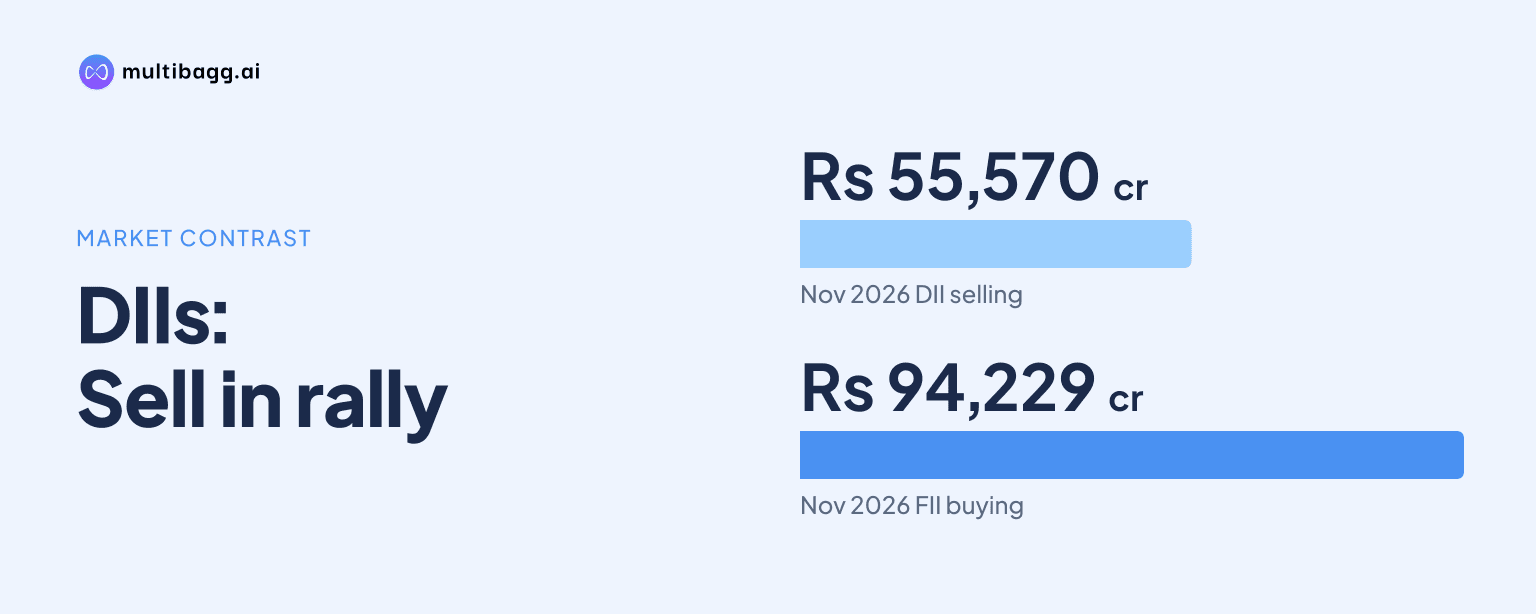
Domestic institutional investors sold ₹55,570 crore in November 2026 while foreign institutional investors bought ₹94,229 crore and the Nifty 50 rose more than 9%, indicating that foreign demand outweighed domestic profit-booking in the cash market during the rally.
Why are DIIs selling during the November rally?
DIIs appear to be booking profits and rebalancing portfolios after buying heavily during an extended period of foreign selling. The discussion around the November flows describes a sell-on-rise approach, with domestic institutions using the market recovery and improved liquidity to reduce exposure in selected holdings and maintain targeted equity allocations.
This activity does not by itself establish that DIIs have turned bearish on Indian equities. Domestic institutional investors include mutual funds, insurers, banks and pension funds, and their decisions can reflect portfolio mandates, gains in individual shares, rebalancing needs and redemption requirements. The context also notes that DIIs had been buyers while FIIs were sustained sellers, leaving domestic institutions with profits that could be realised as prices recovered.
Mutual funds were reported to have turned net sellers in November for the first time since April 2023. DIIs were net sellers in 12 of 13 trading sessions during the month, according to the cited exchange data. That pattern can limit parts of a rally, particularly if domestic selling persists after foreign buying slows.
How large are the November FII and DII flows?
Foreign institutional investors bought a net ₹94,229 crore of Indian equities in November, versus net sales of ₹55,571 crore by DIIs, producing combined net institutional buying of ₹38,658 crore. The figures show why the market could rise despite domestic selling: foreign purchases were substantially larger than domestic sales in the cited cash-market data.
A separate figure in the discussion puts DII sales at about ₹27,998 crore in five sessions up to 9 November. Kotak Institutional Equities was also cited as estimating domestic institutional net sales of $6.6 billion in November so far. These figures should be read as measures of market participation and liquidity, not as a standalone forecast for the Nifty 50 or for any fund category.
The reversal is notable because domestic money had previously helped absorb foreign selling. Between July 2025 and October 2026, foreign portfolio investors were said to have sold Indian equities in the secondary market for 16 consecutive months, offloading about ₹6.3 lakh crore. In the current rally, the roles have reversed, with foreign buying supporting prices as domestic institutions take profits.
Got a follow-up? Ask IRIS
What does DII selling mean for mutual fund returns?
DII selling can affect market liquidity and the path of returns, but it does not directly determine the return of an individual mutual fund. A fund's performance also depends on its holdings, stock selection, sector exposure, cash position, expenses and the movement of the broader market. A rising Nifty 50 therefore may not translate into similar gains in every portfolio, especially in midcap and smallcap funds.
For SIP investors, the immediate effect of a rising market is mechanical. At the Nifty's Wednesday close cited in the discussion, a ₹10,000 monthly instalment in an index-tracking fund would buy about 10.7% fewer units than it would have at October's close. At the same time, units accumulated through earlier instalments would be worth more. Neither outcome indicates where prices will move next.
Continued mutual fund inflows remain relevant to the market backdrop. October equity mutual fund inflows were ₹32,994 crore, while SIP contributions were ₹32,160 crore. The cited view is that DIIs cannot keep selling indefinitely if such inflows continue, because the funds need to be deployed. However, the timing and choice of investments remain subject to valuations, mandates and market conditions.
Should SIP investors act on FII and DII flow data?
SIP investors should not make investment decisions on institutional flow data alone, because FII and DII activity is only one input into market movement. The discussion specifically notes that these flows can provide context on sentiment and volatility, while mutual fund performance depends on several other factors.
A foreign-led rally can be more exposed if foreign purchases stop or reverse quickly. If that happens, domestic inflows may again serve as a cushion, as they did during the earlier foreign sell-off. Conversely, if FII buying slows while DII selling continues, the rally may lose momentum. Those are market-risk considerations rather than a reason to assume a particular return from an SIP.
The relevant distinction is between a regular investment process and a short-term reaction to headlines. An SIP continues to buy across market levels, including at higher prices during rallies and potentially lower prices during corrections. Past performance is not an indicator of future returns, and institutional flows do not remove the need to assess a fund's mandate and portfolio exposure.
Conclusion
The November 2026 flow pattern shows foreign institutional investors providing the larger source of net demand while DIIs book profits after a period of domestic support for the market. Net FII buying of ₹94,229 crore exceeded DII sales of about ₹55,570 crore, helping explain why the Nifty 50 could rise more than 9% even as domestic funds and other institutions sold.
The next issue to watch is whether foreign buying remains strong and whether sustained mutual fund and SIP inflows lead DIIs to resume selective purchases. If FIIs turn net sellers again, valuations and domestic deployment decisions will determine how much support local institutions provide.

