










DMCC operating cash flow falls 76% as receivables absorb cash
Key highlights
- DMCC’s consolidated operating cash inflow fell 76% to Rs 4.23 crore in the half year ended 30 September 2026 from Rs 17.42 crore a year earlier.
- Trade receivables absorbed Rs 49.75 crore of cash, while total working-capital changes resulted in a Rs 37.02 crore outflow.
- Consolidated net profit rose to Rs 23.63 crore from Rs 13.51 crore, and sales increased to Rs 525.88 crore from Rs 253.07 crore.
- Short-term borrowings increased to Rs 66.52 crore at 30 September 2026 from Rs 49.67 crore at 31 March 2026, while finance costs rose to Rs 7.32 crore from Rs 3.93 crore.
powered by IRIS
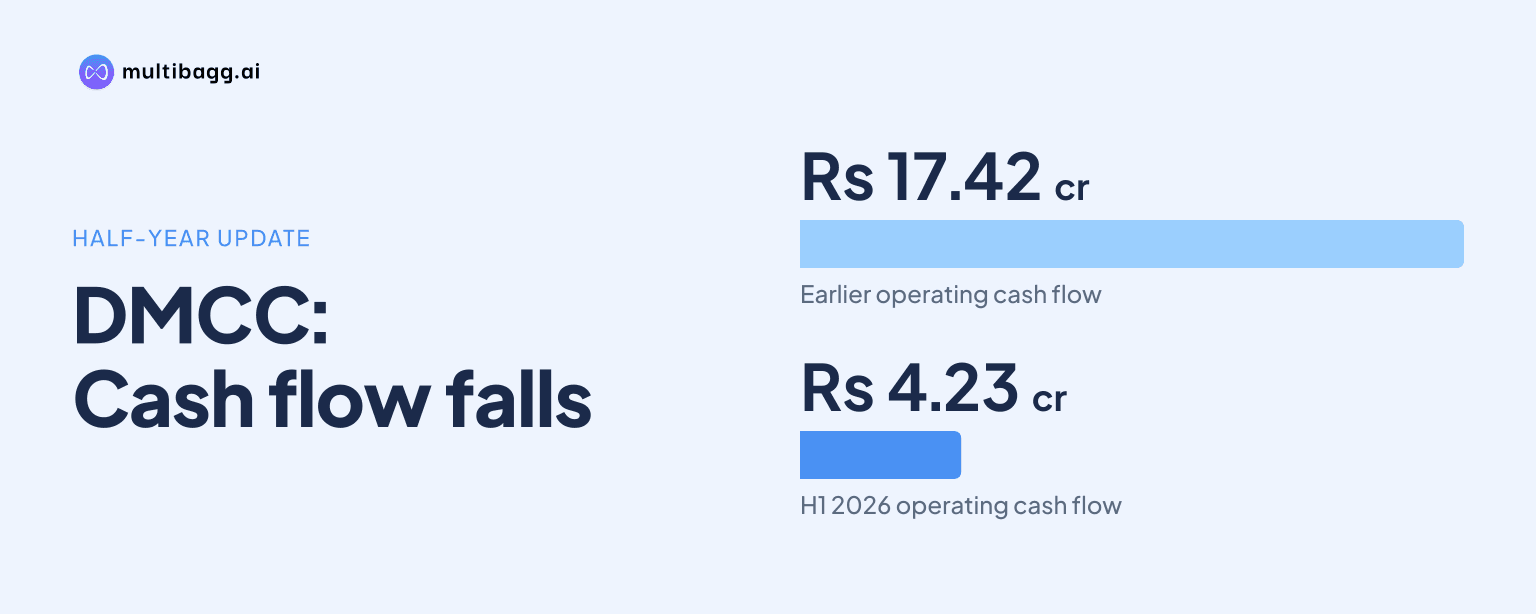
DMCC Speciality Chemicals Limited reported consolidated operating cash inflow of Rs 4.23 crore for the half year ended 30 September 2026, down 76% from Rs 17.42 crore a year earlier. The decline came despite net profit rising to Rs 23.63 crore, because trade receivables absorbed Rs 49.75 crore of cash and working-capital movements remained negative.
Know DMCC Speciality Chemicals inside out
Results, valuation, peers and who's buying, in one view.
What happened to DMCC’s operating cash flow?
DMCC’s consolidated net cash inflow from operating activities fell to Rs 4.23 crore in the half year ended 30 September 2026 from Rs 17.42 crore in the corresponding 2025 period. This Rs 13.19 crore decline followed a reduction in cash generated from operations to Rs 9.05 crore from Rs 20.30 crore, before direct tax payments.
The cash-flow result differed from the profit outcome. Consolidated profit before tax rose to Rs 31.19 crore from Rs 19.31 crore, while net profit increased to Rs 23.63 crore from Rs 13.51 crore. After paying direct taxes, net of refunds, of Rs 4.82 crore against Rs 2.88 crore a year earlier, DMCC retained Rs 4.23 crore in operating cash.
Why did higher profit not produce higher cash?
The main reason was DMCC’s Rs 49.75 crore cash absorption from increased trade receivables in the half year ended 30 September 2026. In the corresponding prior-year half, the trade-receivables line added Rs 0.46 crore of cash rather than consuming it. That shift was the largest reported movement among the working-capital lines.
DMCC’s operating profit before working-capital changes improved to Rs 46.04 crore from Rs 31.97 crore. The improvement included profit before tax of Rs 31.19 crore, depreciation and amortisation of Rs 7.54 crore, and interest charged of Rs 7.32 crore. These adjustments did not offset cash tied up in receivables and other working-capital movements.
The consolidated balance sheet lists trade receivables of Rs 145.53 crore at 30 September 2026, compared with Rs 95.94 crore at 31 March 2026. The cash-flow statement records the period’s receivables movement as Rs 49.75 crore, while the balance-sheet figures show the receivables balance at the reporting date.
Which working-capital movements offset receivables pressure?
DMCC received partial offsets from trade payables and other liabilities, but these did not compensate for the receivables increase. Trade payables generated Rs 11.99 crore of cash in the 2026 half year, compared with a Rs 7.01 crore outflow in the prior-year period. Other financial liabilities added Rs 1.57 crore, and other current liabilities added Rs 2.51 crore.
Inventory used Rs 4.41 crore of cash, reversing a Rs 2.18 crore cash contribution in the previous half year. Other non-current assets absorbed Rs 2.26 crore, while other financial assets used Rs 0.01 crore. Other current assets contributed Rs 3.34 crore, but the combined working-capital effect remained a Rs 37.02 crore outflow, compared with an Rs 11.68 crore outflow a year earlier.
The reported movements show that working capital had a greater effect on cash generation than the increase in half-year profit. DMCC’s consolidated revenue from operations rose to Rs 525.88 crore from Rs 253.07 crore, while the trade-receivables movement changed from a modest cash inflow to a large cash use. The filing does not disclose a customer-wise ageing analysis or a receivables-collection plan.
Got a follow-up? Ask IRIS
How did DMCC fund cash requirements during the half year?
DMCC generated Rs 2.48 crore of net cash from financing activities in the 2026 half year, compared with a Rs 19.90 crore financing cash outflow in the prior-year half. Net proceeds from current borrowings were Rs 16.90 crore, compared with Rs 7.51 crore a year earlier, during a period when operating cash flow declined.
The additional current borrowing was partly offset by a Rs 1.00 crore net repayment of non-current borrowings, Rs 7.29 crore of interest and other finance-cost payments, and Rs 6.24 crore of equity-dividend payments. In the 2025 half year, DMCC had repaid Rs 11.87 crore of non-current borrowings, alongside Rs 3.96 crore of interest and other finance-cost payments and the same Rs 6.24 crore dividend payment.
The consolidated balance sheet reports short-term borrowings of Rs 66.52 crore at 30 September 2026, compared with Rs 49.67 crore at 31 March 2026. Long-term borrowings stood at Rs 41.36 crore at 30 September, compared with Rs 36.87 crore at 31 March. Finance costs in the income statement rose to Rs 7.32 crore from Rs 3.93 crore across the two half-year periods.
What do DMCC’s sales and profit figures show?
DMCC’s consolidated sales increased to Rs 525.88 crore for the half year ended 30 September 2026 from Rs 253.07 crore a year earlier. Total income from operations rose to Rs 526.40 crore from Rs 253.75 crore, while raw-material consumption increased to Rs 433.46 crore from Rs 163.87 crore.
Profit before tax increased to Rs 31.19 crore from Rs 19.31 crore, but the second quarter was lower than the first quarter. Consolidated profit before tax was Rs 3.98 crore in the quarter ended 30 September 2026, against Rs 27.21 crore in the quarter ended 30 June 2026. Net profit similarly fell to Rs 3.23 crore in the September quarter from Rs 20.40 crore in the June quarter.
DMCC’s cash and cash equivalents increased because operating and financing inflows together exceeded investing outflows. Net cash used in investing activities was Rs 5.93 crore, compared with Rs 1.21 crore in the prior-year half. Cash and cash equivalents ended the period at Rs 2.94 crore, up from Rs 2.16 crore at the beginning of the year; in the comparable prior period, they fell to Rs 0.70 crore from Rs 4.39 crore.
Conclusion
DMCC reported higher half-year sales, profit before tax and net profit, but its operating cash inflow fell to Rs 4.23 crore from Rs 17.42 crore. The key difference was working capital: a Rs 49.75 crore increase in trade receivables consumed cash, while inventory also used Rs 4.41 crore, leaving increases in payables and other liabilities insufficient to preserve the prior year’s cash generation.
The next point to watch is whether DMCC converts the reported Rs 145.53 crore of trade receivables into cash while containing dependence on short-term funding, which stood at Rs 66.52 crore on 30 September 2026. The filing discloses no receivables-collection target, cash-flow target or scheduled financing event, while it records Rs 16.90 crore of net current-borrowing proceeds during the half year.