










Dodla Dairy Ltd Q2 Revenue Rises 17.4% as Margins Contract
Key highlights
- Dodla Dairy reported Q2 FY27 revenue of ₹1,196 crore, up 17.4% year-on-year.
- Q2 FY27 EBITDA fell 30.9% to ₹64.1 crore, with EBITDA margin at 5.4%.
- Q2 FY27 net profit declined 44.3% year-on-year to ₹36.6 crore.
- Dodla Dairy raised prices by ₹2.5 per litre in September 2026 and guided for 7.5%-8% EBITDA margin in Q3 FY27.
powered by IRIS
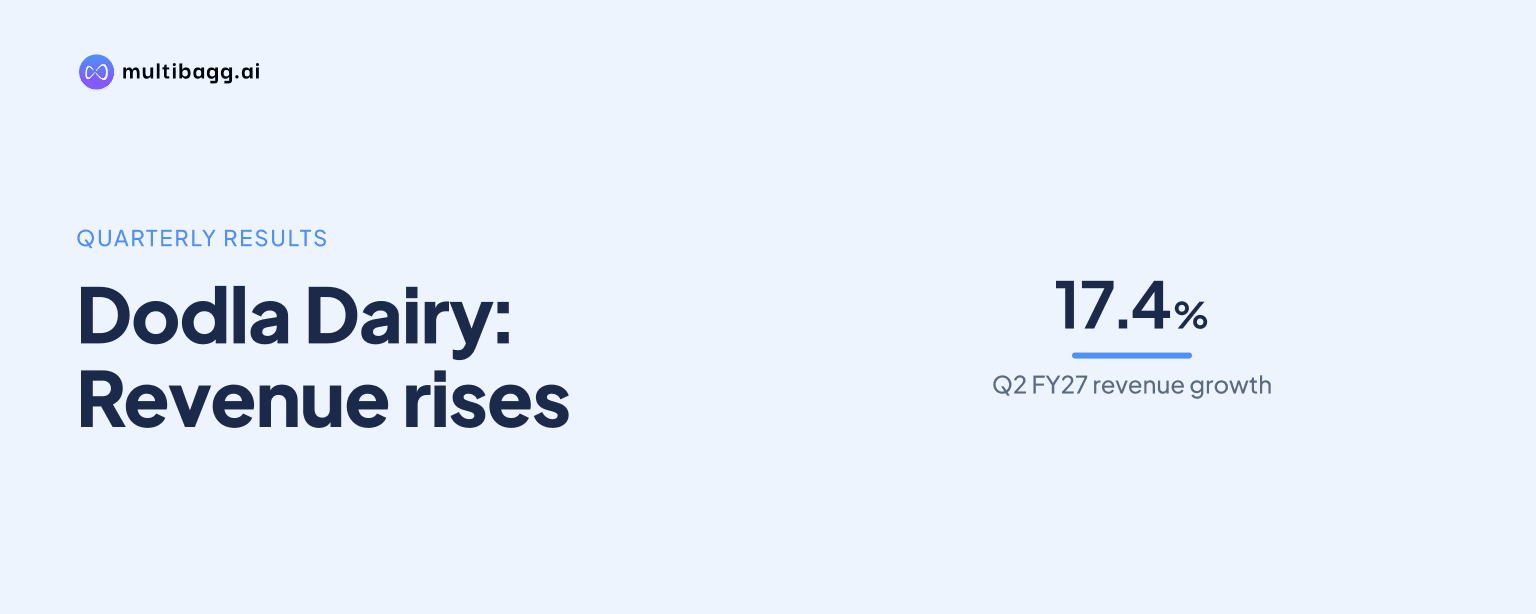
Dodla Dairy Ltd reported Q2 FY27 revenue of ₹1,196 crore, up 17.4% year-on-year, but EBITDA margin fell to 5.4% as elevated milk procurement and operating costs reduced profitability. The company said a ₹2.5-per-litre price increase implemented in September is expected to support margin recovery in the following quarter.
Know Dodla Dairy inside out
Results, valuation, peers and who's buying, in one view.
What did Dodla Dairy report for Q2 FY27?
Dodla Dairy reported consolidated revenue of ₹1,196 crore for the quarter ended September 2026, compared with the corresponding quarter a year earlier. Revenue growth was supported by the company’s India operations, the full-year contribution trend from OSAM, and continued expansion in its Africa business.
Profitability, however, did not move in line with revenue. Gross profit was ₹275.7 crore, down 2.3% year-on-year, while EBITDA declined 30.9% to ₹64.1 crore. The EBITDA margin stood at 5.4%, reflecting higher milk procurement prices and other operating costs during the quarter.
Net profit fell 44.3% year-on-year to ₹36.6 crore from ₹65.7 crore. EBIT was ₹40.5 crore, down 43.9% year-on-year, and the EBIT margin was 3.4%. For the first half of FY27, Dodla Dairy reported revenue of ₹2,394 crore, EBITDA of ₹129 crore and net profit of ₹77.2 crore.
Why did Dodla Dairy's margin decline despite revenue growth?
Dodla Dairy attributed the pressure primarily to elevated milk procurement costs, which affected gross profit and operating profitability. Management said procurement prices were expected to remain at current elevated levels, though it did not anticipate further significant increases because inflation appeared to have peaked and been front-loaded.
The company increased prices by ₹2.5 per litre in September 2026. Management said the full impact of this change would be visible in subsequent quarters, since the increase did not benefit the entire September quarter. It guided for EBITDA margin of 7.5% to 8% in Q3 FY27, subject to no major changes in prevailing conditions.
The difference between revenue growth and profit growth shows the importance of pricing and procurement costs in the dairy business. Milk is a key input cost, and a rise in procurement prices can quickly reduce margins unless consumer pricing, product mix or operational efficiencies offset the increase.
Which businesses supported Dodla Dairy's growth?
Dodla Dairy identified Africa growth and the OSAM business as contributors to FY27 revenue expansion. Management said Africa sales had reached a record level in Q2 FY27 and indicated that the business could sustain volume growth of around 20% annually. The company has also outlined plans to expand in Uganda and Kenya.
In India, the company expects organic growth of 8% to 9% for FY27. It has targeted liquid milk volume growth of 5% to 6% and value-added products volume growth of about 10%. Value-added categories include curd, yogurt, lassi, buttermilk, ghee, butter, paneer, flavoured milk, ice cream and sweets.
Management provided a value-added product sales breakdown for India during the earnings call. Curd, yogurt, lassi and buttermilk generated ₹251 crore of sales, while ghee and butter contributed ₹22.1 crore and paneer contributed ₹21 crore. Flavoured milk, ice cream and sweets accounted for ₹13 crore, ₹11 crore and ₹6.6 crore, respectively.
Got a follow-up? Ask IRIS
What are Dodla Dairy's operational and expansion plans?
Dodla Dairy said operational improvements had been made at the OSAM plant, including automation and layout changes. Management expects OSAM margins to converge with the broader company within six to 12 months, although the company did not provide a quarterly margin figure for that business.
The company has also set a Maharashtra procurement target of at least 5 lakh litres per day by the end of FY27, compared with a stated current level of 3 lakh litres per day. Its Maharashtra plant is targeted to begin commercial operations by the end of FY27.
Standalone regular capital expenditure for FY27 is projected at ₹130 crore, excluding the Maharashtra project. Dodla Dairy has identified Maharashtra, OSAM improvements and Africa expansion as priority areas for capital allocation. It also approved a proposal to establish a joint venture company in India with Meadow India Holdings for B2B dairy ingredients, though the supplied information does not specify financial terms or a launch date.
What regulatory matter has Dodla Dairy disclosed?
Dodla Dairy disclosed a regulatory matter concerning its Batlagundu plant and issued a clarification under Regulation 30 of the SEBI Listing Obligations and Disclosure Requirements regulations. The company’s filing referred to news items regarding an FSSAI regulatory matter at the plant.
On April 24, 2026, the company submitted a representation to the Food Safety and Standards Authority of India challenging a referral laboratory report. It highlighted significant variations between the findings of the primary laboratory and the referral laboratory.
The available information does not state the final outcome of the representation, the specific product involved, or any financial impact on the company. Investors assessing the issue would therefore need to rely on future exchange disclosures or formal updates from the Food Safety and Standards Authority of India.
Conclusion
Dodla Dairy's Q2 FY27 results showed that revenue expansion did not translate into higher earnings because procurement and operating costs compressed margins. Revenue rose 17.4% to ₹1,196 crore, while EBITDA fell to ₹64.1 crore and net profit declined to ₹36.6 crore. The quarter also highlighted the growing role of Africa, OSAM and value-added dairy categories in the company’s operating plan.
The next key monitorable is whether the September ₹2.5-per-litre price increase helps the company achieve its stated Q3 FY27 EBITDA margin guidance of 7.5% to 8%. Investors may also watch progress on the Maharashtra plant and procurement target, OSAM efficiency measures, the Africa expansion programme and any further disclosure on the FSSAI matter at the Batlagundu plant.