










D. P. Abhushan Limited H1 PAT Rises 19% to ₹104 Crore
Key highlights
- D. P. Abhushan reported H1 FY27 profit after tax of about ₹104 crore, up 19% year-on-year.
- H1 FY27 EBITDA rose 18% to about ₹155 crore and EBITDA margin improved to 9.61% from 8.68%.
- Q2 FY27 revenue from operations was ₹759.9 crore, down 21.5% year-on-year, while net profit was ₹39.7 crore.
- D. P. Abhushan plans three to four new showrooms by March 2027 and is raising about ₹558 crore through equity and warrants.
powered by IRIS
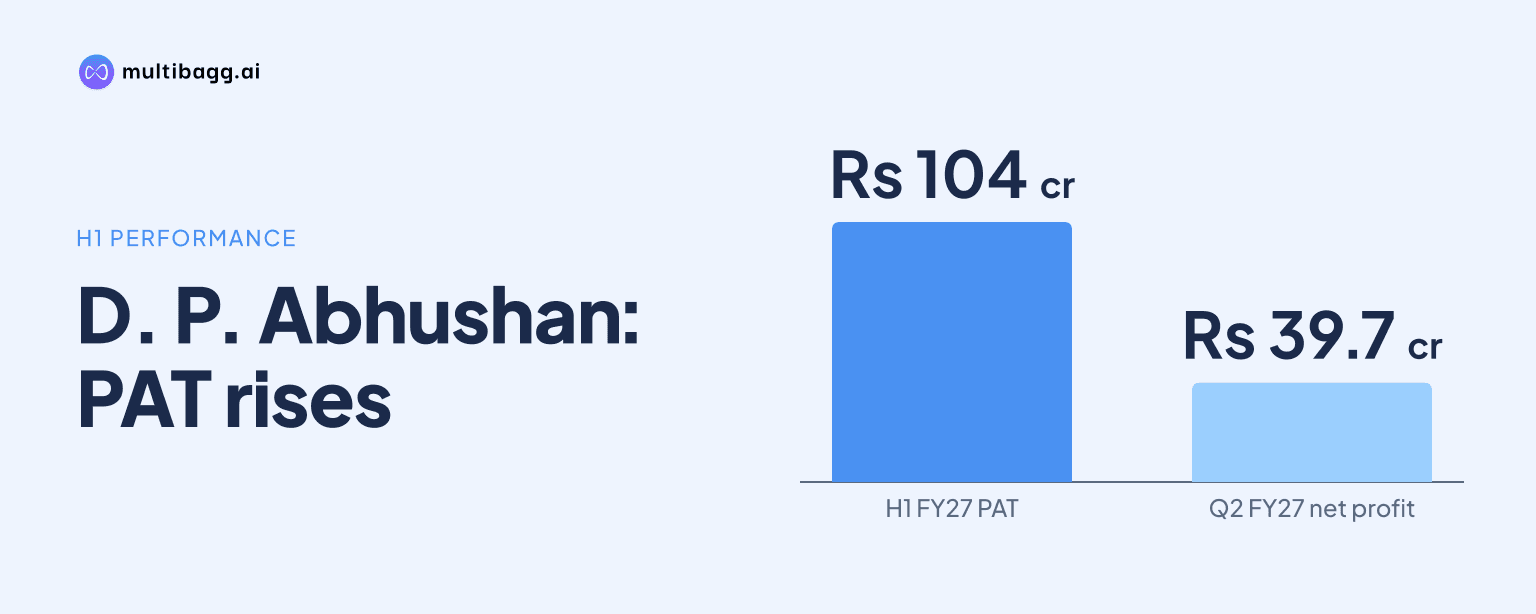
D. P. Abhushan Limited reported profit after tax of about ₹104 crore for H1 FY27, up 19% year-on-year, despite a weaker Q2 in which revenue from operations fell 21.5% to ₹759.9 crore. Management attributed the quarterly weakness primarily to a shift in the festive calendar, which moved demand into the following quarter.
Know D.P. Abhushan inside out
Results, valuation, peers and who's buying, in one view.
What did D. P. Abhushan report for Q2 and H1 FY27?
D. P. Abhushan reported total income of ₹761 crore, EBITDA of ₹61 crore and profit after tax of approximately ₹40 crore in Q2 FY27. Separately reported quarterly results put revenue from operations at ₹759.9 crore and net profit at ₹39.7 crore. The small difference between total income and revenue from operations reflects the use of different reported line items.
On a year-on-year basis, revenue from operations declined 21.5% from the comparable Q2 FY26 period, while net profit declined 22.9%. EBITDA was also reported to be down 19% year-on-year from ₹76 crore in Q2 FY26. The company said a standalone quarterly comparison should be assessed alongside the first-half performance because of the timing of festive sales.
For H1 FY27, total income rose 7% year-on-year to approximately ₹1,615 crore. EBITDA increased 18% to approximately ₹155 crore, while profit after tax grew 19% to approximately ₹104 crore. The half-year figures showed stronger profit growth than income growth, supported by margin expansion.
Why did D. P. Abhushan’s Q2 FY27 performance decline?
D. P. Abhushan said the change in the festive calendar was the key reason for the weaker Q2 comparison. Management indicated that the festive and wedding-led buying season began earlier in Q3, making H1 a more representative period for assessing underlying performance than Q2 alone.
The company’s business has a meaningful seasonal component. Management said festive and wedding demand accounts for 75% to 80% of sales, which can cause revenue to move materially between quarters when festival dates change. It also said early Q3 demand from festive and wedding purchases had been strong, although it did not provide revenue or profit guidance for the full year.
The company reported festive sales of ₹815 crore, up 13.8%, with gold sales up 9.3% and silver sales up 29%. These figures indicate that demand remained active during the festive period cited by management, but they should not be treated as a full-year forecast.
How did margins improve in the first half?
D. P. Abhushan improved its H1 FY27 EBITDA margin to 9.61% from 8.68% in the corresponding period of FY26. Its PAT margin rose to 6.45% from 5.82%. EBITDA growth of 18% and PAT growth of 19% therefore exceeded the 7% increase in total income.
The first-half margin improvement is important because it came despite the quarterly distortion created by the festival shift. However, the company did not provide a detailed breakdown of costs, product mix or store-level profitability during the information provided. Investors therefore have limited disclosed data to quantify the contribution of individual operating factors to the margin expansion.
D. P. Abhushan’s established market is Central India, where management said it has operated for decades and has detailed knowledge of customer preferences and local purchasing patterns. Its offering spans bridal, festive, lightweight, traditional and contemporary jewellery, serving demand across core jewellery categories.
Got a follow-up? Ask IRIS
What are D. P. Abhushan’s expansion and funding plans?
D. P. Abhushan plans to open three to four new showrooms by March 2027 as part of its retail expansion programme. Management identified Gujarat and Rajasthan among the geographies for network growth, extending the company’s presence beyond its core Central Indian market.
The company is also raising approximately ₹558 crore through equity and warrants to support inventory and retail-network expansion. Management defended the pricing of the fundraise during the call, while investor summaries noted that the issue was priced below the market price. The transcript does not provide sufficient detail to assess the final dilution, warrant conversion terms or deployment schedule.
Higher inventory requirements are relevant for a jewellery retailer adding stores, particularly in gold-led categories. Management also said old-gold exchange contributes 28% to 30% of sales. This channel can support customer purchases but makes the operating mix relevant when assessing sales quality and inventory movement.
What should investors track in the second half of FY27?
D. P. Abhushan expects H2 FY27 to account for 65% to 72% of annual sales, reflecting the concentration of festive and wedding demand in the second half. The company did not issue numerical guidance for revenue growth, profit growth or margins.
The key reported indicators for investors are the recovery in revenue following the Q2 decline, the sustainability of the 9.61% H1 EBITDA margin, progress on the showroom rollout and the terms of the proposed ₹558 crore fundraise. Management also noted that its diamond business remains unfinalised, leaving that area without a disclosed operating plan.
The contrast between Q2 and H1 makes timing especially important for evaluating the business. A quarter affected by calendar shifts may not fully show demand trends, but the next results will provide clearer evidence on whether festive demand and new-store additions translate into sustained sales and profitability.
Conclusion
D. P. Abhushan delivered higher first-half income, EBITDA and profit despite a year-on-year decline in Q2 revenue from operations and net profit. H1 PAT of about ₹104 crore, higher margins and reported festive demand provide the central context for the company’s assertion that the quarter was affected by seasonal timing rather than a broad deterioration in demand.
The next areas to watch are H2 sales, which management expects to represent 65% to 72% of annual revenue, the opening of three to four showrooms by March 2027, and further disclosures on the approximately ₹558 crore equity-and-warrants fundraise. Investors will also need clarity on the diamond business plan and the effect of expansion on margins and working capital.