










Duke Offshore takeover brings a proposed mining strategy
Key highlights
- Aspect Global Ventures India Private Limited acquired 69,59,800 Duke Offshore equity shares on July 21, 2026.
- Duke Offshore reconstituted its board effective July 27, 2026, and shareholders regularised appointments on September 30, 2026.
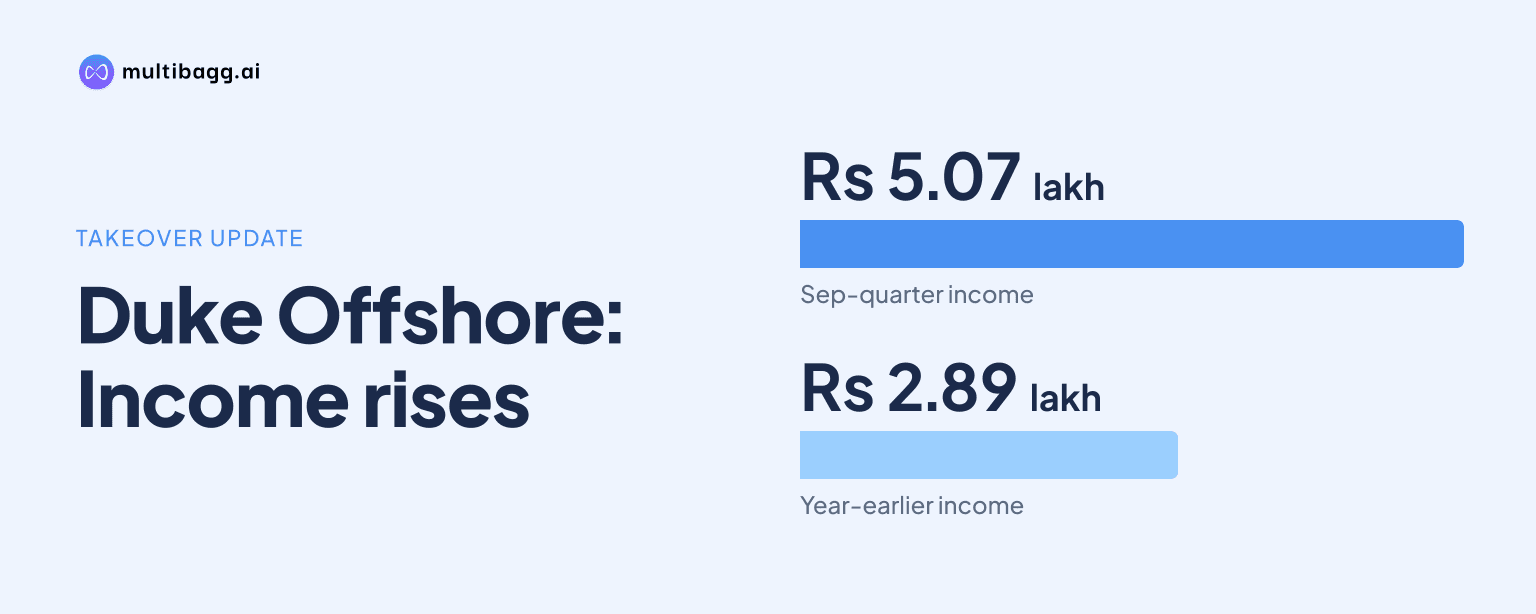
- Duke Offshore reported September-quarter income of Rs 5.07 lakh, compared with Rs 2.89 lakh a year earlier.
- Duke Offshore used Rs 52.17 lakh of operating cash in the half year ended September 30, 2026, versus Rs 115.30 lakh a year earlier.
powered by IRIS
Duke Offshore Limited’s takeover was completed on July 21, 2026, when Aspect Global Ventures India Private Limited acquired 69,59,800 equity shares, ending the former promoters’ ownership and control; the incoming management subsequently proposed mining, minerals, metals, ores, quarrying, processing, manufacturing and other natural-resources activities.
Know Duke Offshore inside out
Results, valuation, peers and who's buying, in one view.
What changed in Duke Offshore’s ownership?
Duke Offshore changed promoter control on July 21, 2026, when Aspect Global Ventures India Private Limited completed the acquisition of 69,59,800 equity shares. Aspect Global Ventures India Private Limited was classified as Duke Offshore’s promoter from that date, while the former promoters ceased to hold any shares in or control over the company.
The transaction arose from a Share Purchase Agreement, or SPA, dated June 17, 2026, between George Albert Donald Duke, Avik George Duke, Komal Duke and Aspect Global Ventures India Private Limited. A public statement followed on June 18, 2026, and a draft letter of offer was filed with the Securities and Exchange Board of India on June 25, 2026. Duke Offshore said it made disclosures under Regulations 29(1) and 29(2) of the SEBI Substantial Acquisition of Shares and Takeovers Regulations, 2011, and Regulation 30 of the SEBI Listing Obligations and Disclosure Requirements Regulations, 2015.
The September 30, 2026 financial-results note identifies the event as a change in management, rather than simply a shareholding movement. The independent auditor’s limited review report dated November 6, 2026 also drew attention to that note as describing an acquisition and control-related transaction, while stating that its review conclusion was not modified in respect of the matter.
How did Duke Offshore’s board change after the acquisition?
Duke Offshore reconstituted its board with effect from July 27, 2026, six days after the 69,59,800-share acquisition was completed. Avik George Duke, identified as managing director and promoter, resigned along with Pranay Mehta, Vipul Patel, Revati Ganesh Pambala and Ameet Avinash Kimbahune.
The replacement board included Ashutosh Janak Kumar Thakar as an additional executive director and whole-time director. Sukumar Anand Shetty and Aksha Mohit Kamboj joined as additional non-executive directors, while Rajesh Chunilal Bhojani, Vaibhav Agarwal and Arjun Bikas Dutta joined as additional non-executive independent directors. Duke Offshore said it made the required Regulation 30 notifications to BSE Limited and filed electronic forms with the Registrar of Companies, Mumbai.
Shareholders regularised the appointments of the directors and whole-time director at the annual general meeting on September 30, 2026. The board then appointed Arun Lodha as chief financial officer, or CFO, effective November 6, 2026; the filing describes him as a graduate and semi-qualified chartered accountant with 24 years of experience in finance, accounting and financial management.
What mining business does Duke Offshore’s management propose?
Duke Offshore’s new management proposes to enter mining, minerals, metals, ores, quarrying, processing, manufacturing and other natural-resources businesses. The November 6, 2026 limited review report says the proposal is in accordance with the amended main objects in Duke Offshore’s amended Memorandum of Association.
The filing does not disclose a mine, mineral asset, capacity, project location, capital-spending commitment, customer agreement or launch date for those activities. The distinction matters because the auditor describes the wider natural-resources entry as a management proposal, not as a completed operating project or a disclosed acquisition of operating assets.
Duke Offshore’s September 30, 2026 financial-results notes nevertheless state that it operates mainly in one reportable business segment: mining, quarrying, processing and manufacturing of minerals, metals, ores and natural resources. That segment classification appears alongside the disclosure of the July 21 promoter change and the July 27 board reconstitution.
Got a follow-up? Ask IRIS
What do Duke Offshore’s September 2026 results show?
Duke Offshore reported unaudited standalone income of Rs 5.07 lakh for the quarter ended September 30, 2026, compared with Rs 2.89 lakh in the quarter ended September 30, 2025. Income therefore increased by Rs 2.18 lakh year on year, but was below Rs 5.96 lakh reported in the immediately preceding quarter ended June 30, 2026.
The results cover a period in which the change in control occurred on July 21, 2026 and the board changed on July 27, 2026. Duke Offshore’s audit committee reviewed, and its board approved, the unaudited standalone results on November 6, 2026. The statutory auditor said nothing had come to its attention to indicate that the results failed to disclose information required under Regulation 33 or contained a material misstatement.
The half-year cash-flow statement reported net cash used in operating activities of Rs 52.17 lakh for the half year ended September 30, 2026, compared with net operating cash used of Rs 115.30 lakh in the corresponding half year of 2025. It reported Rs 8.55 lakh of cash generated from investing activities in the 2026 half year, while financing activities used Rs 1.32 lakh, based on items including Rs 2.50 lakh of loans availed and Rs 3.03 lakh of lease-liability repayment.
The financial results are standalone and unaudited, rather than consolidated results. Duke Offshore said its accounting policies for the September 30, 2026 quarter and half year were consistent with those applied in the annual financial statements for the year ended March 31, 2026, and it said previous-period figures had been regrouped or reclassified where necessary.
What remains undisclosed about Duke Offshore’s strategy?
Duke Offshore has disclosed a changed promoter, a reconstituted board and an amended-object basis for a proposed natural-resources strategy, but not operational specifics. As of the November 6, 2026 filing, there was no disclosed mining licence, resource estimate, quarry, processing facility, manufacturing asset or acquisition consideration connected to the proposed activities.
The filing also does not provide a revenue target, profitability target, financing plan or timetable for the proposed mining and natural-resources businesses. The reported September-quarter income of Rs 5.07 lakh supplies a financial reference point during the transition, but it does not identify income by mineral, project or customer because Duke Offshore reports mainly one business segment.
Conclusion
Duke Offshore’s July 2026 transaction changed control through the acquisition of 69,59,800 equity shares, removed the former promoters’ ownership and control, and led to a board reconstitution six days later. The company’s disclosed operating framework now centres on a single segment covering mining, quarrying, processing and manufacturing of minerals, metals, ores and natural resources, while management has proposed a wider entry into those fields.
The next issue to watch is whether Duke Offshore discloses a project, asset, licence, funding arrangement or timetable to implement the proposal under its amended main objects. Investors can also monitor subsequent financial disclosures after Arun Lodha assumed the CFO role on November 6, 2026 and after the director appointments were regularised at the September 30, 2026 annual general meeting.