








E2E Networks adds token inference alongside GPU rentals
MAX Plan at ₹4,999/yr

Find your next multibaggerBe a Pro Investor
Research stocks and track your picks on the go. Download the app.
Key highlights
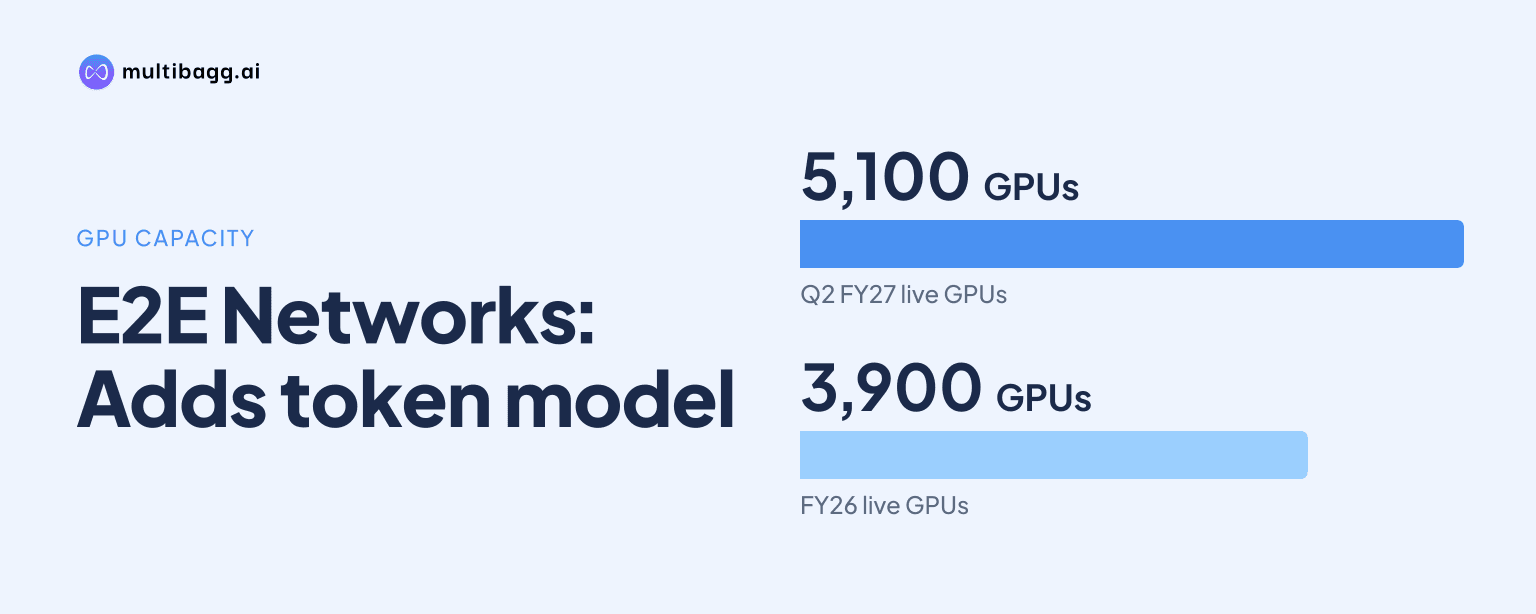
- E2E reported 5,100 live GPUs in FY27Q2, compared with 3,900 in FY26.
- E2E's binding sovereign AI term sheet is worth about Rs 1,000 crore excluding taxes through June 2029.
- E2E Blaze bills for tokens consumed, adding a usage-based model alongside GPU-hour rentals.
- E2E has secured about 27.4 megawatts of data-centre capacity and plans a 5.4-megawatt Blackwell build.
powered by IRIS
E2E Networks is adding pay-per-token inference and dedicated sovereign deployments alongside GPU rentals, supported by a binding term sheet worth about Rs 1,000 crore excluding taxes through June 2029. E2E is using NVIDIA GPU capacity for developer cloud, managed AI workflows and customer-specific deployments rather than only GPU-hour billing.
Know E2E Networks inside out
Results, valuation, peers and who's buying, in one view.
How does E2E monetise its GPU fleet through several models?
E2E monetises its GPU fleet through public cloud services, token-based inference and dedicated private deployments using its three in-house platforms: TIR, Jarvislabs.ai and Blaze. Its infrastructure comprises NVIDIA Hopper and Blackwell GPUs in data centres in Delhi NCR and Chennai, while its go-to-market routes include a self-service portal, enterprise sales, partners and government empanelment.
The public platforms serve large language model, or LLM, builders and AI-native teams with training, fine-tuning and inference services. Blaze and Jarvislabs.ai provide pay-per-token inference, while E2E’s sovereign and private platform provides dedicated deployments for customers with regulatory or data-residency requirements. The distinction is between public, usage-led services and customer-specific environments.
E2E reported 5,100 live GPUs in FY27Q2, compared with 3,900 in FY26 and 1,900 in FY25. The FY27Q2 figure includes 1,024 B200 GPUs, and the company describes Blackwell capacity as being under a multi-year contract. The increase from FY25 to FY27Q2 provides the capacity base for its developer, enterprise and sovereign offerings.
A binding term sheet with an India-based sovereign AI company supports the dedicated-deployment route. It is worth about Rs 1,000 crore excluding taxes, covers NVIDIA Blackwell cloud GPUs and allied services, and is valid until June 2029. Management says the arrangement validates a move from pay-as-you-go capacity towards a longer-term commitment.
What does E2E TIR provide for AI teams?
E2E TIR provides an end-to-end artificial intelligence and machine-learning platform for building, fine-tuning, deploying and scaling models on E2E infrastructure. GPU Notebooks provides Jupyter environments on H200 and B200 GPUs with NGC frameworks preloaded, while Foundation Studio supports fine-tuning of Llama, Mistral, Gemma and Stable Diffusion models.
TIR also includes retrieval-augmented generation, or RAG, and a managed Qdrant vector database with embeddings. E2E says this combination can support a chatbot going live in minutes. The service differs from raw GPU rental by combining managed data retrieval and model-serving components within the platform.
The deployment stack includes auto-scaling model endpoints using vLLM, SGLang, Triton or PyTorch. It also provides datasets, a model repository, pipelines and multi-node training, as well as a generative-AI application programming interface, or API, for LLM, speech and embedding models compatible with the OpenAI API format. These components place training and production inference on one platform.
E2E has added VPC Connect, a virtual private cloud networking feature for GPU instances, training clusters and inference endpoints. The company says it provides secure private networking and isolation across the AI lifecycle for regulated workloads. This feature supports dedicated-platform deployments where private connectivity is required alongside GPU capacity.
Got a follow-up? Ask IRIS
How does E2E Blaze change the revenue mechanism?
E2E Blaze adds usage-based income by billing customers for tokens consumed in production AI inference, alongside its GPU-hour rental model. The fully managed service runs on E2E’s NVIDIA GPU infrastructure and is tuned across GPU generations. This means billing is linked to inference use rather than the duration for which a GPU instance is allocated.
Blaze manages GPU capacity and availability, model serving and optimisation, autoscaling, endpoint operations, model switching, and token-usage, performance and cost analytics. E2E says onboarding to value takes a few minutes, while customers can switch supported models without infrastructure changes. Those functions keep endpoint operations within the managed service.
Blaze is hosted in Indian data centres, which E2E describes as sovereign by design. It offers models including NVIDIA Nemotron, DeepSeek and Qwen through one OpenAI-compatible API. The India-hosted service combines inference access with the data-residency proposition that also underpins E2E’s regulated-customer deployments.
The Blaze model differs from the Rs 1,000 crore sovereign term sheet. The term sheet covers Blackwell cloud GPUs and allied services under a multi-year commitment through June 2029, whereas Blaze charges by token consumption. Both use E2E infrastructure, but they pursue contracted capacity revenue and variable inference revenue respectively.
What role does E2E Jarvislabs.ai play?
E2E Jarvislabs.ai is a developer-first GPU cloud that lets users launch GPU instances from a command-line interface, or CLI, or through code. It has been an E2E platform since December 2025 and offers on-demand H100, H200, A100 and RTX Pro 6000 GPUs, which the company says can be launched in seconds.
The platform lets users pause an instance and pay only for storage, then switch GPU type when resuming. It also offers persistent storage, framework templates and a Python software development kit, or SDK, alongside CLI-based management of the instance lifecycle. These features are designed for users seeking direct access to GPU infrastructure.
Jarvislabs.ai also provides managed endpoints and model APIs, including production-ready open-weight models and pay-per-token APIs for GLM, DeepSeek, Gemma and Qwen. It therefore overlaps with Blaze in inference access, but retains a separate developer-cloud role centred on GPU provisioning and programmatic controls.
E2E has 5.4 megawatts planned for NVIDIA HGX B300 and other Blackwell GPUs, including 1,024 or more B200 GPUs. It has secured about 27.4 megawatts of data-centre capacity, including 12.8 megawatts added in November 2026, and says Vera Rubin planning is under way. The planned capacity is relevant to TIR, Blaze, Jarvislabs.ai and dedicated deployments.
Conclusion
E2E’s platform structure applies one GPU estate to several billing mechanisms: developer GPU instances through Jarvislabs.ai, managed training and deployment through TIR, token-priced inference through Blaze and Jarvislabs.ai, and dedicated environments for sovereign or regulated customers. The Rs 1,000 crore term sheet through June 2029 gives the dedicated model a disclosed longer-term commitment, while 5,100 live GPUs in FY27Q2 support the wider platform range.
The next disclosed milestones are the planned 5.4-megawatt Blackwell build, including NVIDIA HGX B300 and 1,024 or more B200 GPUs, and deployment of about 27.4 megawatts of secured data-centre capacity. E2E has also said Vera Rubin planning is under way, but the presentation does not disclose a deployment date or commercial value for that plan.

