










ECL targets Rs 1,600-1,800 crore revenue in valves and paints
Key highlights
- ECL’s valve and industrial-paint targets together imply Rs 1,600-1,800 crore of revenue.
- ECL targets Rs 800 crore of valve revenue by FY30-31 and plans Indian production by March 2027.
- ECL targets Rs 800-1,000 crore of paint revenue over five years with planned investment of Rs 250-300 crore.
- ECL expects paint capacity of 1,000 KL per annum by March 2027 and 4,000 KL per annum by September 2027.
powered by IRIS
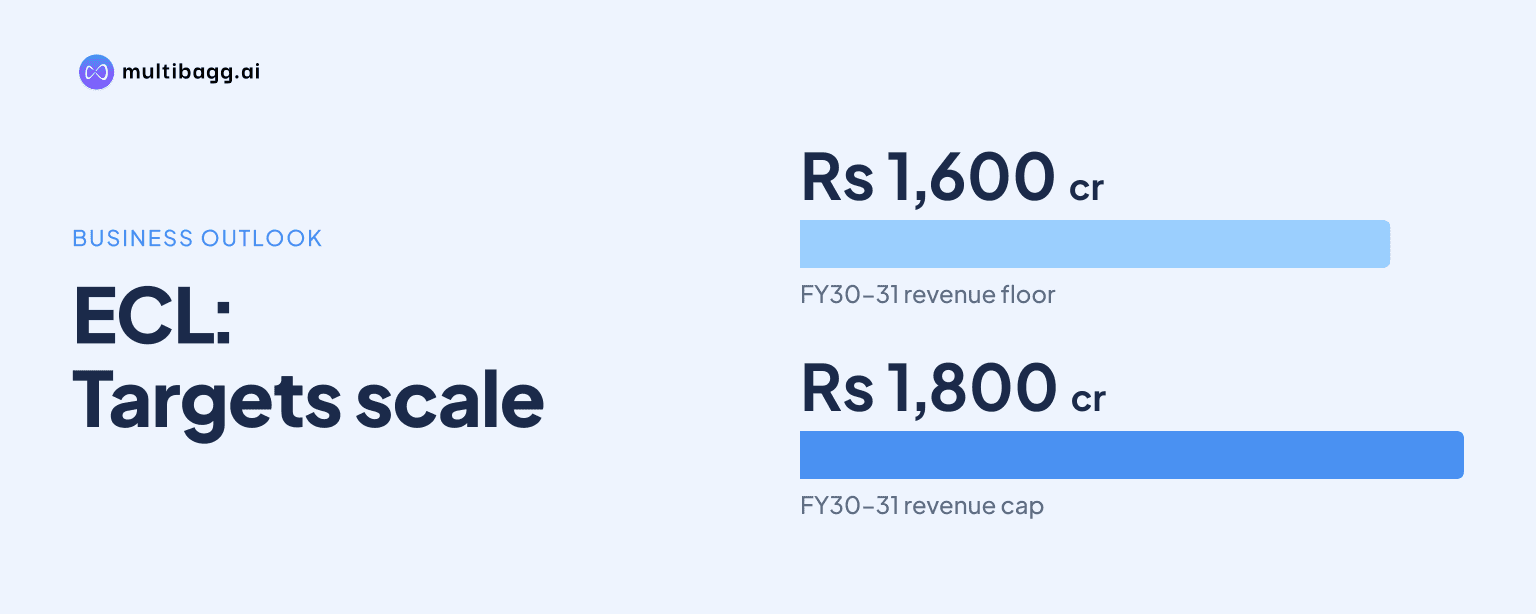
Electrosteel Castings Ltd has set targets that imply Rs 1,600-1,800 crore of revenue from valves and industrial paints, based on Rs 800 crore of valve revenue by FY30-31 and Rs 800-1,000 crore of paint revenue over five years. ECL plans Indian valve production by March 2027 and a paint-capacity expansion.
Know Electrosteel Castings inside out
Results, valuation, peers and who's buying, in one view.
What revenue is ECL targeting from valves and paints?
ECL is targeting Rs 800 crore in valve revenue by FY30-31 and Rs 800-1,000 crore in industrial-paint revenue over five years. Together, the management targets imply Rs 1,600-1,800 crore of revenue, although the valve and paint targets have different stated time periods.
ECL’s established portfolio remains ductile iron, or DI, pipes and fittings, with current DI-pipe capacity of 9 lakh tonnes per annum. The company positions valves as an extension of its water-infrastructure offering and industrial paints as an external-market use of its protective-coating capability.
The market sizes cited by ECL differ sharply between the two businesses. The presentation puts the Indian valves market at about Rs 2,000 crore, while it places the industrial-paints market at Rs 29,000 crore, growing at about 10% compound annual growth rate, or CAGR.
How does T.I.S. support ECL’s valve revenue target?
ECL acquired 100% equity in Italy-based T.I.S. Service S.p.A. in July 2025 for about €11.5 million, funded from internal funds. The company’s journey slide records the transaction in 2025-26, while the strategic-expansion slide labels T.I.S. as acquired in Q2FY25.
T.I.S. operates two plants, in Italy and Turkey, which ECL says have spare capacity. Its valve range serves water mains, sewage, hydropower, desalination plants and mining, allowing ECL to offer pipes, fittings and valves across water-network applications.
T.I.S. had turnover of about €41 million in calendar year 2025 and an earnings before interest, tax, depreciation and amortisation, or EBITDA, margin of about 13%. ECL says it acquired the business at 7-8 times enterprise value to EBITDA, with enterprise value of €31 million, and management has guided for an approximately 16% EBITDA margin in valves.
ECL identifies a patented FR line as a new-product-development lever and says T.I.S. has 11 registered patents and five pending applications. The company’s stated localisation milestone is the start of valve production in India by March 2027, rather than relying solely on the Italian and Turkish plants.
What is ECL’s industrial-paints capacity plan?
ECL plans to move from 4,200 kilolitres, or KL, of existing annual paint capacity to an upcoming plant capacity of 17,000 KL. The existing facility supplies captive coating of DI pipes, while the expansion is intended to support sales in industrial paints and protective coatings.
Phase 1 is expected to provide 1,000 KL per annum by March 2027 and 4,000 KL per annum by September 2027. ECL has planned investment of around Rs 250-300 crore, but the presentation does not disclose a commissioning date for the full 17,000-KL capacity.
ECL initially intends to pursue protective-coating segments valued at Rs 7,000-9,000 crore, rather than the full Rs 29,000 crore industrial-paints market. Management cites approximate EBITDA margins of 14-16% for that broader market and says its Rs 800-1,000 crore paint-revenue ambition includes inorganic growth.
The paint plan extends an existing capability rather than starting from a new production base. ECL established a captive paint plant at its Banseria, West Bengal unit in 2011-12, and lists paint among its captive integrated facilities alongside cement, ferro alloys and rubber gaskets.
Got a follow-up? Ask IRIS
Why are valves and paints adjacent to ECL’s pipe business?
ECL presents valves as adjacent to DI pipes and fittings because all three products serve water-infrastructure systems. T.I.S. supplies water, wastewater, hydropower, desalination and mining applications, while ECL describes its DI pipes as products for water supply and sewage networks.
ECL’s DI-pipe platform dates to its 60,000-tonnes-per-annum Khardah plant set up in 1994. Its journey presentation records DI-pipe capacity at the Srikalahasti unit rising to 550,000 tonnes per annum in 2025-26, within the company’s stated total capacity of 9 lakh tonnes per annum.
The industrial-paints adjacency is based on captive production and coating activity. ECL says its backward-linked facilities include blast furnaces, coke ovens, sinter plants, power plants, ferro alloys, cement, paint and rubber gaskets, a structure it says reduces production costs.
ECL also has an established export presence through fittings, though it does not say that these channels will distribute valves or paints. About 60% of DI-fittings revenue comes from exports, and ECL says it sells in more than 130 countries.
What demand backdrop does ECL cite for the expansion?
ECL links its water-related products to Jal Jeevan Mission, or JJM, 2.0, which targets tap-water coverage for 19.4 crore rural households by December 2028. The presentation states a total JJM 2.0 outlay of Rs 869,000 crore and says higher fund releases are expected from the beginning of H2 FY27.
For urban water and sewerage infrastructure, ECL cites AMRUT 2.0, with an indicative outlay of Rs 300,000 crore for FY22-FY26. The company lists about Rs 193,000 crore of approved projects, about Rs 167,000 crore of sanctioned detailed project reports and about Rs 138,000 crore of awarded projects.
ECL also names irrigation, industrial and process-water needs, river interlinking and export markets as demand drivers. Among the listed links, the Rs 44,605 crore Ken-Betwa project is under implementation with expected completion in 2030, while the other listed projects are at planning, detailed-project-report or awaiting-implementation stages.
These programmes are demand conditions cited by ECL, not disclosed orders for its valve or paint operations. The company-specific milestones remain Indian valve manufacturing by March 2027, paint capacity of 1,000 KL by March 2027 and 4,000 KL by September 2027, and progress toward the stated revenue goals.
Conclusion
ECL’s diversification plan combines a valve acquisition with a coatings-capacity build-out beside its DI-pipe and fittings business. The Rs 800 crore valve target for FY30-31 depends on T.I.S., product development and Indian manufacturing, while the Rs 800-1,000 crore paint target over five years depends on converting a 4,200-KL captive base into an external industrial-coatings business.
The next disclosed checkpoints are operational: ECL plans to begin Indian valve production by March 2027 and expects paint capacity of 1,000 KL per annum by March 2027 and 4,000 KL per annum by September 2027. The presentation leaves unresolved the completion date for the remaining capacity towards 17,000 KL and the pace of inorganic growth included in the paint target.