










EIH Limited Q2 RevPAR rises 19% as rates offset renovation pressure
Key highlights
- EIH's Q2 FY27 RevPAR rose about 19% to Rs 13,598 while reported occupancy declined to 71%.
- EIH's Q2 FY27 ARR increased to Rs 19,216 from Rs 15,967 a year earlier.
- EIH said reduced renovation inventory would have lifted Q2 FY27 occupancy to 74% and RevPAR to Rs 14,129.
- EIH's MICE share of room revenue increased to 16% in Q2 FY27 from 12% in Q2 FY26.
powered by IRIS
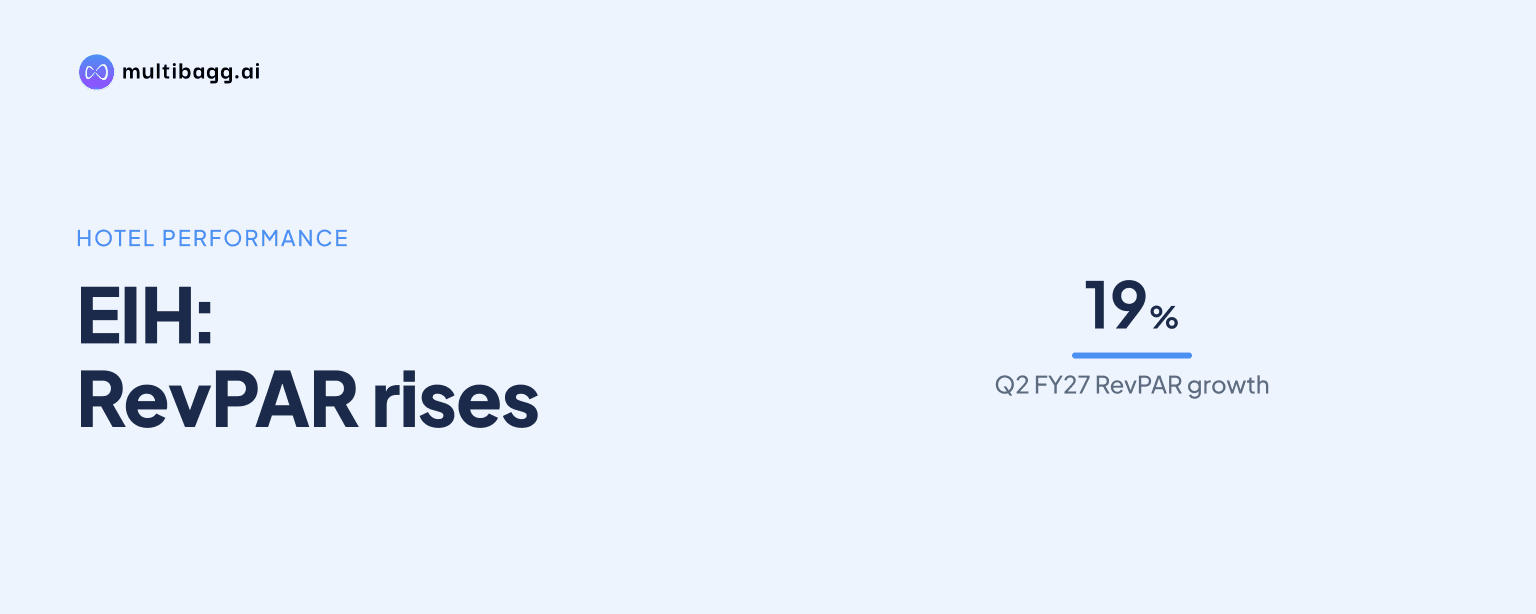
EIH Limited lifted Q2 FY27 revenue per available room (RevPAR) 19% to Rs 13,598 as average room rate (ARR) rose to Rs 19,216, offsetting reported occupancy's decline to 71% during renovations. On reduced inventory, EIH said occupancy would have been 74% and RevPAR Rs 14,129.
Know EIH inside out
Results, valuation, peers and who's buying, in one view.
How did EIH's Q2 RevPAR change?
EIH's Q2 FY27 RevPAR rose to Rs 13,598 from Rs 11,435 in Q2 FY26, while occupancy declined by 1 percentage point to 71% from 72%. ARR increased to Rs 19,216 from Rs 15,967, a rise of about 20%, and was the principal driver of the reported RevPAR increase across all domestic hotels, including managed properties.
The monthly figures showed higher room rates in each month of Q2 FY27. July ARR increased to Rs 16,668 from Rs 14,397, August ARR rose to Rs 17,686 from Rs 15,353, and September ARR reached Rs 23,277 from Rs 18,212. Monthly RevPAR also increased throughout the quarter, with September at Rs 16,818 versus Rs 13,139 a year earlier, while occupancy was 70% in July and August and 72% in September.
How much did renovations affect EIH occupancy?
EIH said renovations reduced reported Q2 FY27 occupancy to 71% because rooms were unavailable at The Oberoi Mumbai, Trident Nariman Point and Trident Bandra Kurla. The unavailable inventory was about 35 keys at The Oberoi Mumbai, 80 keys at Trident Nariman Point and 80 keys at Trident Bandra Kurla. On reduced inventory, EIH said quarterly occupancy would have been 74%, compared with the reported 71%.
The effect was also visible in EIH-owned hotels, where Q2 FY27 occupancy was 71%, down from 74% in Q2 FY26. ARR at owned hotels rose to Rs 21,980 from Rs 17,168, while RevPAR increased to Rs 15,527 from Rs 12,760. Using reduced inventory, EIH said owned-hotel occupancy would have been 76% and RevPAR Rs 16,646; this calculation used about 30 unavailable keys at The Oberoi Mumbai and about 80 keys at each of the two Trident hotels.
Which EIH hotel brands outperformed their segments?
EIH's The Oberoi hotels reported Q2 FY27 RevPAR of Rs 17,227, up 20.9% from Rs 14,245, exceeding the 18.2% increase in the India luxury segment to Rs 10,174. The Oberoi hotels recorded a revenue generation index (RGI) of 169, compared with 165 a year earlier. The presentation notes that changes in RevPAR include hotels opened and closed during the respective periods.
EIH's Trident hotels reported Q2 FY27 RevPAR of Rs 11,039, compared with Rs 9,615 in Q2 FY26, while the India upper-upscale segment rose to Rs 6,461 from Rs 5,870. Trident's RGI increased to 171 from 164. For the year to date, The Oberoi hotels' RevPAR rose 14.5% to Rs 16,661, while Trident RevPAR reached Rs 10,768 from Rs 9,413.
EIH also reported benchmarking data for domestic hotels covered by STR, with data sourced from CoStar. At September 2026, its market penetration index (MPI) was 107%, average rate index (ARI) was 122%, and RGI was 130%, compared with 103%, 118% and 121%, respectively, at September 2025. Thirteen of 15 benchmarked hotels ranked first or second, including eight ranked first, although EIH noted that comparison sets may change.
Got a follow-up? Ask IRIS
What did EIH's city and revenue-mix data show?
EIH's fastest disclosed Q2 FY27 city or regional RevPAR growth was 35% in Jaipur and Ranthambore, followed by 29% in Delhi and the National Capital Region, 25% in Udaipur, and 23% in Shimla and Chandigarh. Mumbai recorded 17% growth, although EIH said that renovations affected the result and that growth would have been about 31% on reduced inventory. Chennai recorded the lowest disclosed growth at 6%, while international hotels grew 13%.
EIH's room-revenue mix shifted towards meetings, incentives, conferences and exhibitions (MICE). MICE represented 16% of total room revenue in Q2 FY27, up from 12% in Q2 FY26. Direct business declined to 45% from 48% and corporate business moved to 27% from 28%, while leisure remained at 12% in both periods.
The industry data included in the presentation showed Q2 FY27 occupancy improvement of 1% to 3% year on year, ARR growth of 8% to 10%, and RevPAR growth of 13% to 15%. EIH's reported RevPAR increase of about 19% was above that industry range, despite domestic air traffic contracting by about 6% year on year in Q2 FY27. The presentation cited resilient domestic leisure demand and a pickup in corporate and MICE travel as offsets to monsoon seasonality and geopolitical uncertainty.
Conclusion
EIH's Q2 FY27 operating performance was led by room pricing, with ARR rising to Rs 19,216 and RevPAR reaching Rs 13,598 despite a 1-percentage-point decline in reported occupancy. Renovations reduced available inventory at three Mumbai hotels, while The Oberoi and Trident brands recorded Q2 RGI readings of 169 and 171, respectively, and MICE increased its room-revenue share by 4 percentage points to 16%.
The next operating measure to watch is the return of renovated Mumbai inventory and its effect on reported occupancy and RevPAR. Management expects demand momentum to remain strong through FY27, supported by MICE and an expected revival in foreign tourists, and has outlined 32 new domestic and global properties scheduled to be operational by 2031 through direct ownership, joint ventures or management contracts.