










EMA Partners India H1 FY27 Revenue Rises 107% to ₹84 Cr
Key highlights
- EMA Partners India reported H1 FY27 revenue of ₹83.9 crore, up 107.2% year-on-year.
- H1 FY27 EBITDA margin declined to 10.98% from 19.2% in the prior-year half.
- Net profit rose 26.8% year-on-year to ₹9 crore in H1 FY27.
- Taggd was consolidated from 6 July 2026, while borrowings were reported at ₹22 crore.
powered by IRIS
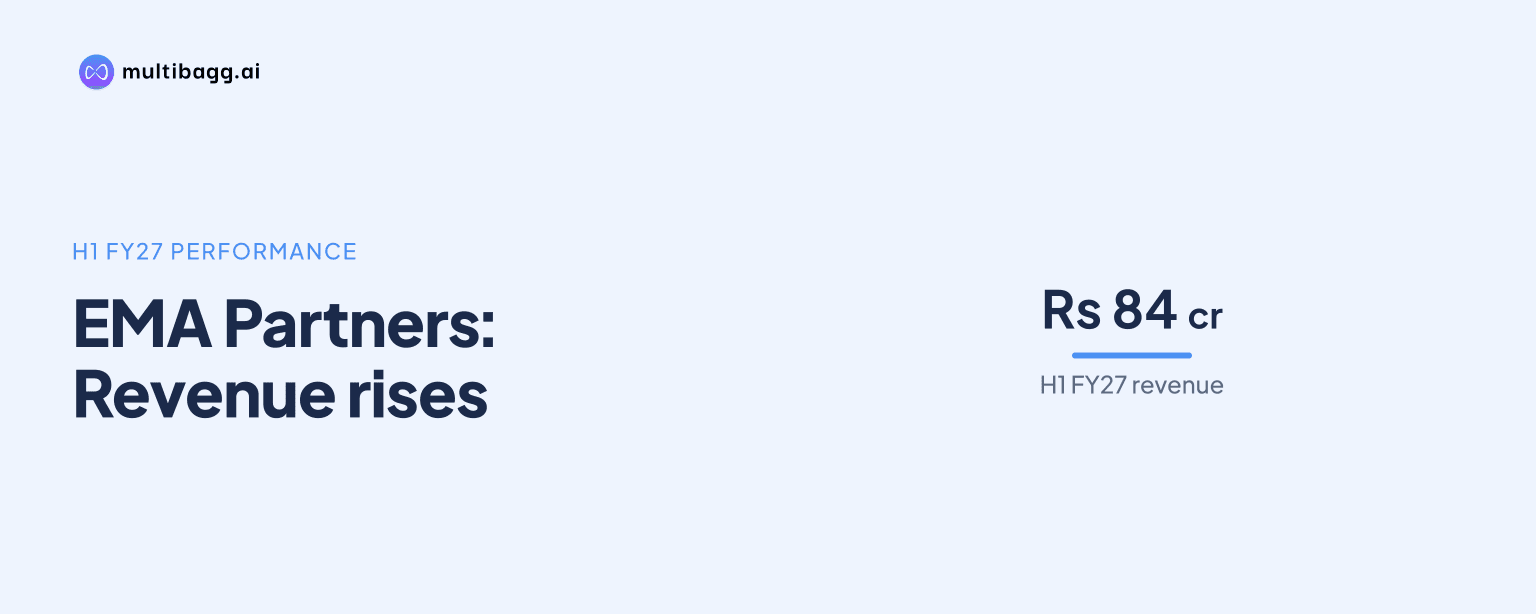
EMA Partners India Limited reported H1 FY27 consolidated revenue of ₹83.9 crore, up 107.2% year-on-year, largely following the consolidation of Taggd from 6 July 2026. Net profit rose 26.8% to ₹9 crore, while EBITDA margin declined to 10.98% from 19.2% a year earlier.
Know EMA Partners India inside out
Results, valuation, peers and who's buying, in one view.
Why did EMA Partners India revenue rise 107% in H1 FY27?
EMA Partners India reported that the consolidation of Taggd was the principal reason for its 107% year-on-year increase in H1 FY27 revenue. Consolidated revenue from operations stood at ₹83.9 crore for the half year ended 30 September 2026, compared with the prior-year period.
Management indicated that growth excluding Taggd was about 26%. Its mature businesses grew about 9%, showing that most of the reported increase came from the newly consolidated recruitment process outsourcing, or RPO, business rather than the older operations alone.
Taggd was consolidated from 6 July 2026. This means its contribution was included for part of the first half, making it a material factor in both revenue growth and the change in the group's operating mix. The company did not provide a sector-wise demand break-up during the call.
The earnings call covered unaudited standalone and consolidated results for the half year. The call was held on 5 November 2026 and lasted about 50 minutes. EMA Partners India subsequently filed the transcript with the NSE.
What happened to EBITDA margin in H1 FY27?
EMA Partners India reported EBITDA of about ₹9 crore in H1 FY27, with EBITDA margin at 10.98%, compared with 19.2% in the comparable prior-year half. The sharp decline reflected the larger share of RPO revenue in the consolidated mix and losses at James Douglas.
Revenue expansion therefore did not translate into a similar increase in profitability. EBITDA rose about 19% year-on-year, substantially below the 107% rise in revenue. This difference illustrates the effect of consolidating a business with a different margin profile.
Management said it is targeting an EBITDA margin of 17% to 18% over the next three to three-and-a-half years. It also cited a 20% EBITDA margin objective for James Douglas over roughly 2.5 to three years, while Taggd is targeted to reach a 14% to 15% margin over two to two-and-a-half years.
These are longer-term margin aspirations rather than FY27 guidance. Management declined to provide forward financial numbers during the call.
How is Taggd changing EMA Partners India's business mix?
Taggd is changing EMA Partners India's reported revenue mix because it adds an RPO business with long-term recurring contracts. The company identified these contracts as a source of demand visibility, although it did not disclose client concentration, sector-wise demand, or contract values.
RPO services generally involve managing parts of a client's recruitment process on an ongoing basis. In the reported period, the inclusion of Taggd supported the group's revenue base but also contributed to lower consolidated margins relative to the earlier period.
The company has placed Taggd's medium-term EBITDA margin target at 14% to 15%. That target remains below the 17% to 18% group-level margin objective cited for the longer term, underscoring the importance of scale, operating efficiency and the eventual performance of other businesses in determining consolidated profitability.
The call summary also flagged approximately 90-day receivables at Taggd. Receivable days matter for an RPO-led business because a rise in billed revenue does not automatically mean faster cash collection. EMA Partners India did not provide additional collection data or a revised working-capital outlook on the call.
Got a follow-up? Ask IRIS
What are the key financial risks investors should monitor?
The main disclosed financial risk is margin pressure, as EBITDA margin fell from 19.2% to 10.98% despite strong revenue growth. The reasons identified were the RPO-heavy business mix and losses at James Douglas, rather than a reduction in reported demand.
Borrowings of ₹22 crore were also flagged in the call summary. Alongside Taggd's approximately 90-day receivables, this makes debt levels, interest costs and working-capital conversion relevant items for investors assessing the quality of the group's expansion.
Net profit increased to ₹9 crore, but at a slower pace than revenue. That outcome shows that the financial benefit from Taggd's consolidation was more pronounced at the top line during H1 FY27. The reported figures do not establish how quickly the acquired business can improve margins or cash conversion.
Management was also defensive on valuation and market-share questions and did not offer FY27 guidance. The absence of near-term forecasts limits the ability to measure the pace of expected operational improvement against a company-issued annual target.
How did management address the outlook for FY27?
EMA Partners India did not provide revenue, profit or margin guidance for FY27. Management instead discussed longer-term margin goals for the group, James Douglas and Taggd, while declining to give forward numbers during the earnings call.
This approach leaves the H1 FY27 result as the clearest disclosed reference point for investors. Revenue was ₹83.9 crore, EBITDA was about ₹9.2 crore and net profit was ₹9 crore, with profitability affected by the changed operating mix.
The company said Taggd has long-term recurring contracts, which provides some visibility into business activity. However, it did not disclose the value, tenure or renewal profile of those contracts. It also did not provide sector-wise demand information, preventing a more detailed assessment of customer-industry trends.
For the broader recruitment and talent-services industry, the result highlights how acquisitions and RPO consolidation can increase scale while initially reducing blended margins. The subsequent financial outcome will depend on execution, cost control, receivable collection and progress at James Douglas, rather than revenue growth alone.
Conclusion
EMA Partners India's H1 FY27 results show rapid reported expansion following Taggd's consolidation, with revenue rising 107.2% to ₹83.9 crore and net profit increasing 26.8% to ₹9 crore. But the EBITDA margin decline to 10.98% from 19.2% indicates that the new revenue mix and James Douglas losses have materially affected operating profitability.
Investors will next watch whether Taggd's recurring contracts translate into improved collections, whether receivables remain near 90 days, and whether margins move towards management's stated medium-term targets. Management has not issued FY27 guidance, so future quarterly disclosures will be the main basis for tracking those indicators.