










Embassy Office Parks REIT posts ₹670 crore Q2 distribution
Key highlights
- Embassy REIT's Q2 FY2027 revenue rose 16% year-on-year to ₹1,303 crore.
- Net operating income increased 15% year-on-year to ₹1,069 crore.
- Embassy REIT declared a record quarterly distribution of ₹670 crore, or ₹7.07 per unit.
- The REIT leased 1.5 million square feet and reported a 30-basis-point quarter-on-quarter occupancy gain in Pune.
powered by IRIS
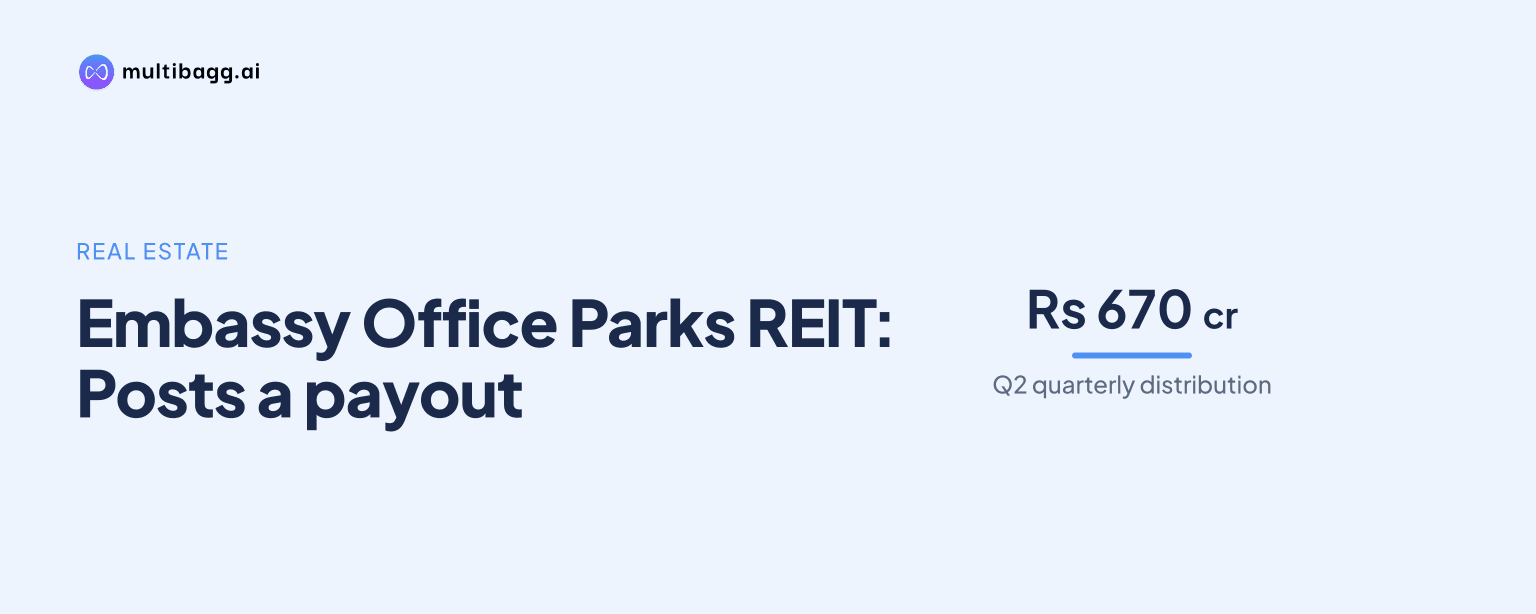
Embassy Office Parks REIT Ltd. declared a record ₹670 crore distribution, or ₹7.07 per unit, for Q2 FY2027 after revenue rose 16% year-on-year to ₹1,303 crore for the quarter ended September 30, 2026. The office REIT also reported 15% growth in net operating income and an 18% increase in net asset value.
Know Embassy Office Parks REIT inside out
Results, valuation, peers and who's buying, in one view.
What did Embassy REIT report for Q2 FY2027?
Embassy REIT reported double-digit growth in its core operating measures for the September quarter, supported by leasing activity, rent growth and additions to its operating portfolio. Revenue increased 16% year-on-year to ₹1,303 crore, while net operating income, or NOI, rose 15% to ₹1,069 crore.
The REIT declared a quarterly distribution of ₹670 crore, equivalent to ₹7.07 per unit. Management described this as its highest-ever quarterly distribution. The distribution was 9% higher than the corresponding quarter of the previous year, indicating that the rise in property income translated into higher cash payouts to unitholders.
Net asset value, or NAV, increased 18% year-on-year, according to the earnings call. NAV is a key valuation measure for a listed REIT because it reflects the value of the underlying assets after liabilities. The company did not provide a NAV per unit figure in the supplied transcript.
What drove Embassy REIT's revenue and NOI growth?
Embassy REIT attributed the quarter's performance to continued leasing momentum, healthy rent growth and the addition of new office and hotel buildings to the operating portfolio. These factors lifted both revenue and NOI, although NOI grew marginally slower than revenue.
The REIT said it leased 1.5 million square feet during the quarter. Leasing is central to an office REIT's performance because occupied space produces rental income and can support distributions after operating expenses and financing costs. The earnings call also cited sustained demand from global capability centres, or GCCs, as a support for leasing activity.
Management reported early signs of recovery in the Pune portfolio, where occupancy expanded by 30 basis points quarter-on-quarter. This is a measured improvement rather than a large shift, but it is relevant because occupancy gains in an existing portfolio can add rental income without requiring a new acquisition.
The operational additions of office and hotel buildings were another stated contributor to revenue growth. The available call extract does not specify the number of buildings, their location or their individual financial contribution. Therefore, the reported performance should be assessed on the aggregate revenue, NOI and distribution figures disclosed by the REIT.
Got a follow-up? Ask IRIS
Why does the record distribution matter to unitholders?
The record ₹670 crore distribution matters because distributions are the principal cash-return measure for REIT investors. At ₹7.07 per unit, the Q2 payout was 9% above the year-earlier level, while revenue and NOI expanded at faster rates of 16% and 15%, respectively.
The increase also follows a lower base in the comparable prior period. In Q2 FY2025, Embassy REIT had reported a distribution of ₹553 crore, or ₹5.83 per unit, alongside revenue of ₹997 crore and NOI of ₹805 crore. These historic figures provide context for the subsequent growth in the operating portfolio and cash distribution, though they relate to a different financial year.
For investors, the combination of revenue growth, NOI growth and a higher distribution is more informative than any single metric. Revenue reflects the scale of property income, NOI shows income after property-level operating costs, and the distribution shows the amount declared for unitholders. The reported 18% year-on-year NAV increase adds a separate indication of change in underlying asset value.
How are office-market conditions shaping Embassy REIT's operations?
Office demand from GCCs remained an important theme in Embassy REIT's commentary. GCCs have continued to be a significant source of office-space demand in India, particularly in established technology and business districts, and the REIT linked its leasing momentum to this demand.
The company retained its FY2027 guidance, according to the earnings-call summary. Management said leasing momentum, rental growth and GCC demand supported this stance despite higher interest rates. The supplied material does not specify the numerical targets within that guidance, so no target values can be inferred from the call extract.
Higher interest rates remain relevant to property owners and REITs because they can affect borrowing costs and investor comparisons with fixed-income returns. Embassy REIT's reported operational data shows continued growth in the September quarter, but the transcript does not quantify the interest-cost effect or provide a revised financing outlook.
The occupancy increase in Pune also shows that market conditions can differ across individual portfolios. A 30-basis-point quarter-on-quarter gain is a specific operating improvement, while the broader leasing result of 1.5 million square feet demonstrates activity across the REIT's platform.
Conclusion
Embassy REIT's Q2 FY2027 result combined 16% revenue growth, 15% NOI growth and an 18% rise in NAV with its highest quarterly distribution of ₹670 crore. The reported figures point to the contribution of leasing, rental growth and new operating assets, while the 9% increase in distribution directly benefits unitholders.
Investors will next watch whether leasing demand, particularly from GCC occupiers, continues to support rental growth and occupancy across the portfolio. The key disclosed operating point to monitor is the retained FY2027 guidance, along with further progress in Pune after its 30-basis-point occupancy improvement during the quarter.