










Everest Kanto capex reaches Rs 91.83 crore in six months
Key highlights
- Everest Kanto spent Rs 91.83 crore on fixed and intangible assets, including capital work-in-progress, in the six months ended 30 September 2026.
- Trade and other receivables consumed Rs 105.10 crore of cash in the September 2026 half year, versus Rs 55.97 crore a year earlier.
- Current trade receivables rose to Rs 317.50 crore at 30 September 2026 from Rs 223.53 crore at 31 March 2026.
- Cash and cash equivalents increased by Rs 23.18 crore to Rs 58.75 crore during the six-month period.
powered by IRIS
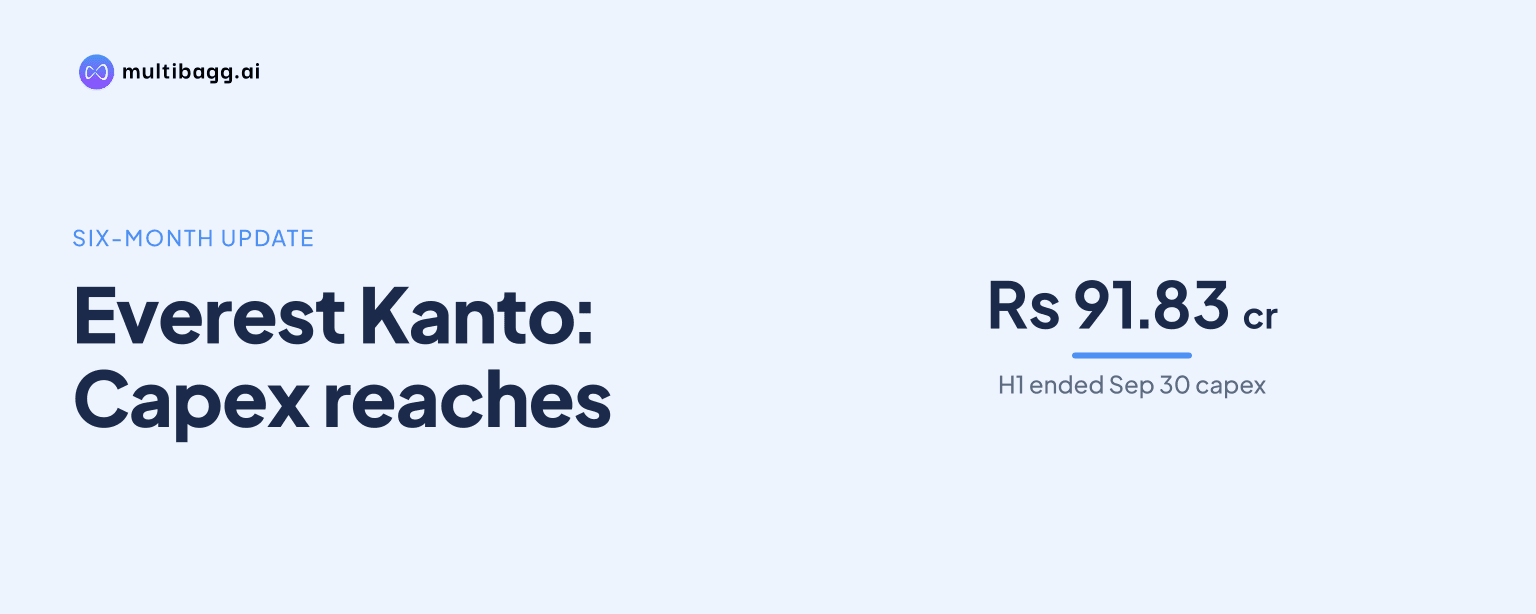
Everest Kanto Cylinder Limited spent Rs 91.83 crore on property, plant, equipment and intangible assets, including capital work-in-progress, in the six months ended 30 September 2026. Trade and other receivables used Rs 105.10 crore of cash during the same period, while net operating cash generated was Rs 52.33 crore.
Know Everest Kanto Cylinder inside out
Results, valuation, peers and who's buying, in one view.
How much did Everest Kanto spend on capital expenditure?
Everest Kanto spent Rs 91.83 crore on purchases of property, plant and equipment and intangible assets, including capital work-in-progress, during the half year ended 30 September 2026. The outlay was Rs 14.72 crore higher than the Rs 77.11 crore reported for the half year ended 30 September 2025, according to the consolidated cash-flow statement prepared under Indian Accounting Standard 7, or Ind AS 7.
The balance sheet also shows investment in the asset base at 30 September 2026. Property, plant and equipment increased by Rs 49.67 crore to Rs 609.29 crore from Rs 559.62 crore at 31 March 2026, while capital work-in-progress increased by Rs 10.02 crore to Rs 172.30 crore. Intangible assets under development rose by Rs 1.65 crore to Rs 9.53 crore. These balance-sheet movements differ from cash capital expenditure because they can include depreciation, disposals and other accounting entries.
Everest Kanto’s net investing outflow was Rs 49.84 crore in the 2026 half year, compared with Rs 111.71 crore a year earlier, despite the increase in asset purchases. The cash-flow statement records Rs 6.02 crore of investing inflows in the latest period, including Rs 3.02 crore of interest received, Rs 1.07 crore from sale of current investments, Rs 0.82 crore from sale of property, plant and equipment, and Rs 1.11 crore of lease rent received.
Why did receivables reduce Everest Kanto's operating cash conversion?
Everest Kanto reported a Rs 105.10 crore increase in trade and other receivables as a working-capital cash outflow for the six months ended 30 September 2026. This was Rs 49.13 crore greater than the Rs 55.97 crore outflow in the corresponding 2025 period, and operating profit after working-capital changes declined to Rs 66.26 crore from Rs 71.12 crore.
Current trade receivables stood at Rs 317.50 crore at 30 September 2026, compared with Rs 223.53 crore at 31 March 2026, an increase of Rs 93.97 crore. Non-current trade receivables rose to Rs 0.41 crore from Rs 0.23 crore. The cash-flow item covers trade and other receivables, so the filing does not identify how much of the Rs 105.10 crore outflow relates solely to current trade receivables.
Inventories provided a partial offset, producing a Rs 19.43 crore cash inflow from a decrease in the 2026 half year, compared with a Rs 18.99 crore inflow a year earlier. Inventory on the balance sheet declined to Rs 514.01 crore from Rs 526.46 crore. Trade and other payables generated Rs 38.88 crore of cash, against a Rs 1.15 crore cash outflow in the prior-year half year.
Got a follow-up? Ask IRIS
What was Everest Kanto's cash flow after investment and financing?
Everest Kanto generated Rs 52.33 crore from operating activities, used Rs 49.84 crore in investing activities and generated Rs 22.52 crore from financing activities in the six months ended 30 September 2026. After a Rs 1.83 crore adverse exchange-rate effect on cash and cash equivalents, cash and cash equivalents increased by Rs 23.18 crore to Rs 58.75 crore.
Profit before tax was Rs 72.66 crore in the 2026 half year, down from Rs 86.35 crore a year earlier. Depreciation, amortisation and impairment expense increased to Rs 32.61 crore from Rs 22.04 crore, while finance costs increased to Rs 10.71 crore from Rs 7.91 crore in the operating-cash reconciliation. Direct taxes paid were Rs 13.93 crore, compared with Rs 18.79 crore in the earlier period.
Financing cash flow included Rs 32.28 crore of net proceeds from non-current borrowings and Rs 0.11 crore of net proceeds from current borrowings. The statement also records Rs 4.46 crore of repayment of non-current borrowings, Rs 6.55 crore of dividend paid, Rs 8.85 crore of finance costs paid and Rs 3.11 crore of lease-liability payments. Current borrowings were Rs 139.56 crore at 30 September 2026, up from Rs 110.43 crore at 31 March 2026.
Which operations changed alongside Everest Kanto's asset investment?
Everest Kanto’s consolidated revenue from operations was Rs 745.14 crore for the half year ended 30 September 2026, marginally below Rs 747.26 crore a year earlier. India revenue declined to Rs 457.72 crore from Rs 469.33 crore, while revenue from the United States and Hungary increased to Rs 204.01 crore from Rs 195.30 crore. United Arab Emirates revenue declined to Rs 81.10 crore from Rs 87.22 crore.
India’s segment result before foreign-exchange variation, finance costs and tax increased to Rs 56.38 crore in the latest half year from Rs 45.34 crore a year earlier. In contrast, the United States and Hungary segment result decreased to Rs 25.62 crore from Rs 38.67 crore, while the United Arab Emirates recorded a Rs 5.07 crore segment loss against a Rs 6.71 crore profit in the prior-year period.
Segment assets rose in each principal geography compared with 31 March 2026. India segment assets increased to Rs 980.13 crore from Rs 907.22 crore, United States and Hungary assets rose to Rs 486.15 crore from Rs 433.44 crore, and United Arab Emirates assets reached Rs 301.56 crore from Rs 280.99 crore. Everest Kanto identifies high-pressure seamless gas cylinders and related cylinders, equipment, appliances and tanks as its principal business, with geographical reporting as the primary segment disclosure.
Consolidated total assets increased to Rs 2,037.16 crore at 30 September 2026 from Rs 1,893.93 crore at 31 March 2026. Total equity increased to Rs 1,451.70 crore from Rs 1,399.78 crore, while current liabilities rose to Rs 349.31 crore from Rs 275.12 crore. The filing does not disclose a separate capital-expenditure budget, project completion date or expected return for the Rs 91.83 crore of six-month asset purchases.
Conclusion
Everest Kanto’s first-half cash profile combined Rs 91.83 crore of asset purchases with a Rs 105.10 crore working-capital use from trade and other receivables. Net operating cash flow remained Rs 52.33 crore, unchanged from the previous year’s half, although profit before tax declined by Rs 13.69 crore and financing activities generated Rs 22.52 crore of cash.
The next reporting period should show whether the Rs 317.50 crore current trade-receivables balance converts into collections and how the Rs 172.30 crore capital work-in-progress balance changes. Everest Kanto’s 13 November 2026 filing provides no separate future capital-expenditure or receivables-collection target, leaving subsequent balance-sheet and cash-flow disclosures as the stated measures to watch.