










Excelsoft has launched four products from 38 AI-first ideas
Key highlights
- Excelsoft has disclosed 38 AI-first ideas, 16 prototypes, nine customer pilots and four product launches.
- Excelsoft's AI approach has five active layers, including NVIDIA A6000 GPU infrastructure and governance.
- Saras Assessments in-a-Box supports more than 100 candidates per box without a local test-centre server.
- Education Technology Services generated Rs 49.14 crore in Q2 FY27 and represented 60.75% of revenue.
powered by IRIS
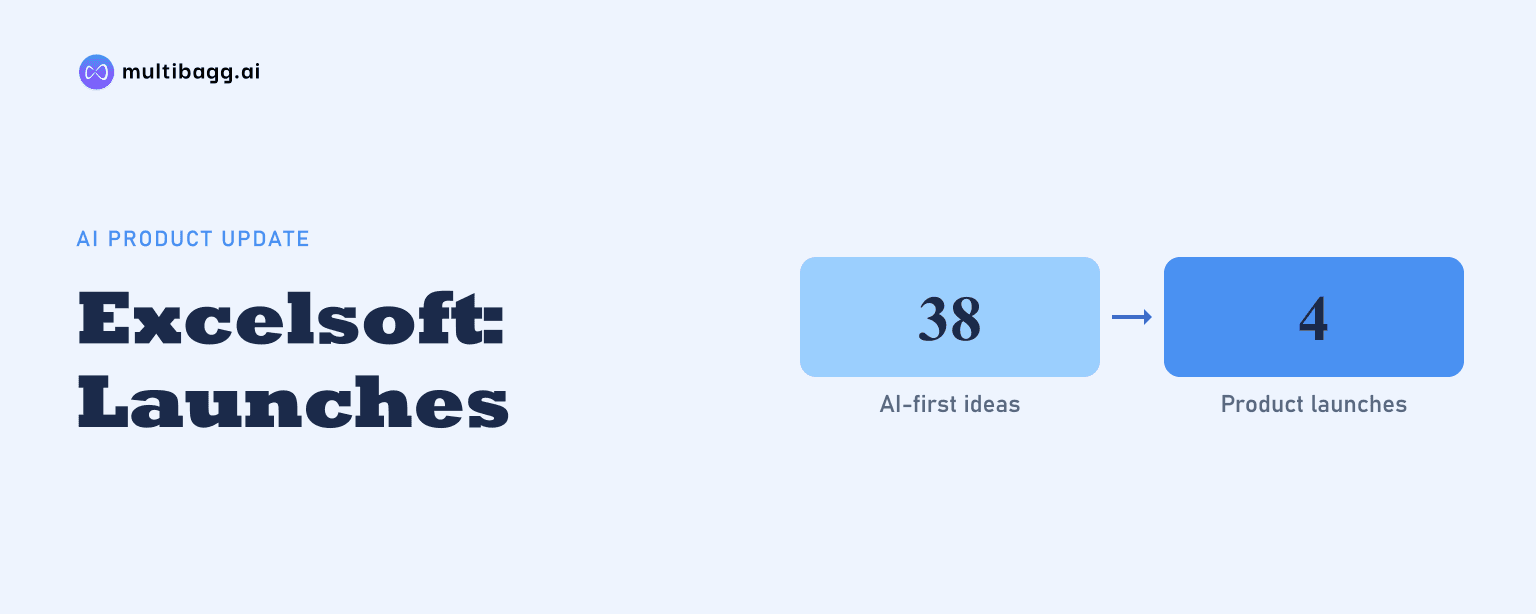
Excelsoft has disclosed four launched products from 38 AI-first ideas, following 16 prototypes and nine customer pilots, with its five-layer AI stack supported by NVIDIA A6000 graphics processing unit infrastructure. The launches cover AI micro-applications, school teaching tools, offline examination delivery and career-oriented student-success capabilities.
Know Excelsoft Technologies inside out
Results, valuation, peers and who's buying, in one view.
How far has Excelsoft commercialised its AI product pipeline?
Excelsoft has identified four launched products within a pipeline of 38 AI-first ideas, 16 prototypes and nine customer pilots. The launched products are AI-levate App Suite, Saras SchoolAI, Saras Assessments in-a-Box and CareerSPARC. The presentation separates these launches from earlier development and pilot stages.
The disclosed pipeline reduces from 38 ideas to 16 prototypes, a decrease of 22, then to nine pilots and four launches. Excelsoft does not state launch dates, contract values, product pricing, pilot-customer names or AI-specific revenue. It identifies enhancement of existing products, new AI-first offerings, dedicated customer infrastructure and expansion into Edge AI as revenue-growth drivers.
AI-levate is a modular suite of plug-and-play micro-applications that integrates with learning, assessment and proctoring systems. Its stated uses include AI-driven question generation, intelligent proctoring, personalised learning and automated assessment analysis. Excelsoft says this approach permits incremental adoption without disrupting established customer workflows.
What AI products has Excelsoft launched?
Excelsoft lists Saras SchoolAI and Saras Assessments in-a-Box with defined operating features, while also naming AI-levate App Suite and CareerSPARC among its four launches. Saras SchoolAI combines school-management functions with AI-enabled teaching tools for lesson planning, quiz generation, slide creation and examination preparation. It is designed as a common platform for teachers, administrators, students and parents.
Saras SchoolAI is currently live at Excel Public School, the only deployment location named in the presentation. Excelsoft does not disclose the number of users, schools, subscriptions or revenue associated with that deployment. The product sits within a wider learning and student-success portfolio that includes Saras OpenPage, enablED, LearnActiv and COLLEGE SPARC.
Saras Assessments in-a-Box is intended for secure examination delivery where internet connectivity is limited or unavailable. Each box supports more than 100 candidates and removes the requirement for a local test-centre server. Examination data can be securely synchronised after the examination is completed.
The two described products address different education workflows. Saras SchoolAI focuses on teaching and school-management activities, while Saras Assessments in-a-Box addresses examination delivery for more than 100 candidates per box. Excelsoft provides no customer-count or revenue comparison between the two products, so their commercial scale is not disclosed.
Got a follow-up? Ask IRIS
What infrastructure supports Excelsoft's AI strategy?
Excelsoft says its full-stack AI approach has five active layers: infrastructure, model deployment, fine-tuning and orchestration, applications, and governance. Its infrastructure includes NVIDIA A6000 graphics processing units, an internal GPU cluster and an in-house GPU team handling operations, cooling and architecture. The presentation describes this capacity as Excelsoft's internal infrastructure.
For model deployment, Excelsoft says it uses suitable open-source and commercial large language models, or LLMs, including Mistral and GPT-4o. It does not state that either model is used in every product or customer installation. Models can be trained on fully owned, bias-screened data or customer-specific datasets, with each deployment isolated for privacy, compliance and domain relevance.
Excelsoft offers deployment through its own GPU infrastructure, a customer's Microsoft Azure or Amazon Web Services environment, on-premise systems, air-gapped environments and UK-resident hosting. For sensitive workloads, dedicated infrastructure can operate without internet egress. These options are relevant to the company's learning, assessment and proctoring products, including easyProctor and Saras Assessments in-a-Box.
The company says its framework is designed for enterprise and high-stakes assessment customers, but it does not report the number of air-gapped installations, cloud deployments or UK-hosted workloads. Its disclosed infrastructure mechanism is therefore clear, while the scale of customer adoption is not. The five active layers place governance alongside technical infrastructure and customer-facing applications.
How does Excelsoft govern customer data and AI risks?
Excelsoft says customer data remains isolated and that a customer-specific model is not reused for another customer. Sensitive workloads can run on dedicated infrastructure without internet egress. The presentation presents these as deployment and data-handling provisions rather than as externally certified security outcomes.
Its governance framework includes a corporate AI usage policy and an AI Governance Board. Excelsoft says reviews address privacy, security, licensing, bias and hallucination risks, with human oversight and auditability across AI applications. Governance is one of the five layers that Excelsoft marks as active.
Excelsoft says either fully owned, bias-screened data or customer-specific datasets are used for its models. It gives deployment isolation as the mechanism supporting privacy and domain relevance. The presentation does not disclose training-data volumes, Governance Board review frequency, audit findings or quantitative measures of bias and hallucination performance.
The AI programme operates alongside Education Technology Services, which accounted for 60.75% of Q2 FY27 revenue. That segment generated Rs 49.14 crore, recorded year-on-year revenue growth of 41.9% and reported a segment result margin of 52.2%. Excelsoft does not attribute any portion of that revenue, growth or margin to its four AI launches.
Conclusion
Excelsoft has set out a defined AI commercialisation process, moving from 38 ideas through prototypes and pilots to four named products. Its approach combines internal GPU capacity, model flexibility, isolated customer deployments and formal review of privacy, security, licensing, bias and hallucination risks. The disclosed products cover teaching support, school administration and secure examinations in low-connectivity settings.
The next issue to watch is whether the nine customer pilots lead to further launches or disclosed commercial deployments. Excelsoft identifies new AI-first offerings, customer workloads on dedicated infrastructure and Edge AI as growth drivers, but it has not disclosed a launch timetable, pilot-conversion target or AI-product revenue figure for Q2 FY27.