










FBL human Vitamin D3 reaches 62% as animal sales halve in H1FY27
Key highlights
- FBL's human Vitamin D3 revenue was Rs 163 crore in H1FY27, representing 62% of total revenue versus 57% in H1FY26.
- FBL's animal Vitamin D3 revenue fell from Rs 46 crore to Rs 22 crore as volumes declined 31% and realisations fell 35%.
- FBL's Nutrition Others revenue increased 58% to Rs 24 crore, while Environmental Solutions rose 10% to Rs 17 crore.
- FBL generated Rs 55 crore of operating cash flow in H1FY27, up 44% year on year, and reported net debt below Rs 3 crore.
powered by IRIS
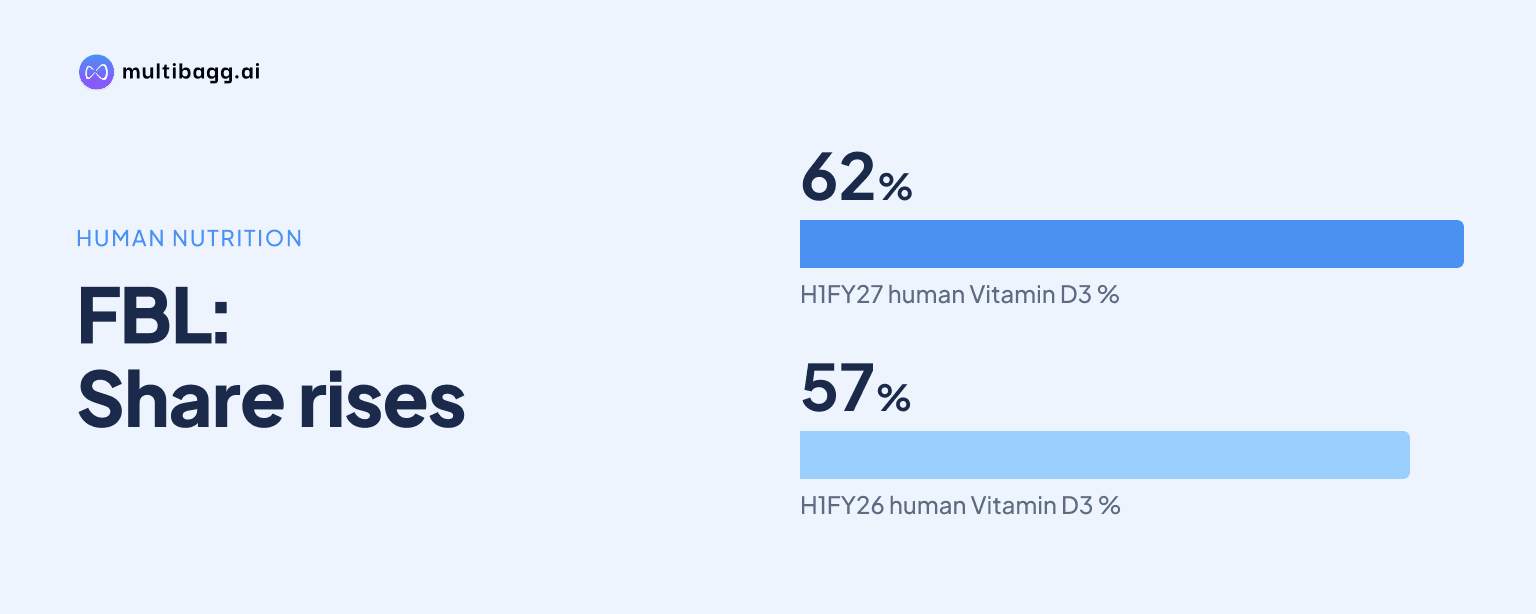
Fermenta Biotech Limited (FBL) derived 62% of its Rs 262 crore H1FY27 revenue from human Vitamin D3, after animal Vitamin D3 revenue fell from Rs 46 crore to Rs 22 crore. Human Vitamin D3 rose 2% year on year to Rs 163 crore, while animal volumes declined 31% and realisations fell 35%.
Know Fermenta Biotech inside out
Results, valuation, peers and who's buying, in one view.
Why did FBL's revenue mix change in H1FY27?
FBL's revenue mix changed because animal Vitamin D3 contracted sharply while human Vitamin D3 recorded a modest increase. Human Vitamin D3 rose from Rs 159 crore in H1FY26 to Rs 163 crore in H1FY27, increasing its share of total revenue to 62% from 57%. Animal Vitamin D3, meanwhile, declined from Rs 46 crore to Rs 22 crore, taking its share to 8% from 16%.
The animal-nutrition decline reflected both lower volumes and lower realisations. FBL reported a 31% year-on-year fall in animal Vitamin D3 volumes and a 35% fall in realisations, describing the movement as a price-cycle effect. This caused animal revenue to more than halve even as total revenue declined by 7%, from Rs 281 crore in H1FY26 to Rs 262 crore in H1FY27.
The longer trend shows a widening difference between the two Vitamin D3 lines. Human Vitamin D3 accounted for 47% of total revenue in FY25 and 53% in FY26 before reaching 62% in H1FY27. Animal Vitamin D3 accounted for 17% in FY25 and 20% in FY26, before declining to 8% in the latest half year.
How large is FBL's human Vitamin D3 business now?
FBL's human Vitamin D3 business was its largest reported revenue stream in H1FY27, generating Rs 163 crore and accounting for 62% of the Rs 262 crore total. The segment supplies premium supplements, food fortification and pharmaceutical applications to nutraceutical companies, food processors and pharmaceutical firms. Its Rs 4 crore year-on-year increase occurred despite the Nutrition Business declining 5% to Rs 209 crore.
FBL also reported that human-nutrition volumes increased 7% over Q1FY27. The presentation does not disclose a human Vitamin D3 realisation figure for H1FY27, so it does not establish the respective contributions of price and volume to the Rs 163 crore half-year revenue. Human Vitamin D3 had risen from Rs 228 crore in FY25 to Rs 293 crore in FY26 before its H1FY27 result.
Got a follow-up? Ask IRIS
Which FBL businesses offset the animal nutrition decline?
FBL's Nutrition Others category partly offset the animal Vitamin D3 decline, rising 58% to Rs 24 crore in H1FY27 from Rs 15 crore a year earlier. The category includes customised food premixes, fortified rice kernels and specialised nutraceutical ingredients. Its share of total revenue increased to 9% from 5%, although it remained substantially below human Vitamin D3 revenue of Rs 163 crore.
Environmental Solutions increased 10% to Rs 17 crore from Rs 15 crore, while Other API & Intermediates remained unchanged at Rs 23 crore in both half-year periods. Green Chemistry declined from Rs 4 crore to Rs 3 crore. Other income fell from Rs 14 crore to Rs 7 crore, and value unlocking from real estate contributed no revenue in H1FY27 compared with Rs 2 crore in H1FY26.
What did FBL's mix change mean for earnings and cash flow?
FBL's H1FY27 earnings declined as lower animal-nutrition prices coincided with a prior-year base containing other income and real-estate gains. Revenue from operations fell 4% to Rs 254 crore, total income declined 7% to Rs 262 crore and profit before tax fell 45% to Rs 29 crore. Profit after tax declined 52% to Rs 19 crore from Rs 40 crore in H1FY26.
Costs did not decrease in line with income. Cost of materials consumed rose 24% to Rs 75 crore and employee-benefit expense increased 15% to Rs 47 crore, while total expenses rose 2% to Rs 233 crore. FBL reported earnings before interest, tax, depreciation and amortisation of Rs 45.6 crore for H1FY27, down 34% year on year.
Cash flow moved differently from reported profit. Operating cash flow rose 44% to Rs 55 crore from Rs 38 crore, aided by an Rs 18 crore working-capital change after an Rs 19 crore outflow in H1FY26. Capital expenditure was Rs 17 crore, leaving free cash flow of Rs 37 crore versus Rs 26 crore a year earlier; cash and equivalents stood at Rs 102 crore in September 2026 and total debt at Rs 105 crore, with net debt below Rs 3 crore.
Conclusion
FBL's H1FY27 business mix moved further toward human Vitamin D3 because the animal business contracted much faster than the human segment grew. Human Vitamin D3 added Rs 4 crore year on year and represented Rs 163 crore of revenue, while animal Vitamin D3 lost Rs 24 crore amid lower volumes and realisations. Nutrition Others and Environmental Solutions added revenue, but did not prevent total income and profit after tax from declining.
The next disclosed developments are VITADEE Green capacity, which management expects from Q2FY28, and Calcifediol being ready for regulatory approvals by the end of FY27. FBL also reported VITADEE Green ESSA approval in July 2026, an NSL listing in August 2026 and an exclusive VIT Vellore Vitamin B12 licence in September 2026. The presentation does not quantify revenue from these initiatives, while animal-nutrition volumes and realisations remain the unresolved operating variables.