










FDC says buyback gains become capital gains from April 2026
Key highlights
- FDC says buyback income becomes capital gains from April 1, 2026.
- FDC states a 12.5% rate for shares held over 12 months and 20% for holdings of 12 months or less.
- FDC says deemed-dividend treatment applied from October 1, 2024 to March 31, 2026.
- FDC requires non-resident purchase-cost declarations on or before November 26, 2026.
powered by IRIS
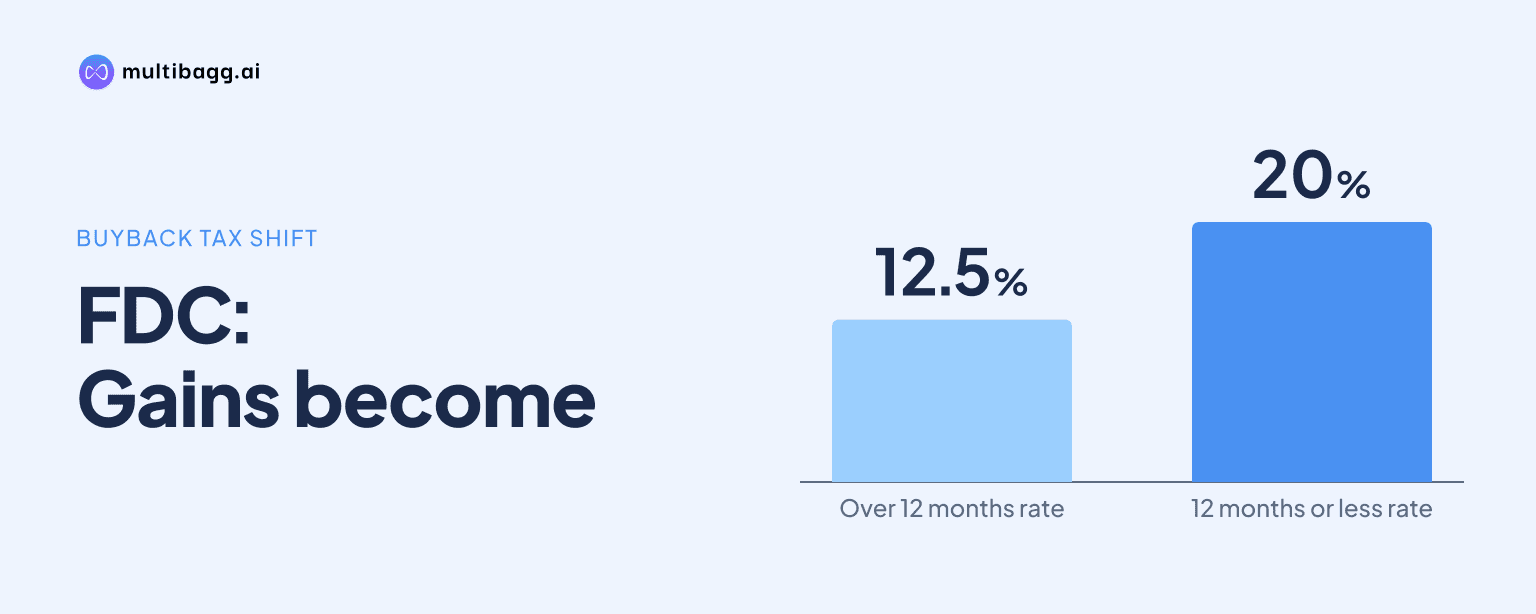
FDC Limited says income from its listed-share buyback will be taxed as capital gains from April 1, 2026, replacing deemed-dividend treatment used from October 1, 2024 to March 31, 2026. FDC states a 12.5% rate for shares held more than 12 months, subject to a Rs 1.25 lakh exemption, and 20% for shorter holdings.
Know FDC inside out
Results, valuation, peers and who's buying, in one view.
How has FDC said buyback taxation changed?
FDC says shareholders, rather than the company, will pay tax on gains from the buyback from April 1, 2026, with income classified as capital gains. Its tax note says the Income-tax Act, 1961 and Income-tax Rules, 1962 were replaced from that date by the Income-tax Act, 2025 and Income-tax Rules, 2026.
The treatment differs from the regime FDC describes for the period from October 1, 2024 through March 31, 2026. During that period, buyback proceeds were fully taxable as deemed dividends at the shareholder's applicable slab rate, while the original acquisition cost was recognised as a capital loss that could be set off against other capital gains.
FDC describes the new calculation as the difference between the buyback price and the shareholder's original cost of acquiring the shares. Its tax note is expressly presented as indicative guidance, and FDC says the outcome depends on individual facts, including the nature of acquisition and fulfilment of statutory conditions.
What capital-gains rates does FDC state for shareholders?
FDC says the applicable rate depends on whether equity shares were held for more than 12 months. It states that long-term capital gains, or LTCG, on shares held over 12 months are taxed at 12.5%, with an exemption up to Rs 1.25 lakh, while short-term capital gains, or STCG, on shares held for 12 months or less are taxed at 20%.
The stated rates may increase for applicable surcharge and cess. FDC also says an additional tax rate under section 69(2)(b) of the Income-tax Act applies where shares are purchased from promoters, although its tax note does not state the amount of that additional rate.
For resident shareholders, FDC says it is not required to deduct tax at source on the buyback payment. That does not determine a resident shareholder's own tax reporting, as FDC advises shareholders to consult tax advisers on the applicable provisions and their individual circumstances.
How will FDC determine the acquisition cost of older shares?
FDC says a special acquisition-cost rule applies when calculating LTCG on shares acquired before February 1, 2018, including bonus shares credited before that date. The deemed cost is the higher of actual acquisition cost and the lower of the stock exchange's highest quoted price on January 31, 2018 and the buyback price.
That formula differs from using the original purchase price alone because it compares the actual cost, the January 31, 2018 fair market value and the buyback price. The source applies this rule to the computation of long-term gains, rather than to shares held for 12 months or less.
FDC says shareholders must consider the nature of acquisition and meet prescribed conditions under the Income-tax Act and Income-tax Rules before applying the provision. It specifically asks shareholders to consult tax advisers to determine the appropriate acquisition cost and consequential capital gain from participating in the buyback.
Got a follow-up? Ask IRIS
What must non-resident FDC shareholders submit?
FDC says it must deduct tax at source from a payment to a non-resident shareholder if the payment is chargeable to tax in India, at the time of payment or credit, whichever is earlier. It says it will consider the appropriate acquisition cost in computing capital gains, while a non-resident may seek relief under a Double Taxation Avoidance Agreement, or DTAA, if conditions and documentation are met.
A non-resident shareholder must provide FDC a self-declaration detailing each purchase transaction separately, including its acquisition date and cost. The same date-wise information is required for bonus shares, including their credit dates, and FDC says the declaration must be supplied on or before November 26, 2026.
FDC says a non-resident may also submit a Lower Tax Deduction Certificate, or LTDC, issued under section 395 of the Income-tax Act, which permits withholding at a lower rate than the standard prescribed rate. In the absence of a permanent account number, or PAN, or where the PAN is invalid, FDC says a 20% rate would apply to non-residents at withholding, subject to documents under Rule 217 of the Income-tax Rules, 2026.
Which records and transaction taxes does FDC identify?
FDC says a non-resident seeking DTAA relief must provide a Tax Residency Certificate for tax year 2026-27, Form 41 obtained electronically through the income-tax e-filing portal, PAN information or prescribed alternative details, and several self-declarations. Those declarations address the absence of a permanent establishment in India, beneficial ownership of shares and fulfilment of DTAA conditions read with the Multilateral Instrument, or MLI.
The DTAA materials and declarations must be submitted to FDC by 5:00 PM Indian Standard Time, after which they will not be accepted, according to the offer document. FDC says these materials are additional to the acquisition-cost declaration, and a withholding-tax benefit depends on the applicable DTAA provisions and the documents submitted.
FDC also says Securities Transaction Tax, or STT, will apply at the applicable rate because the buyback will use the stock-exchange settlement mechanism. It asks shareholders, especially non-residents, to retain contract notes, proof of cost, communications with FDC, tax-deducted-at-source certificates and Tax Residency Certificates for financial year 2026-27, corresponding to assessment year 2027-28.
Conclusion
FDC's stated change replaces the deemed-dividend approach used from October 1, 2024 to March 31, 2026 with capital-gains treatment from April 1, 2026. The holding period and documented acquisition cost therefore become central to the calculation, with FDC listing 12.5% for qualifying LTCG and 20% for STCG, subject to surcharge, cess and applicable conditions.
The next disclosed deadline is November 26, 2026 for non-resident shareholders to provide date-wise purchase-cost declarations, including bonus-share credit dates. Non-residents seeking DTAA treatment also need to submit the specified records by FDC's 5:00 PM Indian Standard Time cut-off, while FDC warns that legislative, regulatory, administrative or judicial changes could alter tax consequences.