










Fino Payments Bank Reports ₹20.9 Crore Q2 FY27 Loss
Key highlights
- Fino Payments Bank reported a ₹20.9 crore net loss in Q2 FY27, compared with a ₹15 crore profit a year earlier.
- Q2 FY27 revenue was ₹333.6 crore, up 9% sequentially but down 17% year-on-year.
- Loan-referral disbursals increased 286% year-on-year to ₹762 crore in Q2 FY27.
- The CASA base reached 1.91 crore accounts and average deposits grew 12% year-on-year to ₹2,794 crore.
powered by IRIS
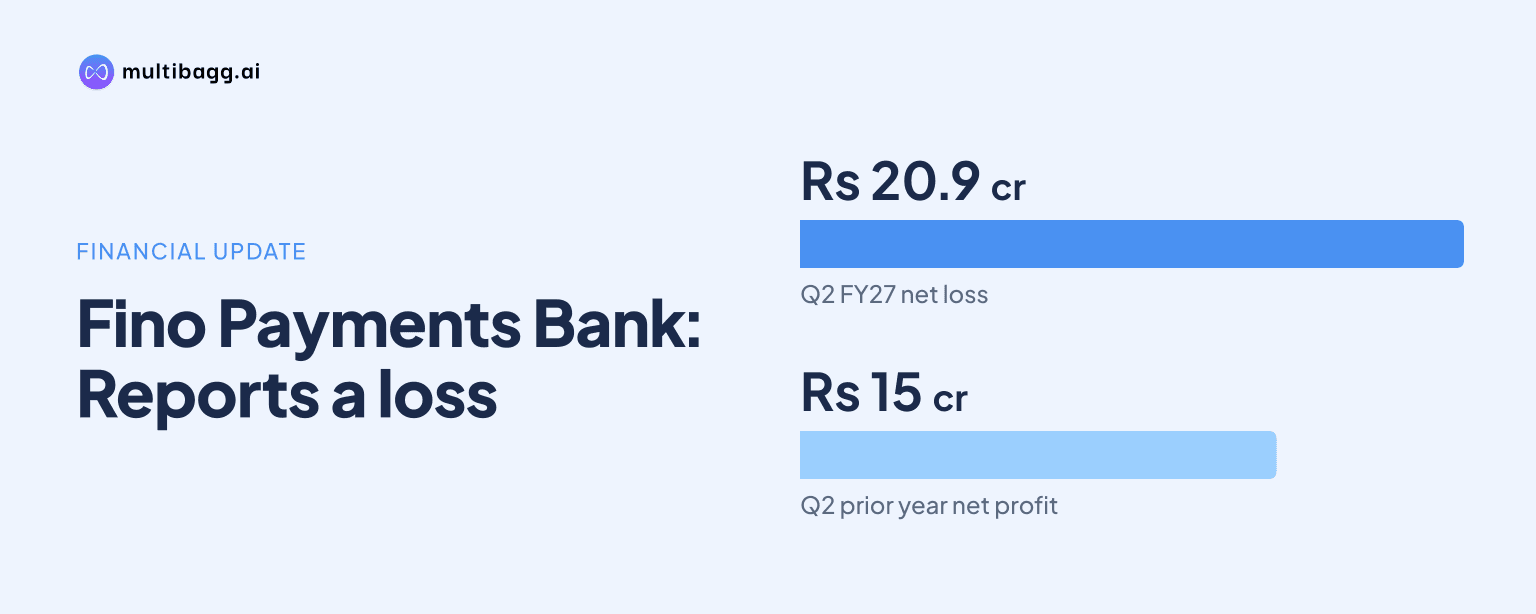
Fino Payments Bank Ltd reported a ₹20.9 crore net loss in Q2 FY27, compared with a ₹15 crore profit a year earlier, as revenue fell 17% year-on-year to ₹333.6 crore and the bank continued investments for its Small Finance Bank transition. The September-quarter result highlights pressure on profitability despite stronger deposits and loan referrals.
Know Fino Payments Bank inside out
Results, valuation, peers and who's buying, in one view.
What did Fino Payments Bank report for Q2 FY27?
Fino Payments Bank reported total revenue of ₹333.6 crore for Q2 FY27, up 9% sequentially but down 17% from the corresponding quarter a year earlier. For the first half of FY27, revenue was about ₹640 crore, down 25% year-on-year. Management attributed the annual decline largely to a recalibration of the B2B payment-to-merchant business.
The bank posted EBITDA of ₹35.1 crore, against ₹61.6 crore in Q2 FY26 and ₹43.1 crore in Q1 FY27. EBITDA margin was 10.5%. The quarterly net loss was ₹20.9 crore, compared with a net profit of ₹15 crore in the year-ago period. Management said the bank remained cash-profit positive, but near-term profitability was affected by spending on technology and talent before the proposed Small Finance Bank conversion.
How did operating volumes and deposits perform?
Fino Payments Bank recorded total throughput of about ₹1.15 lakh crore during Q2 FY27, up 4% sequentially despite industry challenges linked to mule-account concerns, enhanced daily inquiries and competition in B2B alliances. Management said traditional transaction activities and B2B alliances recovered some volume during the quarter, supporting sequential growth across revenue verticals.
Its CASA base reached 1.91 crore accounts at the end of September 2026, after 8.2 lakh accounts were opened in the quarter. Average deposits rose 12% year-on-year to ₹2,794 crore. CASA contributed around 52% of total revenue, underlining the increasing role of the deposit franchise in the bank's revenue mix.
The liability base is central to Fino Payments Bank's plan to broaden its product offering following conversion into a Small Finance Bank. Management said its cost of funds was 1.4% and expected it to remain near 4% after conversion, which it believes would be 250 to 300 basis points below that of traditional Small Finance Banks. This remains a management expectation rather than a reported post-conversion outcome.
How is the Small Finance Bank transition progressing?
Fino Payments Bank said it remains on track to meet Reserve Bank of India conditions for Small Finance Bank conversion within the prescribed timeline, with final readiness expected by Q1 FY28. Interim Chief Executive Officer Ketan Merchant said the bank was tracking the schedule laid out in its investor presentation and was progressing on the RBI-stipulated requirements.
The proposed transition would allow the payments bank to build its own lending portfolio, while its existing loan-referral operation is being positioned as a sourcing foundation. Management did not provide FY27 financial guidance, describing the year as a transition period in which investments in technology and people may affect short-term profitability.
Timing of RBI approval remains outside the bank's control. Management also identified uncertainty around implementation of merchant discount rate rules as a factor that could affect future performance. These regulatory matters are relevant because the bank operates in transaction-led businesses where pricing and payment economics influence revenue and margins.
Got a follow-up? Ask IRIS
Why did loan referrals grow while earnings stayed under pressure?
Fino Payments Bank's loan-referral disbursals rose 286% year-on-year to ₹762 crore in Q2 FY27. Disbursals for the first half reached ₹1,390 crore, exceeding the ₹1,285 crore reported for the full FY26. The increase reflects the scalability of the bank's merchant-led sourcing model, according to management.
However, faster referral disbursals did not offset the impact of lower B2B revenue and higher transition-related costs on quarterly earnings. Pricing competition in the B2B cash-management-services segment continued to weigh on take rates. The bank also cited the recalibration of its B2B payment-to-merchant business as the main reason for the year-on-year revenue decline.
Net revenue margin improved to 38.1% in Q2 FY27, about 100 basis points above the year-ago level. For H1 FY27, management said net revenue margin improved 500 basis points year-on-year to 40.3%, helped by a higher contribution from the higher-margin CASA segment. The margin improvement indicates better revenue mix, though the EBITDA decline shows that operating costs and lower overall revenue remained material factors.
What does the quarter mean for investors and the payments-bank sector?
The Q2 result shows a mixed operating picture for Fino Payments Bank. Deposits, CASA accounts and loan referrals expanded, while revenue recovered sequentially from Q1 FY27. But annual revenue, EBITDA and profit were lower, reflecting the cost of building capability for the next stage of the bank's business model and pressure in B2B payments.
For investors, the key disclosed variables are the pace of RBI-related readiness, the recovery in B2B transaction volumes and the ability to protect take rates amid competition. The bank has not issued FY27 financial guidance, so the reported quarterly figures provide the available reference point for assessing its financial performance during the transition.
The results also illustrate the operating constraints of the payments-bank model. A large low-cost deposit base can support a lending strategy after regulatory approval, but transaction income can be exposed to merchant-pricing competition and changes in payment-market rules. Fino Payments Bank's proposed conversion makes regulatory execution as important as quarterly volume growth.
Conclusion
Fino Payments Bank entered Q2 FY27 with growing liabilities and a sharp rise in loan-referral disbursals, but reported a ₹20.9 crore loss as B2B recalibration, pricing pressure and transition investments reduced earnings. Revenue rose sequentially, while the year-on-year comparison remained weak, making profitability the principal financial issue in the reported quarter.
The next disclosed milestone is final readiness for the Small Finance Bank transition by Q1 FY28, subject to RBI approval. Investors will also watch the bank's deposit growth, B2B business recovery, loan-referral volumes and any clarification on merchant discount rate implementation.