










GAIL (India) Limited and KRIBHCO Plan ₹13,500 Crore Urea Plant
Key highlights
- GAIL and KRIBHCO plan a ₹13,500 crore investment in a proposed 1.27 MMTPA urea plant.
- The Mulapeta project in Srikakulam district could require around 600-700 acres of land.
- The proposed plant is expected to create around 1,300 jobs, including 300-400 direct roles.
- India imports nearly 27% of its annual urea requirement of around 40 million tonnes.
powered by IRIS
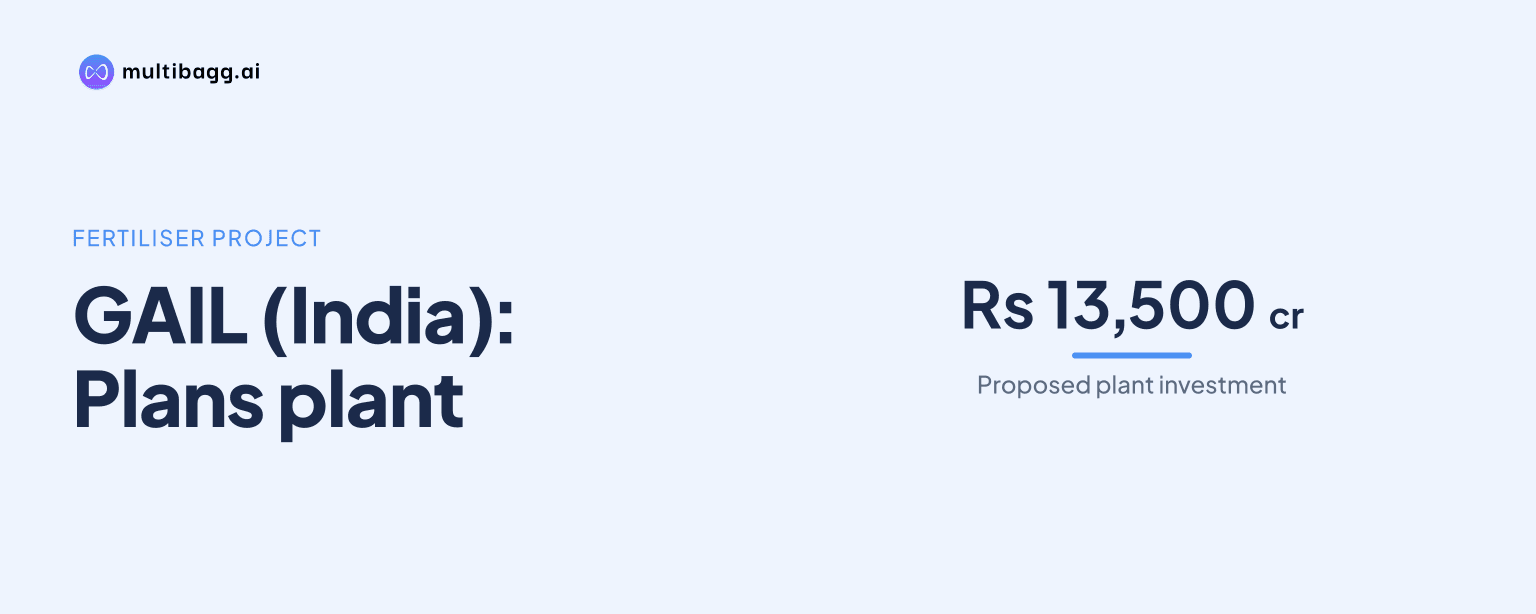
GAIL (India) Limited and Krishak Bharati Cooperative Limited have signed a pact to explore a ₹13,500 crore urea plant with 1.27 million metric tonnes per annum capacity at Mulapeta in Andhra Pradesh's Srikakulam district. The proposed investment could expand domestic fertiliser capacity while creating around 1,300 direct and indirect jobs.
Know GAIL (India) inside out
Results, valuation, peers and who's buying, in one view.
What have GAIL and KRIBHCO agreed to develop?
GAIL and KRIBHCO have entered into an agreement with the Andhra Pradesh Economic Development Board to explore the establishment of a urea manufacturing unit at Mulapeta. The planned facility would have production capacity of 1.27 million metric tonnes per annum, or 1.27 MMTPA.
The companies have indicated that ₹13,500 crore will be invested in phases. The agreement represents an initial step towards the proposed project, with the available information not specifying a construction schedule or commercial commissioning date.
GAIL brings experience in natural gas and gas-sector operations, while KRIBHCO is a fertiliser cooperative that manufactures and markets urea and other crop nutrients. A gas-based urea project would draw on the respective areas of expertise of the two organisations, although the pact does not disclose plant technology, gas-supply arrangements or ownership structure.
The proposed location is Mulapeta in Srikakulam district, in the northern part of Andhra Pradesh. The project is expected to require around 600 to 700 acres of land, according to the memorandum of understanding reviewed by Moneycontrol.
What support will Andhra Pradesh provide for the proposed plant?
Andhra Pradesh has proposed support through land, infrastructure and potential project-linked incentives for the proposed urea facility. The state government is expected to allot land at a nominal cost and provide roads, electricity, water and railway connectivity up to the project site without cost, according to the MoU.
The incentive package cited in the agreement includes a fixed-capital subsidy, an interest-free loan for project capital expenditure and a 100% refund of state goods and services tax. The ultimate terms and implementation of these measures will be important to the project's capital structure, but the source does not state their monetary value.
Infrastructure support is particularly relevant for a large fertiliser plant because its operations require reliable utility supplies and efficient movement of inputs and finished fertiliser. Railway connectivity can support distribution beyond the immediate district, while water and power availability are essential to plant operations.
Got a follow-up? Ask IRIS
Why is additional urea capacity important for India?
The proposed 1.27 MMTPA plant comes as the Centre seeks to increase domestic urea availability and lower import dependence. The government recently approved the National Investment Policy for Urea-2026, which is intended to encourage domestic production.
India imports nearly 27% of its annual urea requirement, which is around 40 million tonnes. This import reliance has gained attention amid concerns about fertiliser shortages that were aggravated by the West Asia war, as stated in the source material.
Urea is a key fertiliser for Indian agriculture, making supply availability and distribution a significant policy concern. The proposed Andhra Pradesh unit, if developed and commissioned, would add to domestic capacity. However, the agreement does not provide an implementation timetable, financing details or confirmation of final investment approval.
GAIL has separately signed a memorandum of understanding with Rashtriya Chemicals and Fertilizers Limited to explore a gas-based fertiliser plant in Maharashtra. That arrangement similarly remains at an exploratory stage, with no disclosed capacity, investment amount or implementation schedule.
How could the proposal affect jobs and local industry in Srikakulam?
The project is expected to generate around 1,300 jobs, comprising 300 to 400 direct roles and about 1,000 indirect roles. Direct employment would be associated with plant operations, while indirect opportunities could arise from construction, logistics, services and supporting activities.
For Srikakulam district, the project would also require development of access roads, power, water and rail connectivity. The state government's stated commitment to provide these facilities indicates that the proposal has implications beyond the factory site, although the source does not set out the planned scale or completion timing of the infrastructure works.
The phased investment approach means expenditure would not necessarily occur at once. Investors and local stakeholders will need to track whether the exploration agreement moves into defined project approvals, land allocation, funding commitments and construction contracts.
What does the proposal mean for GAIL and KRIBHCO?
For GAIL, the proposal extends its participation in gas-linked fertiliser opportunities, where natural gas is an important production input. For KRIBHCO, it could add a large new urea manufacturing asset to its existing fertiliser operations, subject to the project's progress beyond the agreement stage.
The ₹13,500 crore planned investment is the main disclosed financial commitment, but the MoU does not specify the contribution expected from each participant. It also does not disclose the legal vehicle for the project, expected funding mix, production costs or anticipated sales arrangements.
The policy backdrop supports the strategic rationale of adding domestic production capacity, particularly given India's stated dependence on imported urea. But the proposal should be viewed as an announced plan rather than a completed investment, since the disclosed agreement is to explore the development of the facility.
Conclusion
GAIL and KRIBHCO's proposed Mulapeta unit would combine 1.27 MMTPA of planned urea capacity with ₹13,500 crore of phased investment and an estimated 1,300 jobs. The proposal is aligned with efforts to strengthen domestic fertiliser production at a time when India imports nearly 27% of its annual urea needs.
The next developments to watch are the formal land allocation of around 600 to 700 acres, finalisation of state incentives and infrastructure commitments, and any disclosed project timeline or investment approval. These steps will determine whether the exploratory pact advances into construction and operations.