










Galaxy Supermarket cash falls to Rs 9.46 lakh as inventory rises
Key highlights
- Galaxy Supermarket's cash and cash equivalents fell by Rs 68.67 lakh to Rs 9.46 lakh at September 30, 2026.
- Galaxy Supermarket's inventories rose by Rs 3.33 crore to Rs 10.29 crore at September 30, 2026.
- Galaxy Supermarket's current borrowings were Rs 13.92 crore and trade payables were Rs 15.36 crore at September 30, 2026.
- Galaxy Supermarket reported a Rs 1.18 crore net loss for the half year ended September 30, 2026.
powered by IRIS
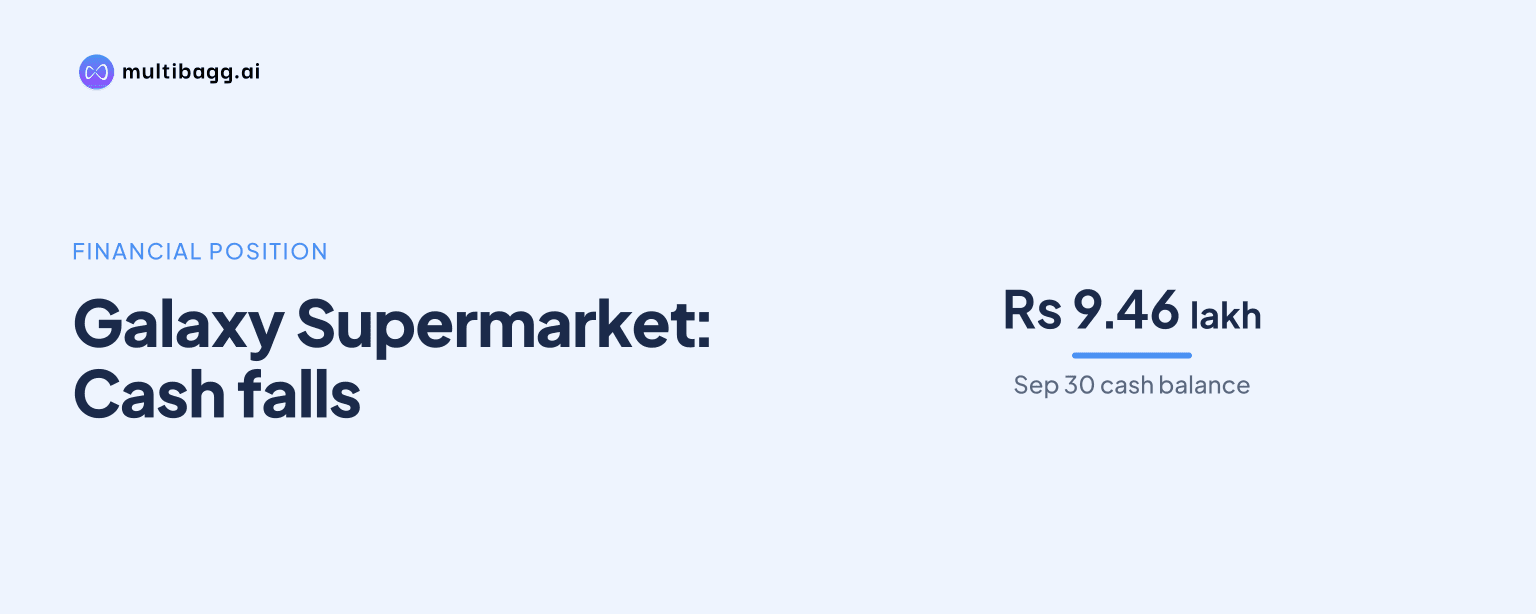
Galaxy Supermarket Limited ended September 30, 2026 with Rs 9.46 lakh of cash and cash equivalents, down from Rs 78.13 lakh at March 31, 2026, after a Rs 3.33 crore inventory increase contributed to a Rs 15.16 lakh operating cash outflow during the six-month period.
Know Galaxy Supermarket inside out
Results, valuation, peers and who's buying, in one view.
Why did Galaxy Supermarket's operating cash flow turn negative?
Galaxy Supermarket's operating cash flow turned negative because its Rs 3.33 crore inventory increase and Rs 10.75 lakh increase in other financial and other assets exceeded cash generated before working-capital changes. Operating cash profit before working-capital changes was Rs 30.09 lakh for the period ended September 30, 2026, compared with Rs 2.87 crore for the year ended March 31, 2026.
The inventory movement was partly funded by a Rs 2.88 crore increase in trade payables, other liabilities and provisions. A Rs 10.58 lakh decline in trade receivables also released cash, but these two inflows did not offset the inventory and other-asset movements. Cash outflow from operations was therefore Rs 15.16 lakh for the six months to September 30, 2026.
The March 2026 comparator reported Rs 2.04 crore of cash generated from operations and Rs 2.01 crore of net operating cash inflow for a full financial year. The periods are not directly comparable because the latest statement covers six months, but the direction changed from annual operating cash generation to a half-year outflow.
How did Galaxy Supermarket's cash position change?
Galaxy Supermarket's cash and cash equivalents declined by Rs 68.67 lakh in the six months ended September 30, 2026, to Rs 9.46 lakh from an opening balance of Rs 78.13 lakh. The balance-sheet cash figure at September 30, 2026 matched the cash-flow statement's closing figure.
Investing activities used Rs 50.94 lakh during the six-month period, mainly because property, plant and equipment purchases totalled Rs 51.29 lakh. Interest received was Rs 36,000, which partly offset the investing outflow. The cash-flow statement recorded Rs 66.14 lakh of net investing outflow for the full year ended March 31, 2026.
Financing activities used Rs 2.58 lakh in the latest period. Galaxy Supermarket received Rs 67.91 lakh of net borrowing proceeds but paid Rs 70.48 lakh in interest, while the full year ended March 31, 2026 had a Rs 1.48 crore financing outflow.
How much did Galaxy Supermarket's short-term liabilities rise?
Galaxy Supermarket's current liabilities increased by Rs 3.56 crore to Rs 33.40 crore at September 30, 2026, from Rs 29.84 crore at March 31, 2026. Current borrowings rose by Rs 67.91 lakh to Rs 13.92 crore, while trade payables rose by Rs 3.02 crore to Rs 15.36 crore.
Current assets increased by Rs 2.38 crore to Rs 11.35 crore over the same period, led by inventories rising to Rs 10.29 crore from Rs 6.96 crore. Cash fell by Rs 68.67 lakh to Rs 9.46 lakh, trade receivables fell by Rs 10.58 lakh to Rs 18.83 lakh, and other current assets declined by Rs 10.82 lakh to Rs 70.47 lakh.
Current liabilities exceeded current assets by Rs 22.05 crore at September 30, 2026, compared with Rs 20.88 crore at March 31, 2026. Other current financial liabilities declined by Rs 18.57 lakh to Rs 3.85 crore, partly moderating the increases in borrowings and trade payables.
Got a follow-up? Ask IRIS
What do Galaxy Supermarket's revenue and losses show?
Galaxy Supermarket reported revenue from operations of Rs 27.25 crore for the half year ended September 30, 2026, up from Rs 21.23 crore in the corresponding half year ended September 30, 2025. Despite the revenue increase, the company reported a Rs 1.18 crore net loss for continuing and discontinued operations, compared with a Rs 45.81 lakh net profit a year earlier.
For the September 2026 quarter, revenue from operations rose to Rs 15.02 crore from Rs 12.23 crore in the June 2026 quarter and Rs 10.62 crore in the September 2025 quarter. The quarterly net loss was Rs 71.65 lakh, compared with a Rs 45.99 lakh loss in June 2026 and a Rs 1.49 lakh profit in September 2025.
Cost of materials consumed increased to Rs 23.95 crore in the six months ended September 30, 2026 from Rs 16.86 crore a year earlier. Employee benefits expense rose to Rs 1.56 crore from Rs 96.28 lakh and other expenses rose to Rs 1.35 crore from Rs 68.63 lakh, while finance costs declined to Rs 70.48 lakh from Rs 97.88 lakh. Galaxy Supermarket identifies dealing and trading in food, beverages and grocery products as its only active business segment.
What going-concern matters did Galaxy Supermarket disclose?
Galaxy Supermarket said its entire net worth had been eroded by prior-year losses and its current liabilities exceeded current assets at September 30, 2026. Total equity was negative Rs 19.41 crore at September 30, compared with negative Rs 18.24 crore at March 31, 2026, and the company said those conditions created material uncertainty about its ability to continue as a going concern.
Management said it was pursuing operational-efficiency measures, sales growth, cost reductions and diversification through supermarket-store operations. Management stated that these initiatives had produced positive results and could generate positive cash flows, and said it was confident that net worth would turn positive in the near future. The September 2026 financial statements were prepared on a going-concern basis.
The auditor repeated the material-uncertainty disclosure without modifying its review conclusion. The auditor also said Galaxy Supermarket had not recognised gratuity and leave-encashment liabilities under Indian Accounting Standard 19 for the period ended September 30, 2026, and the financial impact had not been determined. The company separately disclosed a Rs 2.90 crore contingent liability related to employees of its closed Bengaluru commissary and said it had made a full provision for a possible settlement.
Conclusion
Galaxy Supermarket's September 2026 results show that inventory growth was the main working-capital use, outweighing the increase in trade payables and the collection-related reduction in receivables. The result was a Rs 15.16 lakh operating cash outflow, while capital expenditure and interest payments reduced cash to Rs 9.46 lakh. Revenue grew in the half year, but the company moved from a Rs 45.81 lakh profit to a Rs 1.18 crore net loss.
The next results will show whether management's plans to improve efficiency, raise sales, reduce costs and expand supermarket-store operations translate into operating cash generation. Key disclosed measures to track are inventories of Rs 10.29 crore, trade payables of Rs 15.36 crore, current borrowings of Rs 13.92 crore, and any quantified impact from the unrecognised employee-benefit liabilities.